 14 DAY TRIAL //
 A recent test run of the world's most powerful laser proved that the instrument works, and raised hopes that scientists at the US National Ignition Facility (NIF) will achieve nuclear fusion within two years.
The firing of the laser was the first-ever complete dry run of the machine, which saw the laser being aimed at the peppercorn-sized pellet of nuclear fuel. The stuff was instantly pulverized into a shower of neutrons.
Experts with the NIF want to achieve a type of nuclear fusion that would release more energy that the amount that is put in. This is the same type of reaction that powers up all stars in the Universe.
At this point, nuclear energy is a concept referring to electricity that is produced through nuclear fission inside special reactors. Heavy atomic nuclei are broken apart, and the energy released during this process is harnessed.
But nuclear fusion is the exact opposite. Nuclei of hydrogen isotopes deuterium and tritium are smashed together, forcing them to merge.
The process releases vast amounts of energy, and produced helium gas as a byproduct. The chemical can then be used to create rocket fuel, or for a wide variety of other applications.
Building the NIF laser took more than $3.5 billion, but physicists at the facility say that the investment was well worth it, and that self-sustaining nuclear fusion will be achieved here within two years or less.
“In my mind, to have accomplished this shot is an almost unfathomable scientific achievement,” explains physics expert Paul Drake, quoted by Wired.
“I’ve had a lifetime of experience of big science facilities, and find myself in awe of [the NIF team] having made this thing work this fast,” adds the expert, who is based at the University of Michigan.
He is using the NIF laser as a testbed for studying the physics underlying supernova explosions in deep space. The facility can recreate those conditions in a tightly-controlled environment, he explains.
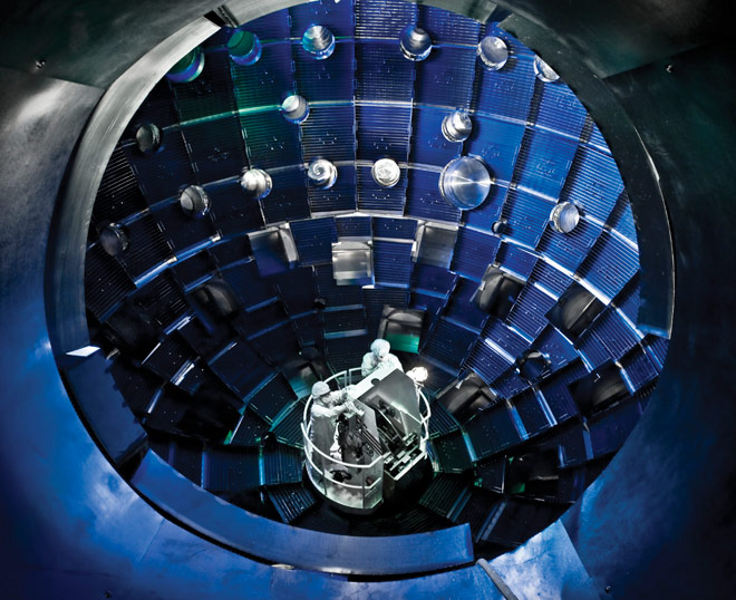
The NIF houses 192 laser beams total, which were used on September 29 to blast away at a metal sphere some 30 feet in diameter.
At the core of the sphere was a small pellet made of plastic, which contained hydrogen isotopes. The laser delivered a 1-megajoule strike right in the middle of the pellet.
“The facility is like a new car engine. You don’t hit the pedal all the way down to the ground the first time,” says Massachusetts Institute of Technology (MIT) fusion scientist Richard Petrasso.
“You have to tune it to get all of the conditions just right – the laser, the diagnostics and the surface of the capsule,” he adds.