1. Inuit (Eskimo) people inhabit a large area on the northern coast of North America, Arctic Archipelago, Greenland and the extreme point of eastern Siberia, on a length of 9,000 km (5,600 mi). They are the human population living in the toughest cold conditions, in a polar clime characterized by winters with tempera... |
19 February 2008 15:06 GMT |
 |
If you find it difficult to play on your phone or to call somebody having your gloves on, the Japanese could have solved this problem.Cold climates won't be a problem anymore, with the new concept phone designed by Yuta Watanabe. I guess many had a phone like this in mind, but nobody has actually thought that i... |
20 December 2007 03:36 GMT |
 |
Its future is bleak because of the global warming and ice melting, but its past is going to be revealed to us. A team led by Professor Olafur Ingolfsson, from the University of Iceland, has discovered what seems to be the oldest known fossil of a polar bear, on the Arctic Svalbard archipelago, on sediments 110,000 to... |
13 December 2007 02:41 GMT |
 |
1.All living bears are the descendants of a fox-sized 20 million-year-old bear called Ursavus. The genus Ursus including modern brown bear (grizzly is part of this species), black bear and polar bear appeared 5-10 million years ago. Ursus etruscus that lived in Europe 1.5-2 million years ago is the ancestor of the ca... |
27 November 2007 13:07 GMT |
 |
Vikings named this land Greenland only for 'promotional' goals, as it was mostly a frozen land. Rapid thawing on the world's biggest island has started to improve conditions for agriculture, commercial fishing, mining and oil exploration. Arctic temperatures experience the most dramatic rise with the g... |
19 October 2007 06:25 GMT |
 |
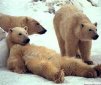
This bear seems to have the shortest life of all the bear species: it appeared about 40,000 years ago, its ancestor being the brown bear (the species that includes the grizzly) and it could be gone till 2050 due to the Polar ice melting. By that year, at least 70 % of the polar bear populations will be gone and in Al... |
10 September 2007 03:07 GMT |
 |
Known as aurora borealis in northern latitudes (after the Roman goddess of dawn, Aurora, and the Greek name for north wind) and as aurora australis in the South (australis meaning "of the South"), the beautiful lights in the sky are now known to be caused by the collision of charged particles (electrons), found in t... |
12 April 2007 08:58 GMT |
 |
On the first of April 1999 the most recent territory of Canada, Nunavut, came to existence. Canada's map had changed for the first time after Newfoundland joined the confederation. Nunavut compasses one fifth of Canada's territory on the mainland, and is larger than any of Canada's provinces. Here live... |
23 March 2007 11:27 GMT |
 |
|