The tiny, pink marsupial embryo outside its mother's womb has yet another curiosity: it jumps ahead in its development, and mixes the 'natural' order of the growth processes of all vertebrate animals.Duke University researchers discovered that in the marsupial embryo, the forelimbs develop before the b... |
30 November 2010 05:32 GMT |
 |
You surely have heard about the Tasmanian devil. You understand why devil, but what do you know about the island of Tasmania?It is a land located between 40o 38' and 43o 39' S, off southeastern Australia, being slightly larger than the island of Ireland (with a similar clime, too). The wet cool temperate cl... |
14 March 2008 17:46 GMT |
 |
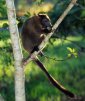
The name "koala" means in an extinct Aborigine language "does not drink." Even if called koala bear, this animal has nothing to do with the actual bear; it is not even a placental mammal, but a marsupial, like the kangaroo. Its closest living relatives are the wombats. A koala (Phascolarctos cinererus) is about 60-80... |
8 March 2008 06:25 GMT |
 |
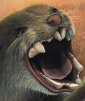
Its closest relative were the koala and the wombats. But it was not a leaf lover; instead, it slew extinct cow-sized kangaroos and hippo-sized Diprotodons. The extinct Australian marsupial lion (Thylacoleo carnifex) was the largest carnivorous marsupial mammal ever and a new research published in the Journal of Zoolo... |
18 January 2008 03:32 GMT |
 |
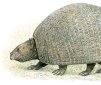
You could not put this one into an armadillo race. In fact, you could not hold it. That's because ancient armadillos were really big. Now, an American team has described in the "Journal of Vertebrate Paleontology" a new large fossil species based on a partial skeleton discovered up in the Andes in northern Chile... |
13 December 2007 05:23 GMT |
 |
Today, kangaroos are Australia's wildlife symbols and the largest living marsupials. Now, a 25-million-year-old marsupial fossil seems to represent the oldest species in the lineage of the kangaroos. Unlike the hopping man-sized kangaroos, these ones ran on all fours, had carnivorous-like fangs and might have be... |
7 December 2007 05:56 GMT |
 |
1.Scientists believe that kangaroos' and wallabies' ancestors could have looked like a Wynyardia, a 21 million years old marsupial found in Tasmania. The largest living kangaroo, the red kangaroo (Macropus rufus) is also the largest living marsupial. Males are up to 1.8m (6 ft) tall and weigh up to 84 kg (1... |
21 November 2007 10:06 GMT |
 |
When you hear about hibernation, you instantly think about the northern snowed plains and marmots, ground squirrels and hedgehogs. But in the generally snowless Australia, its highest mountains are the 'home' of the only hibernating marsupials. The mountain pygmy possum (Burramys parvus) was first discovere... |
30 October 2007 06:16 GMT |
 |
Today the giants of the Australian fauna are the red kangaroos: males can grow up to 1.8m (6ft) tall and weigh up to 85 kg (187lbs). But they are just a pale copy of the beast that once roamed the continent. Diprotodon, an Ice Age koala's relative, was as big as a hippopotamus! This was the largest marsupial eve... |
30 July 2007 05:39 GMT |
 |
Marsupials and placental mammals ( humans included) had a common ancestor about 180 million years ago, during the Jurassic era (middle dinosaur epoch) and chose very different reproductive paths: marsupials rear their offspring externally, sometimes in a pouch, while placental mammals deliver well developed youngst... |
10 May 2007 05:10 GMT |
 |
Tassie is facing its greatest menace: if people and foxes have not managed to exterminate the Tasmanian Devil, a contagious facial cancer could do it, a new epidemic never seen before and against which researchers are desperately looking for a vaccine.The disease also turns upside down the rhythm of the Tasmanian De... |
7 May 2007 04:32 GMT |
 |
Kangaroos hit again on one of the myths of the sex genetics. When it was discovered in the early '90s, the XIST gene was regarded as essential in the process of inactivating the supplementary X chromosome in females. The gene has been believed to switch off the extra X chromosome during embryonic development and... |
1 May 2007 07:19 GMT |
 |
|