 14 DAY TRIAL //
 Moore's law accurately predicted computing power evolution for the last four decades, but in several years or so, maybe less than two decades, it will no longer be able to do so, unless the silicon material used to fabricate computer chips is soon replaced. Moore's law basically states that the number of transistors in a computer chip, thus its computing power, will double every two years. This means that more and more transistors are being crowded on a silicon chip with a constant size.
Technology has evolved so far that the smallest elements created on a silicon chip are about 45 nanometers in size, the so-called 45 nm technology. The problem is that silicon creates stable elements smaller than 10 nm in size. World's thinnest material, graphene, is a carbon allotrope only one atom thick and several tens of atoms wide, first isolated in 2004 by scientists from the University of Manchester.
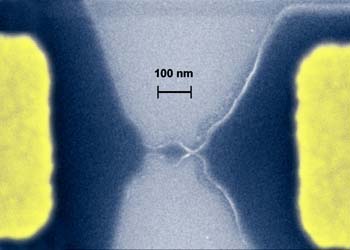
Now, University of Manchester professor Andre Geim and Dr Kostya Novoselov from The School of Physics and Astronomy reveal that graphene can be used to create incredibly small electronic circuits, containing individual transistors smaller than a molecule. It seems that, in the case of graphene, the smaller the transistors, the better they perform.
The University of Manchester team, the same that nearly four years ago isolated graphene for the first time, has shown that nanometer-scale transistors can be created out of a single graphene crystal, which would remain stable even when individual elements are only one nanometer wide.
"Previously, researchers tried to use large molecules as individual transistors to create a new kind of electronic circuits. It is like a bit of chemistry added to computer engineering. Now one can think of designer molecules acting as transistors connected into designer computer architecture on the basis of the same material, and use the same fabrication approach that is currently used by semiconductor industry," said Novoselov.
"It is too early to promise graphene supercomputers. In our work, we relied on chance when making such small transistors. Unfortunately, no existing technology allows the cutting materials with true nanometer precision. But this is exactly the same challenge that all post-silicon electronics has to face. At least we now have a material that can meet such a challenge," said Geim.
"Graphene is an exciting new material with unusual properties that are promising for nanoelectronics. The future should be very interesting," concluded Bob Westervelt, professor at Harvard University.