
|
|
|
|
March 26th, 2008, 14:26 GMT · By Stefan Anitei
|
|
SHARE:
Adjust text size: 
|
|
|
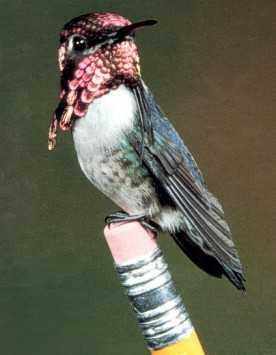
Have you ever wondered which is the world's smallest feathered creature? It is, of course, a species of hummingbird. The Bee Hummingbird (Mellisuga helenae) inhabits Cuba (where people call it zunzuncito) and the Isle of Youth. The bird weighs 1.8 grams, having a length of about 5 cm (2 in). An unaware observer can take this bird for an insect. The bird flies with 80 wing beats per second, a rhythm at which the human retina cannot detect naturally details
. During the courtship displays, the male flap his wings up to 200 times per second! Only high speed cameras can take pictures of this bird. And, in fact, the male Bee Hummingbird is the smallest bird, as he is smaller than the female. This bird has also the smallest number of feathers: about 1,000 feathers (in other bird species, there are up to 25,000 feathers). Its heart rate is the second fastest of all animals, to sustain the high metabolism (explaining its wing rhythm and body temperature). The body temperature is 40°C (104°F), the highest of all birds, but it drops during the night to 19°C (66°F) to save energy (as the bird would lose too much heat because of its small size). Bee hummingbirds eat half their total body mass and drink 8 times their total body mass in water each day. These birds are solitary, accepting each other's company only during the breeding period; in the rest of the time, they are fiercely territorial, defending their territories (represented by blossom trees) very aggressively even against much larger birds. The nest is attached to small branches using spider web threads. The nest is also world's smallest, no larger than the cup of a doll (3 cm or 1.2 inch in diameter). The nest usually hosts two minute eggs, smaller than two coffee beans. The chicks usually hatch in May-June. The appetite of this bird is the opposite of its size. This hummingbird consumes small spiders and mites, but especially the sweet nectar of the tropical vividly colored flower. Its high metabolism means this bird consumes half of its body mass and drink 8 times their body mass in water daily. This bird is crucial in ensuring the pollination and survival of several plant species. Once this bird was relatively common, but even if today it is protected, its numbers are dwindling. Amongst mammals (the only other warm-blooded group of vertebrates, besides birds) only the Etruscan shrew and the bumblebee bat compete with this species in size.
|
|
|
|
TELL US WHAT YOU THINK:
|
56,075 hits
· 33 comments
· Link to this article
· Print article
· Send to friend
· Subscribe to news
|
MUST-READ RELATED ARTICLES:
READER COMMENTS: |
| Comment #1 by: Roger on 23 Sep 2008, 18:59 UTC | reply to this comment | I am in Vence, Provence, France and in our garden are several Bee Hummingbirds which I thought were found only in Cuba and the Isle of Youth. The vdeo and pictures that I took confirm that these birds are less than two inches in length (I used a measuring tape).
Would anyone care to comment on the presence of these birds here in the south of France? |
| Comment #1.1 by: edward on 29 Sep 2008, 19:32 GMT | Hi Roger,
to my astonishement during my last holiday in Lnagedoc I've seen what I would dear to call a Bee Hummingbird. I've spent some just like you trying to find whether it's possible, but didn't come across anything. Are there any other species alike Hummingbirds?
Unfortunately, no other commentators yet. |
| Comment #1.2 by: Ruth on 28 Sep 2011, 16:53 GMT | I would say that you have Hummingbird Moths. They look and act like hummingbirds. Hummingbirds are only found in the Americas.Yet , the Hummingbird Moth is an enchanting insect |
| Comment #2 by: Denis George on 12 Oct 2008, 18:57 UTC | reply to this comment | I have seen in Portugal last Saturday, ( 10th September 2008 ) what my wife and I at first thought was a rather flat Bumble bee, on closer inspection I realised that it was indeed a tiny humming bird, that is until I read on this site that the smallest was from Cuba and is about 2.5 inches long. The one we saw was no more than 2.5 cms with a wingspan of about 3 cm, the tail end was rather flat with some lighter spotting, the overall colouring was very moth like, (grey) the head was indistinguishable from the main body, it had a very curved probiscous ? which was about 9mm long which it was dipping into the flower heads.
Was this a bird or some kind of moth like insect? |
| Comment #2.1 by: Jonathan on 03 Jul 2010, 23:01 GMT | I must say that I have seen a creature of the same size that you are speaking about here, in Israel. Since we got rid of the flowering bushes in the court garden, however, they have not been seen at all.
They are tiny and I thought that they might be an insect as well, but I see that the bee hummingbird description seems to fit them. |
| Comment #3 by: Jewel on 26 Oct 2008, 04:15 UTC | reply to this comment | A friend and I just spotted a bee hummingbird in the Florida Keys! While in flight and hovering it was black with white wings or a low white collared neck. It looked just like a bumble bee from the North, but instead of being black and yellow, it was black and white. It was definately a hummingbird and it was the size of a bumblebee! We are only 90 miles from Cuba, so I guess it is not that extraordinary to see, yet my friend has lived 50 some years in the Florida Keys and never saw one like this before! It was a joy to see this beautiful bird! |
| Comment #4 by: Barry Beckta on 23 Jan 2009, 20:20 UTC | reply to this comment | Live in River Hall Country Club, Fort Myers Florida area. Spotted a Bee Hummingbird while walking dog on the Gof Course. What attracted me to him was the size, thought it was a bumble bee, watched it flit severals times and knew right away it was not a real bee, because of the way it hovered. Pretty Cool |
| Comment #5 by: Barbara on 08 Mar 2009, 05:42 UTC | reply to this comment | I saw a bee hummingbird in the region of Eure et Loir, France in the hameau of Lesfromat, in the extraordinary garden of a woman named Mme. Lieux. This was 15 years ago and one of the most amazing sights I have ever seen. The body was maybe an inch and a half long, not much bigger than bumble bee. I have always felt so lucky to have seen such a wonder! |
| Comment #6 by: Barbara on 09 Mar 2009, 03:34 UTC | reply to this comment | I saw this tiny marvel in the region of Eure et Loir near the village of Arrou about 15 years ago. It was amazing. I think of it so often. It was such a gift to have had the privilege of seeing this wonder of nature. |
| Comment #7 by: Jaime on 25 Apr 2009, 03:20 UTC | reply to this comment | FYI: There is a few species of moths with a much wider distribution than the bee hummingbird called the hummingbird bee (i swear even though it sounds strange). They are also called hummingbird moths and are from the family Sphingidae. In pictures they kind of look like a bee or moth with a probiscus, but in motion they look like baby hummingbirds (with antenas if you can get a close enough peak)! |
| Comment #8 by: libby on 22 Jul 2009, 12:53 UTC | reply to this comment | I'm in michigan . Me and my neighbor was sitting on the porch i have a variety of all types of flowers and was shocked to see this very small bee like creature (wings moved just like a humming bird) but it had some yellow spots on the tail the body looked black could have been dark purple . At first i though what the heck is that its not a moth the wings don't move like that and it fed just like a humming bird . Is it possible to have a small species of that size here in michigan ? I've never seen this thing ever . was shocked |
| Comment #8.1 by: Lynn on 28 Jul 2010, 01:40 GMT | I also live in michigan and tonight i saw what i thought was a baby hummingbird but thought noooo cant be . looked like a bee but wings were moving just like a hummingbird. He was hovering over my potted flowers on my deck. Loved it!!! |
| Comment #8.2 by: Snrgevo on 02 Sep 2010, 06:48 GMT | http://www.insectidentification.org/insect-description.asp?identification=Hummingbird-Moth
Sounds like a humming bird moth... was this it (above link)? |
| Comment #9 by: sara pront on 19 Jan 2010, 16:04 UTC | reply to this comment | I'm in Ella Valley, Israel, the valley where David fought Goliath, I think we saw two of these flying from flower to flower last weekend, is this possible. |
| Comment #10 by: def on 20 Jan 2010, 15:03 UTC | reply to this comment | i SAW A HUMMING BIRD MAURITIUS(in Indian Ocean) . It was about 3 cm and very fast. It was drinking the nectar of a flower and it immediately ran away when I presented myself. |
| Comment #10.1 by: meli on 28 Jul 2011, 16:35 GMT | i've saw a bird,3cm as you told....it was red and black,the wings was really quick,,,and it was drinking nectar while flying...i was too surprised and curious to know wether its really a hummingbird that i didn't have the time to take a photo of it....it was a grand bassin... |
| Comment #10.2 by: nunush on 29 Sep 2011, 13:20 GMT | if you saw it at grand bassin then i can confirm you. because i live near grand bassin, and every time there's a plant that flowers that smells good i can see a bunch at my place. before i could not take any picture of it but today i have been able to take a few pics. thnx to confirm me that im not the only one to see it. |
| Comment #12 by: Lisa on 16 Aug 2010, 00:52 UTC | reply to this comment | We have seen them in central Maine in August of 2010. We were very surprised to learn of them from our neighbor who's brother had seen them earlier in the week. So far we have observed them on flower blossoms. We have a humming bird feeder in the same area and they have not attempted to feed on it. |
| Comment #13 by: fire15s on 18 Aug 2010, 01:42 UTC | reply to this comment | Took my grandsons to Disney World for the weekend, and spotted one at the Old Key West Resort. August 15, 2010 |
| Comment #14 by: seenit on 26 Aug 2010, 01:36 UTC | reply to this comment | Saw a bee hummingbird on a mountain top in Yunnan, China. It was the size of and looked like a moth, reddish-brown and black with white spots. It flew extremely fast and was hard to follow visually unless it hovered. Its wingbeat was very fast and just a blur. |
| Comment #15 by: cierra on 14 Feb 2011, 22:13 UTC | reply to this comment | its very interesting to learn that the hummingbird is ahlf smaller than a robin |
| Comment #16 by: Chris Moffitt on 22 Feb 2011, 15:41 UTC | reply to this comment | Spotted 3 in Melbourne Beach, Florida on 2/19/2011. 1st Time I ever saw one. I identified it by this web sight. Sure thought it was a large bee at first. |
| Comment #17.1 by: birdnerd on 16 Apr 2011, 14:29 GMT | Saw hundreds of bee hummingbirds on lavender flowers in Provence, near Avignon, France in 1996. Like many birds that wind up out of their range, scientists say that the bee hummingbird was probably caught in the jetstream during storms in the Caribbean and carried across the Atlantic. Makes sense, as we are now seeing the occasional pair of West Coast birds here in Southern Ontario. |
| Comment #17.2 by: Neo orthno on 27 Jun 2011, 10:06 GMT | Last night we are sure we saw a hummingbird the size of a bumble bee in the garden here in La Charite, Loire valley, France. Some have told us it was likely the hummingbird moth. But this had a straight beak, not curved proboscis, a defined head colouring, and darted in and out of the lavender and other flowers like the larger hummingbirds we see in British Columbia. A bee hummingbird is my conclusion. Will be watching for it again. |
| Comment #18 by: Polasson on 29 Aug 2011, 00:18 UTC | reply to this comment | This creature seems to have been seen in in my backyard in Bosnia and Herzegovina which is very unusual for this geographical location. We even got it on camera...It was amazing... |
| Comment #19 by: poss on 01 Sep 2011, 18:17 UTC | reply to this comment | Thursday 1st Sept 2011 Nottingham
Today I saw what I first thought was a moth, But it was beating its wings and flying backwards & forwards dipping its beak into various flowers. It was about 3to 4 cms. it was definatly a small bird,(very small) It must have escaped from some collection,how else could it be here. |
| Comment #20 by: UB on 22 Sep 2011, 23:28 UTC | reply to this comment | For the last 3 years we have had one of the bumblebee sized hummingbirds
for about 3-4 days. Today, we have seen one feeding at the 4 o'clock flowers and lantana. We live 22 miles north of Palestine, Tx. Is this a rare occurence? |
| Comment #21 by: Barn on 28 Sep 2011, 02:14 UTC | reply to this comment | Saw a Bee Hummingbird this morning at the crack of dawn in my garden, I live in Pembroke Pines, Florida, in the Miami/Fort Lauderdale area. I didn.t know what it was until I researched it all day. Was amazing to see. Hope to see again. |
| Comment #22 by: Rumdnoor on 23 Oct 2011, 15:39 UTC | reply to this comment | I've seen several times in my backyard garden,. bee hummingbirds between 2-3 birds as small as 2.5 cm feeding on nectar from sweet smelling bunch of flowers. It has a long beak and a pointed tail and because it is so fast i couldn't catch it on camera. It's amazing to see these birds in Malaysia. |
| Comment #23 by: Smitty on 01 Nov 2011, 13:59 UTC | reply to this comment | We have a dwarf Poinciana tree in our front yard. On Halloween night, around 5:00 p.m., while waiting for the kids, I spotted something flying around our tree. I could not believe my eyes, they were Bee Hummingbirds. There were at least 8 to 10 of them swarming the tree for the nectar. I have never seen a sight like this, it was an experience. |
| Comment #24 by: Smitty on 01 Nov 2011, 14:08 UTC | reply to this comment | Gosh darn, what I thought was a bee hummingbird turned out to be a hummingbird moth. Could have fooled me. Smitty | |
Copyright © 2001-2012 Softpedia. Contact/Tip us at 
|
|