 14 DAY TRIAL //
 Scientists from the Norfolk State University in Virginia, together with colleagues from the Purdue University, have recently showcased their latest nanolaser, which they say is the smallest in the world. The new device is, however, not a laser in the strictest terms. It is rather a “spaser,” a device that does not amplify light, but produces it itself. It is also the first spaser ever built, and the instrument holds great promise for the ultrafast nanocircuit technology. According to the team of constructors, the instrument is also fit to be used as a light source for scanning near-field optical microscopes, Nature News informs.
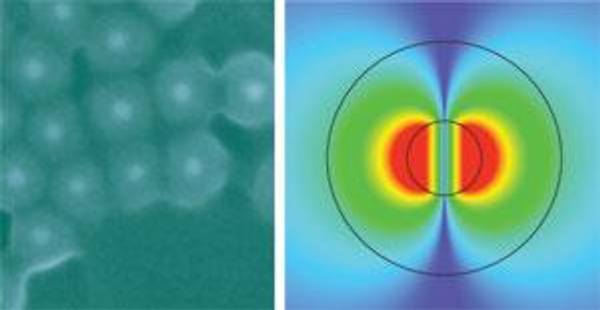
The new spaser is so small that it can completely fit inside a silica sphere just 44 nanometers across, the team says, which means that it is about ten times smaller than the wavelength of visible light itself. Rather than amplifying light inside a mirrored cavity – the basic principle of an average laser – the spaser amplifies tiny oscillations in the density of free electrons on the surface of metals, called plasmons, which are, in turn, responsible for generating light.
Such a small light source has numerous types of applications waiting for it, ranging from scanning near-field optical microscopes to nanoscale circuits and nanolithography. In the latter, the new technology could help etch models on substrates that would essentially create nanocircuits. These circuits would operate several times faster than today's most advanced microelectronic chips, the researchers believe.
“This work has utmost significance. The spaser is the smallest possible quantum amplifier and generator of optical fields on the nanoscale – without it, nanoplasmonics is like microelectronics would have been without a transistor,” Georgia Tech Professor Mark Stockman, who was one of the two researchers who first proposed the spaser back in 2003, explains. The other scientist was Tel Aviv University expert David Bergman. The thing about the new laser is that it emits light in all directions, and not just in a tightly focused beam, like a laser does.
“I can think of applications in tagging large biochemical assays and in security marking, where the spaser's narrow spectral output gives better tagging capacity than existing semiconductor quantum dot emitters,” Southampton University Optoelectronics Research Center physicist Nikolay Zheludev, from the United Kingdom, says of the new achievement.