 14 DAY TRIAL //
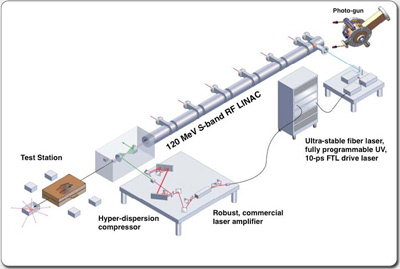
 The Thomson-Radiate Extreme X-ray Source is an energetic light source emitting picosecond laser pulses and possibly one of the brightest laser light sources in the world at this moment. T-REX is a LLNL project developed in collaboration with the NIF & Photon Science Principle Directorate and the Physical Sciences Directorate, specially built to produce monochromatic, highly collimated, tunable X-rays and gamma-rays scattered from relativistic electrons.
During last month testing, the T-REX achieved, for the first time, megaelectronvolts class light by outputting a gamma-ray emission with a power of .776 megaelectronvolts from its 10 picosecond electron bean, with an energy of 120 megaelectronvolts collided with UV laser photons, making it the brightest laser system in this class.
"We are still working on verifying the absolute record brightness of the source. But without a doubt, the 0.75 MeV radiation Produced by T-REX is unique in the world with respect to its brightness, spectral purity, tunability, pulse duration and laser-like beam character," said Lab's Photon Science and Applications Program director Chris Barty.
Usually, X-ray and gamma-ray light sources are based on synchrotron devices that are able to achieve record pulses with powers of 70 keV (PLEIADES system in 2003) in the X-ray wavelengths. However, T-REX peaks a brightness ten times higher.
Gamma-ray pulses are used to detect nuclear energy levels in specific nuclei and isotopes through a technique referred to as nuclear resonance fluorescence. A photon of light with a precise energy may hit the nucleus of an atom, thus inducing an excitation state. However, this state is unstable and the nucleus immediately decays to another energy state by emitting photons that carry the signature of the nucleus. By studying the energy spectrum of these light emissions, individual atoms and isotopes may be identified.
Based on the technology of the T-REX, Fluorescence in the Nuclear Domain with Extreme Radiation, or FINDER for short, devices may be constructed in order to make up the isotopic composition of well-shielded materials or to detect concealed high-enriched uranium. Barty argues that a dynamic application could make an isotope composition analysis of moving materials at speeds as high as 100 billionth of a second.
"It's a new area that may very well have a large impact on the Lab's core national security missions," Barty added.