 14 DAY TRIAL //
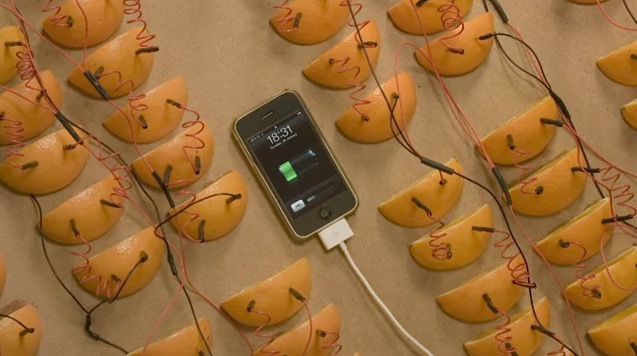
 A short video entitled “Orange Fruit Batteries Power An iPhone” shows that it takes approximately 2,380 orange slices to charge an iPhone. The clip, uploaded on YouTube, doesn’t aim to induce a negative view of the iPhone, but merely promotes an interesting experiment.
The video starts out with a woman preparing a glass of orange juice from freshly squeezed fruit. She sits down, takes a sip from the juice she has just poured in a glass, and goes through some documentation on single-cell batteries. These, as some of you may know, are comprised of few elements: an acidic liquid, and metals.
She proceeds to do an experiment by bringing in large cases of oranges, cutting them up, and connecting them in a series, through wires. The reaction between the metals puncturing the oranges and the acidic orange juice begins to create electricity. Finally, the end of each polarity is connected to the iPhone (via a custom-made cable), closing the circuit, thus charging the iPhone.
It is generally misunderstood that citrus fruit create electricity, whereas it’s the reaction between their juice and the aforementioned metal bars (generally zinc and copper is used) that creates electricity, once the metal bars are forced inside the fruit. The reaction dissolves small amounts of the two metals, making their electrons react with each other. At this point, negatively charged ions start traveling through the wires, creating what is known as “an electrical current.” Regular batteries that we buy from the store are not much different, from an ingredient standpoint.
Citrus fruit like oranges and lemons are excellent conductors. While even simple experiments will require more than one piece of fruit (to power a small light bulb, for example), more complex experiments (such as the one presented to us in this video) will require more fruit connected in a series, within a closed circuit. This is ultimately referred to as a multi-cell battery.