

Softpedia
 

NEWS CATEGORIES:


NEWS ARCHIVE >>
SOFTPEDIA REVIEWS >>
MEET THE EDITORS >>
TRENDING TODAY
Home > News > Microsoft > Windows

October 20th, 2009, 17:02 GMT · By

Windows 7 vs. Vista SP2 vs. XP SP3 Performance Comparison

SHARE:

Adjust text size:

Windows logos
Enlarge picture
Windows 7 has been receiving high praises as far as performance goes since the operating system debuted into Beta. Not even at the Beta Build 7000 level and not at Release Candidate (RC) Build 7100 was Windows 7 criticized for any sort of performance issues. On the contrary in fact, Windows 7’s new task execution speed, responsiveness, lack of hangs and freezes were applauded across the board by testers and adopters. Just imagine an operating system that is at the opposite pole compared to Windows Vista RTM, which was crucified as soon as it hit the shelves, and found to be slower than its predecessor on the same hardware. In contrast, Windows 7 has been receiving nothing but accolades performance-wise, and well-deserved accolades at that.

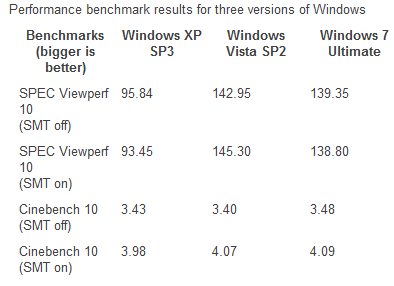
Microsoft managed to deliver the first official Windows Vista vs. Windows 7 performance measuring contest with a boot speed drag race back in early 2009. But startup speed is only one aspect of performance. InfoWorld’s Andrew Binstock put together a comparison of Windows 7, Vista SP2 and XP SP3 on a Dell Precision T3500 workstation (equipped with a quad-core Xeon W3540 (formerly codenamed Nehalem) CPU 2.93GHz, Nvidia FX Quadro 4800, and 4GB of RAM). Two benchmarks were used in order to compare the three operating systems, namely SPECViewperf benchmark from the Standard Performance Evaluation Corporation and Cinebench from Maxon Computer.

The tests run on the Nehalem processor involved two scenarios, the first in which symmetrical multithreading (SMT) was enabled, the second in which it was not. SMT is a technology specific to the latest Intel Core microarchitectures, developed under the codename Nehalem, which makes it possible for each core to run two simultaneous threads. This means that the quad-core Xeon W3540’s can run up to eight threads simultaneously, two per core.

Performance benchmark results
Enlarge picture
Windows 7’s scores were unquestionably superior to those of XP according to the results provided by the SPECViewperf and Cinebench. Of course so were Vista’s. However, users should take note that the benchmark in question involves Windows Vista Service Pack 2, a release that was made available in mid-2009, when the development process of Windows 7 was approaching the end. The highest score Windows 7 got with SPECViewperf was 139.35, much superior to XP SP3’s 95.84, but inferior to Vista SP2’s 145.30. In the Cinebench benckmark, Windows 7 got the biggest rating, 4.09, Vista SP2 was runner up with 4.07 and XP SP3 last with 3.98, considering just the highest scores the three operating systems received.

The benchmarkings indicate that the performance of Windows 7, while leaving XP SP3 in the dust, is approximately on par with Vista SP2’s. Microsoft has after all had three years to fine tune Windows Vista into the usable operating system that it is today. Fact is that if Microsoft had released Vista at SP2 and not as RTM XP’s successor would have never been compared with Windows ME.

It’s not surprising to me that there’s little to no difference between Vista SP2 and Windows 7 performance-wise, as resulted from the two benchmarks. But I think that a fair comparison would have had to involve Windows XP RTM and Windows Vista RTM, not the evolved versions of the two operating systems. And I believe that in such a scenario Windows 7’s superiority in terms of performance would have been unquestionable.

Still, users must understand that a benchmarking could be little relevant compared to using the operating system day-to-day. I have always opined that it is the users’ impression of performance and not the actual performance that in the end makes the difference.


52,012 hits · 7 comments
Link to this article · Print article · Send to friend

MUST-READ RELATED ARTICLES:


Office 2010 Public Beta Available for Download in November

Windows 7 RTM Resource Kit PowerShell Pack from Microsoft

Download Visual Studio 2010 Beta 2 on October 19, RTM on March 22, 2010

Microsoft Sync Framework 2.0 Redistributable and SDK Available

Ballmer to Keynote SharePoint Conference 2009

READER COMMENTS:


Comment #1 by: Chris on 28 Oct 2009, 08:09 UTC reply to this comment

Performance on win7 is of no concern. It is good. Very good. Never since I started using a Pc, that is from win 95 etc, did I have the experiance I had in installing an operating system. Everything worked the first time. Not once did I have to install any device drivers for my hardware. Motherboard, graphics card. printer, sound and any other device I plugged into the Pc was recognised and installed. Once I connected to the internet, all drivers that needed updating was updated. My Pc is a Intel E7400 prosessor running on a XFX G 31 Motherboard. Graphics card is Nvidia 9500 GT. 2 Gig Samsung Ram. 22 Inch Samsung SyncMaster 2253 Gw monitor and two hard drives, a 320 Gig and a 80 Gig. Not much but it works even better than it did on Xp. I am running Win7 Home Premium. Looks like MicroSoft finally got it right. Vista can be dumped now like was the case with Win 2000. Just my Opinion.


Comment #2 by: Toxic on 29 Oct 2009, 16:05 UTC reply to this comment

I am a critical PC user, having to use mine professionally and doing so for far more than 20 years now. So I've seen any of Microsofts operating systems and used them all with more or less fun and satisfaction. Some were a true pain regarding stability and got sacked pretty quick.

Windows 7 is a great step forward from my point of view, neither the Beta nor RC1 versions let me down in any respect and did not nag me with comments, messages or requests like Vista does. 7 works fast and reliable, all drivers are loaded like magic, almost any software runs on it and if it doesn't there is a newer version that does or a good replacement. So much for the platform which allows me to work and which does so to my total satisfaction.

What I am still missing with MS operating systems, though, is a true file manager. I could now rant on about how useful such a tool is and how you really know *what* is on your machine and where it *really* lies and how the directories *really* are named and how much faster it is than any mouse clicking and how versatile it is for exactly selecting files using delimiters and wildcards etc., but I do what I always did: install one, work with it and just use Windows as the executing platform for running the software I need on the hardware I have. And as that, as I already said, 7 is really doing a great job.

But I will, as I have done in all the years past, still have that one constant remark in my next MS beta test comments: When will you supply a true file manager? That would be really great. Ceterum censeo Windows debet habere administratorem tabulatorii!


Comment #3 by: RK on 31 Oct 2009, 23:05 UTC reply to this comment

Writing involves editing and fixing your typos! benckmark? SPEC Viewperf should be written as one word: SPECViewperf, but that's a little more specialized knowledge that only IT writers would know - oh, hey, you're an IT writer!

Otherwise, good piece, very informative. Thank you.


Comment #4 by: Z911 on 03 Nov 2009, 14:00 UTC reply to this comment

And it's really embarrassing when you correct someone with the wrong answer: SPECviewperf.

Otherwise, good comment. Thank you.


Comment #5 by: filth on 07 Jan 2010, 15:22 UTC reply to this comment

"Writing involves editing and fixing your typos!"

Wrong! Writing involves creatively putting words down so that something interesting is the result. Mechanical processes like editing and correcting typos is the reason that places that hire writers also hire subeditors.


Comment #6 by: XP better on 12 Jul 2011, 22:47 UTC reply to this comment

I think those supporting Vista speeds on par are just bribed companies. I have vista since it launched and it is so slow compared to my 3 years older XP laptop


Comment #7 by: MUHAW on 24 Feb 2012, 04:33 UTC reply to this comment

The benchmarkings indicate that the performance of Windows 7, while leaving XP SP3 in the dust, is approximately on par with Vista SP2’s. It’s not surprising to me that there’s little to no difference between Vista SP2 and Windows 7 performance-wise. it is the users’ impression of performance and not the actual performance that in the end makes the difference. That being said, it's all marketing. While reading this I gather, do I want to spend the extra money and the hastle of downloading the latest windows 7 drivers; user forums for my recording interface claim there are alot of conflects ( even though they clain the latest driver will work ). Dam, why is everyone fixed on replacing? If Vista SP2 works fine " like they say, if it an't broken, then don't try to fix it and if a guitar plays fine, so what it's a 73 Strat.

Copyright © 2001-2013 Softpedia. Contact/Tip us at

WindowsGamesDriversMacLinuxScriptsMobileHandheldNews

SUBMIT PROGRAM   |   ADVERTISE   |   GET HELP   |   SEND US FEEDBACK   |   RSS FEEDS   |   UPDATE YOUR SOFTWARE   |   ROMANIAN FORUM