 14 DAY TRIAL //
 Not only birds can fly.
Some amphibians (flying frogs), reptiles (flying dragon lizards and flying snakes) and mammals (flying squirrels, flying marsupials, colugos) can float through the air and bats can really fly, but their flight does not have the grace of the bird flight. And more interesting, they do not share the birds' ability to glide.
So, what's the trick the birds use in their sliver when approaching gliding flight?
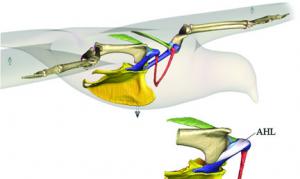
Researchers at Brown and Harvard have found that a single shoulder joint's ligament stabilizes the wings of birds during flight, like a linchpin, saving the birds of spending energy and explaining many flight records of the birds like albatrosses and petrels traveling tens of thousands of km over the seas. "How animals got off the ground - how limbs became wings - is a fascinating question," said David Baier, a post-doctoral research fellow in the Department of Ecology and Evolutionary Biology at Brown. "What we learned here is that, in the evolutionary line to birds, a single ligament played an increasingly important role in flight."
In order to see how the shoulder joint keeps the wing stable during gliding flight, the team studied living animals and fossil bird related dinosaurs, examining how the interaction of aerodynamic soft tissue and bony forces affect the shoulder joint.
The team investigated pigeons to understand how the birds stabilized their wings during flight, using CAT scans to make a 3D "virtual skeleton" and calculating the forces needed to maintain a gliding posture. But neither the shoulder socket nor the muscles could keep pigeon wings stable. The main piece was the acrocoracohumeral ligament, a short band that connects the humerus to the shoulder joint. The ligament balances all of the forces exerted on the shoulder joint - from the pull of the massive pectoralis muscle in the bird's breast to the push of wind under its wings - making it a linchpin for modern bird flight with the minimum energy spending. As the crocodilians are the closest living relatives of the birds, they investigated in an alligator how to the primitive version of the shoulder joint looks. Alligators and dinosaurs (birds' ancestors) evolved from archosaurs, that emerged some 250 million years ago, during the early Mesozoic Era. The 3D computer animation revealed that alligators use muscles, not ligaments, to do the hard work of supporting the shoulder, a process associated with energy consumption and muscle fatigue.
Then the researchers investigated the skeleton of Archaeopteryx lithographica, the oldest known bird, and fossils of Confuciusornis, Sinornithoides youngi and Sinornithosaurus millenii, feathered dinosaurs very close related to birds.
The new ligament-based force balance system shows a gradual evolution inside the fossil records, so this trait was not critical for the origin of the flight, but flight perfected with its development. "What this means is that there were refinements over time in the flight apparatus of birds," Baier said.
"Our work also suggests that when early birds flew, they balanced their shoulders differently than birds do today. And so they could have flown differently. Some scientists think they glided down from trees or flapped off the ground. Our approach of looking at this force balance system can help us test these theories."
Image credit: David Baier