
Softpedia
 

NEWS CATEGORIES:


NEWS ARCHIVE >>
SOFTPEDIA REVIEWS >>
MEET THE EDITORS >>
Home > News > Editorials

January 5th, 2008, 08:47 GMT · By Stefan Anitei

Who Are the Australian Aborigines?

SHARE:

Adjust text size:


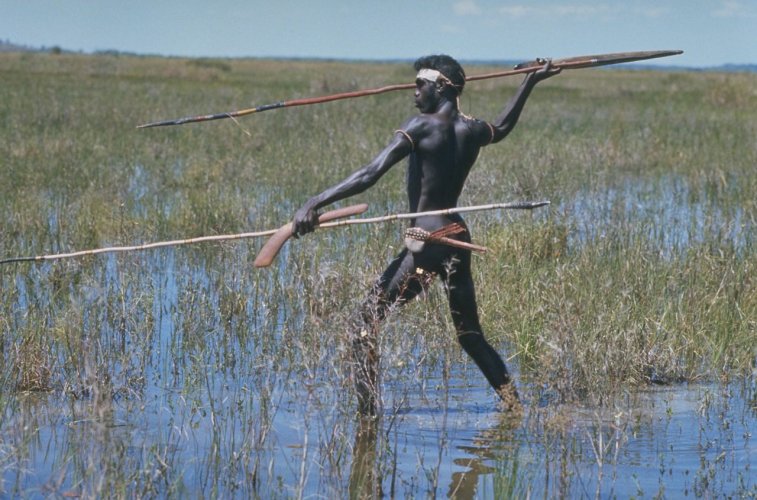
Aborigine hunting with spear. He holds a spear and a boomerang in the left hand
Enlarge picture
The Australian Aborigines form together with the Bushmen and pygmies one of the oldest human race. They are one of the first human groups to have moved out of Africa perhaps 60,000 years ago. This group formed a race later known as Black Asians. 12,000 years ago, they were the main inhabitants of India, Indochina, Indonesia, New Guinea, Melanesia, and perhaps even eastern China. They make the most primitive form of this race, later types being represented by Papuans or Melanesians.

Unlike African Blacks, these people have abundant beards, a lot of hair on the body, are shorter, have slimmer lips, a tilted front (not cambered), prominent eye ridge and aquiline noses. The hair is somewhat less kinky. The Aborigines maintain in their physic some very primitive traits for modern human races: evasive foreheads, very prominent eyebrow ridge, eyes sunk into the sockets, and extremely wide noses, with a depressed base and elusive chin. The skin is dark, but not so much like in African Blacks; the body is rather slim and tall, with long and thin arms and feet.

This race has one of the highest genetic diversity amongst current human races (being bypassed just by the Bushmen, the oldest living human race), the mitochondrial DNA showing an age of at least 35,000 years for this human type.

One curiosity of the Black Asian race (Aborigines included) is that some children can have naturally blond hair. Still, with the age this hair turns gradually dark.

But later than 12,000 years ago, in India entered White populations from central and southwestern Asia, greatly displacing or mixing with this race. Still, even today, many Indian populations, especially in the south, still preserve this Black Asian racial type, and some Gurus from the south cannot be distinguished from a Papuan or Australian Aborigine. In southeastern Asia, they were replaced by Mongoloids coming from Tibet and central China.

Australian Aborigines could have entered Australia through New Guinea about 40,000 years ago, as during the peak of the last Ice Age New Guinea was connected to the Australian continent via a land bridge, forming the called Sahul.

When European colonization started, Aborigines retreated to the inner deserts and steppes and to the remote north. The Aborigine culture is one of the Paleolithic (Old Stone Age), a glimpse of how we lived more than 20,000 years ago.

Aborigines made from stone their knives,
axes and adzes. The technology for making these stone tools involved hitting one stone against another, till making them bounce required chips, which were slowly given the shape of the desired object; once achieved, their surface was polished by rubbing it against a tough object. The wooden handle was attached using a glue made of resin and secured further with fibers.

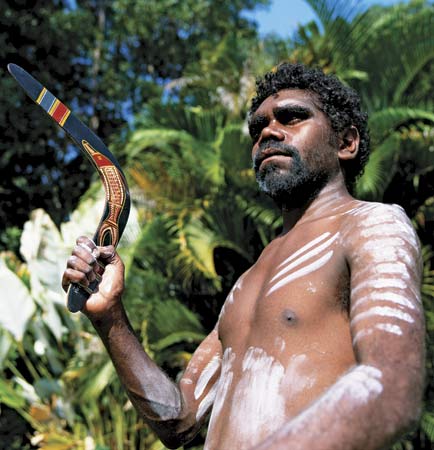
The most common weapon used by Aborigines was a short wooden spear with a stone tip. The most curious weapon was the boomerang, used for hunting rapid animals and birds, while for hunting emu or bush turkeys was employed the spear. The boomerang has the property to return to its launcher if missing the target. Axes and adzes were used for cutting branches and trees, or for making passage amongst spiny bushes, while the knives were used for cutting the meat of the hunted animals.

Aborigine launching a decorated boomerang
Enlarge picture
Because Aborigines lacked any contact with other cultures, their own is poor: they do not know pottery, weaving, metals and even more basic elements like the bow and arrows or hunting traps.

Their dwellings are one of the most primitive on Earth, mere shelters made of two stakes finishing on a pitchfork and fixed on the soil at a distance of 3 m (10 ft) one from another. These sticks sustain another horizontal layer, against which is leaned a wall made of branches and leafs which protects the family against the wind. Sometimes a type of tree bark was added. In the front of the hut a bonfire was set, for cooking and heating the sleeping people during the night, also chasing away the dangerous animals. When the cold was intense, a bonfire was set close to each sleeping member of the group, and one person watched over the fire not to wane.

Today, most Aborigines have adapted to the western lifestyle, working mostly as herders in the inner grassland areas of Australia. Still, some groups maintain a more or less traditional lifestyle.

Ancient Aborigine rock art
Enlarge picture
Aborigines make painting over tree bark, representing stylized animals (kangaroos, emu, snakes, birds and others) in various attitudes. Sometimes their paintings are complicated, depicting scenes of their legends and myths. In the inner Australia, there are also rock paintings, very similar in style to those found from the Paleolithic of France, Spain and Sahara. In fact, the Cro-Magnon people of the Ice Age Europe are believed to have been an Aborigine type.

Even if Aborigines usually went naked, they adorned with "tattoos", smeared their hair (usually long) with mud, and inserted large feather headdresses in it. Sometimes, they wore false beards made of feathers or fibers.

In the Aborigine group, children receive special care, receiving the best food, a lot of affection and not being punished for their pranks. Children stay with the women, helping them in gathering berries, seeds and small animals (insects included).

When the boy reaches 10-12 years of age, he will pass through a series of ceremonies: his body is tattooed and painted and he is taught legends and customs of the tribe, he learns to hunt, and he is submitted to a series of physical probes meant to fortify him. This learning period can last years, and when considered adult, he could marry.

The most important festivity of the Aborigines is the corroborri. The men adorn themselves with feather headdresses, imitating the look of the totem animal of the tribe. The magic ceremony has as a final purpose the achievement of the favor of the spirits of the animals which the Aborigines wanted to hunt so that they came in the reach of their weapons. By mimicking animals' movements, Aborigines took over the spirits of the animals forcing them to accomplish their will.

The corroborri dance is accompanied by the singing and the rhythmic beating of wood pieces: the rhythm and velocity grew gradually till the dancers fell exhausted to the ground.

One characteristic of the Aborigines is that they have the same mobility in the big toe like in the thumb. This way they could grab small objects from the soil with their feet, fuel the fire or take a spear from the ground without the need for bending down.

This was useful for climbing trees for collecting bee hives (one of their delicacies), especially as Australian bees use to make their nests in smooth and branch free trees. Unlike other humans, which advance in the trees by moving one arm or feet at a time, the Aborigines made jumps on the tree trunk with both hands or both feet at the same time. This property gives them jobs as wood cutters.

The Aborigines of the northern Australia fish using one-trunk made boats. The trunk is carved in a very primitive way. For fishing, Aborigines use harpoons ending in pitchforks made of wood hardened on fire. Using this harpoon, they hunt even large sharks, which, after being wounded with the harpoon, they are approached and finished with heavy stone axes.

In rivers and lakes, fishing nets are employed. Like the Indians of the Amazon, Aborigines can use the method of poisoning the shallow waters, the dizzy fish being collected with nets or baskets.

Aborigine men usually went to hunt in group. Even when going to hunt alone, the hunter had to share the game with the rest of the group. The Australian fauna is original, but poor, and Aborigines had to content from possums to kangaroos and emus. Usually, they do not hunt dangerous animals, except the crocodile. The hunter knew by the traces the species and the age of the trace. Aborigines looked for filtering how much they could close to the large prey (like kangaroos) to a distance that allowed them to kill with the spear. Sometimes the hunters smeared their body with clay for camouflaging during the hunt. The presence of termite mounds eased the task of getting closer.

They also organized collective hunts, involving women too. When encountering a kangaroo group, a few men together with the women herded the animals through screams and gestures to a certain direction where skilled hunters stalked in hidden places. When the animals were in their reach, they went out of their hidings, throwing their spears.

Another method involved fencing an area from three sides with twigs and branches, while the kangaroo group was herded through the free side. Inside the place, Aborigines could also dig holes covered by twigs that trapped the animals. Like Bushmen and pygmies, Aborigines can also practice a very old hunt: the chase.

Even if the hunt is exhausting, and the Aborigines are eager to eat, they never consume raw meat. Small mammals and birds are cooked unskinned, with bowels intact. They are put on embers, hot stones or sand, while large animals are cut in large pieces and the meat cooked on fire. Sometimes, the bowels were put out through a cut made into the abdomen, and inside hot boulders were introduced, so that the meat cooked also from the interior. As the game is not skinned, the roasted meat remained juicy.

In many places, the animal filled with hot stones was put on holes containing amber, being wrapped in leaves and soil. In 2-3 hours, the dinner was ready.
TELL US WHAT YOU THINK:

31,834 hits · 21 comments · Link to this article · Print article · Send to friend · Subscribe to news

MUST-READ RELATED ARTICLES:


Dolphins' Language, Much More Sophisticated Than Believed!

Surprising Dinosaur Found in Antarctica

Some Amazing Facts About Ladybirds

6 Amazing Facts About Cockroaches!

Why Are the Pygmies so Short? Because of Early Sex!

READER COMMENTS:


Comment #1 by: NOVO on 19 Oct 2008, 10:57 UTC reply to this comment

Whites entered India about 1800 BC. There were different races of black Indians called Drabirs or Dravirs. One race formed the biggest civilization which gave the world the wheel and much more -- It was the Indian civilization. The whites came and adopted the culture and civilization.

NOVO

Comment #1.1 by: Smart ass on 13 Jan 2012, 23:38 GMT

So how did the whites get to India without the wheel? *

Comment #1.2 by: jumbuck on 14 May 2012, 12:58 GMT

you are a complete goose Novo ! You cannot change history and take credit for white or european civilization. and to say white people entered India thousands upon thousands of years ago, just to take parts of the culture there, then head back to europe, like it is a vacation they were on, is just false!
Any group they may have migrated from europe to asia or vice versa that far back, pretty much was not returning ever and especially thinking about stealing or borrowing other cultures ideas.

And for the wheel ! don't be to fast to take credit for something many cultures across, asia, middle east and europe all was figuring out by themselves anyways around the same time.
It is like saying The Myans ctole the idea to build a Pyramid structure from the ancient Egyptians, but history tells us, these two cultures never even knew each other existed until recent times. Just like the wheel, it isn't just one cultures evention.

Back to the story of the native australians. If anyone actually chooses to get to know a first australian, they would be pleasently surprised, because they are not primitive, or backwards. They have some of the best sporting brains on the planet and talent and they have more or less always pleasant people to meet. Unlike most around the world.


Comment #2 by: Dan on 01 Dec 2008, 21:16 UTC reply to this comment

in my opinion this evaluation of the Australian Aboriginal culture is lacking in knowledge. In contrast to the writers coment i think that the aboriginals are a more advanced culture and need more credit than this. I mean they dont need good houses, and useless technology. They live in harmony with the earth and didn't need that, it doesn't make them primitive, It just means you are ignorant. Why fix something that isnt broken. leave them alone.


Comment #3 by: cosmo Pessoa on 21 Dec 2009, 03:03 UTC reply to this comment

I agree with Dan on 01 Dec 2008, 21:16 GMT 100%
The Native Australian People’s culture worked in harmony with the Environment , and had little or no effect on damaging the planet , for thousands of years .
The Europeans showed up in their paradise, ravished them and their lands and Animals. Now within 200 years the civilized Europeans are about to bring the entire planet to its untimely death. (this time there is no where for the Europeans to run, the planet is about to fight back , and the meek shall inherit the land)

Comment #3.1 by: Pglan Bsow on 17 Jun 2010, 20:52 GMT

What an idiotic comment. The aboriginal culture did not "live in harmony" with nature; they were just limited by their utter lack of technology. The planet is not about to die; grow up already.

Comment #3.2 by: flabbawabba on 17 Nov 2011, 18:52 GMT

The aborigines didn't live in harmony with their environment, they burned down the forests covering half of australia and killed all the megafauna. The reason Australia is mostly desert is because of 50,000 years of hunting by setting massive fires ablaze.

Comment #3.3 by: mrclean on 12 Dec 2011, 00:41 GMT

90% of amphibians have gone extinct in the past 20 years for just 1 example, the planet is most certainly dieing.

Comment #3.4 by: proud aborigine on 07 Jan 2012, 15:24 GMT

Aboriginal tribes from all over Australia would hunt animals and use different tactics for hunting like setting the bush on fire. After they hunted and lived of the land for a while they would go to a different location so the land where they previously hunted could regrow.

Comment #3.5 by: milo on 14 May 2012, 13:13 GMT

Cosmo get your facts right. Aboriginals didn't actually live in harmony with the land as modern white story tellers would like you to believe. They actually caused a lot of desctruction to the australian landscape. Slashing and burning over a 50,000 year period caused plants and trees to change to survive (which is why many australian trees today have extremely dull leaves and thick bark, to protect them from fires). Many of the mega-animals that were around at the time of the first humans entering australia, were killed off forever. and much of the land through constant burning, turned into desert.
So NO aboriginies didn't live in harmony with the land at all. They did however, survive the best way they thought though.
And to say Europeans destroyed their lands, is just false also, have you ever visited Europe ? one of the cleanest and prettiest lands on earth.

I'm sure many different native peoples over 50,000 years entered australia, moved established tribes on, and some blended in with others. The Europeans were no different for what they did, it only looks different, because of the color skin.

Humans have been around for such a short period of this planet, and yet carry on like they were running the show from the start LOL
Long after lands have been washed back into the sea and new lands form from the oceans depths, i'm sure man will still be around syaing, "that's mine"


Comment #4 by: EARTHMAN on 28 Sep 2010, 17:14 UTC reply to this comment

Australian Aborigines have the appearance of drawings made showing what anthropologists characterize as Neanderthals. Some Swedes have a similar bone structure forming their brows. Where did these people come from? What does their DNA tell us about their Neanderthal origins, if any? Why don't sub Saharan Africans have Neanderthal DNA?


Comment #5 by: te on 06 Jan 2011, 13:42 UTC reply to this comment

Earthman,you have the greatest name.


Comment #6 by: stupid on 07 Jan 2011, 20:23 UTC reply to this comment

what sort of religion do the aborgines follow?

Comment #6.1 by: Smart ass on 13 Jan 2012, 23:44 GMT

The follow fairy tails dremed up from one generation to the next... :/

Comment #6.2 by: declan on 13 Feb 2012, 13:01 GMT

Animists


Comment #7 by: Beenz on 13 Mar 2011, 15:50 UTC reply to this comment

there is so much stuff on this one article. I can't use it for my project notes.
You ought to shrink it down or have a summary section.


Comment #8 by: Yamatji on 02 May 2011, 15:55 UTC reply to this comment

This story is very uninformed ...

"Today, most Aborigines have adapted to the western lifestyle, working mostly as herders in the inner grassland areas of Australia. Still, some groups maintain a more or less traditional lifestyle."

Sounds like something written in the 1920's. But that's why it's good that there are people like me out there; here to educate people about our culture. Better to get it from the source as opposed to reading someone's misinformed ramblings. Sorry - not trying to take anything from your research. Just some of this I found offensive.

I am a Yamatji (Indigenous Australian) ... my work goes all over the world ... google my name - Darryl Bellotti - far from primitive I'd say ...


Comment #9 by: RAVI SHWANKA on 21 Sep 2011, 00:49 UTC reply to this comment

The Australian people are the oldest culture on planet Earth. It is even possible to say that they are the ancestors to all humans outside of Africa. Including White Europeans. I wold think that they are also the Direct descendant of the Neandethal, and a cousin of CroMagnon. Cave paintings, rock carvings etc (particularly the hand prints made by spitting pigment on the hand making a shape on a rock) is virtually the same from the caves of France, to the caves of the Mediteranian, to the outcrops/caves of Australia.
The Ice ages made humans migrate from Europe toward the Equator, then south to Aust. They probably didnt go to Africa, because that spot was taken. Even North/South America has traces of pre asian ancient people, with Aust. people characteristics. The Aust. Peoples are a noble Race, and should be treated as such. All Indians are descendents of Aust. Peoples.

Comment #9.1 by: ant on 15 Jan 2012, 20:16 GMT

there is some small level of variety of 'race' within different the human species. it is childish to compare for the sake of making a 'ratings table. ... however, to generalise a little, it is a reality that some races / cultures are more in tune with nature, some are better with technology, some are more athletic, some are more artistic,
it is simply the reality of life in the human race. A white European would not do well if transported to the outback with nothing more than the cloths on his back, and a laptop. equally, an aboriginie would not excell if transported to a rough London or paris suburb with nothing more than a boomerang.
Reality of life!
that said, as equal members of the human race, one would expect that the 'locals would realize the predicament of the 'tourist' , and afford him the hospitality he deserves. I fear more for the plight of the aboriginie than that of the white guy. I have no doubt that the white guy will get a friendlier reception in the OB than theaboriginie in London or Paris.

Comment #9.2 by: declan on 13 Feb 2012, 13:14 GMT

I like your point ... We harp on about "Out of Africa" but surely we didn't always * to the north, how improbable. We would always * in any direction. The compass would not contain us. The waves of Neanderthal and Homosapien or whatever would be best equated to * chaos contained by geography.


Comment #10 by: Deadra on 13 Feb 2012, 00:28 UTC reply to this comment

This was amazingly knowledgeable.

Copyright © 2001-2012 Softpedia. Contact/Tip us at

WindowsGamesDriversMacLinuxScriptsMobileHandheldNews

SUBMIT PROGRAM   |   ADVERTISE   |   GET HELP   |   SEND US FEEDBACK   |   RSS FEEDS   |   UPDATE YOUR SOFTWARE   |   ROMANIAN FORUM