 14 DAY TRIAL //
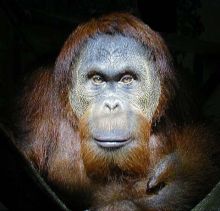
 The great apes are the smartest of all nonhuman primates, with orangutans and chimpanzees consistently besting monkeys and lemurs on a variety of intelligence tests, Duke University Medical Center researchers have found.
"It's clear that some species can and do develop enhanced abilities for solving particular problems," said Robert O. Deaner, Ph.D., who led the study as part of his doctoral dissertation. "But our results imply that natural selection may favor a general type of intelligence in some circumstances. We suspect that this was crucial in human evolution."
The study was published online August 1, 2006, in the journal Evolutionary Psychology. Funding was provided by the medical center's Department of Biological Anthropology and Anatomy.
Experts in psychology broadly define intelligence as general problem-solving skills -- "domain-general cognition" in the parlance of the field. This intelligence allows an animal to tackle new and unpredictable situations. Domain-general cognitive ability is separate from domain-specific abilities for solving certain environmental challenges, such as a bird remembering where it cached food.
Intelligence testing of animals has repeatedly revealed that some species perform better than others. This suggests that some animals have better domain-general skills, Deaner said. However, scientists have been hard-pressed to convincingly prove these differences could be attributed to intelligence, he added.
"The trouble is that one species may outperform another in a problem-solving test not because it's smarter, but because one species is poorly suited to that particular testing situation," he said. For example, one species may be more comfortable grabbing a joystick.
Deaner and his colleagues reasoned that they could refute this premise -- that performance differences resulted from particular testing situations -- by demonstrating that some primate species surpassed others across a wide range of problem-solving tests. Primates are an excellent comparison group because their similar perceptual and motor skills means that the same tests are generally appropriate for all of them, Deaner said. But developing a suitable data set to test this idea was not easy.
"At first we thought gathering the data would require a lifetime," said Deaner, now an assistant professor of psychology at Grand Valley State University in Allendale, Mich. "Ideally, one would test several individuals from each of 20 or 30 species with dozens of cognitive tests, but this certainly didn't seem practical. Then we realized the data had already been gathered by an army of comparative psychologists."
The team first pored through hundreds of published studies, and then assigned each testing situation or experiment to one of nine overall paradigms. For example, one paradigm was patterned strings. During the test, a primate is shown an array of crossing strings, only one of which is tethered to a treat. The subject is allowed to pull only one of the strings and must decide before pulling which string is actually attached to the food. The paradigm taps the ability to form spatial representations, considered crucial for intelligent behavior.
The results were clear: there were a few cases where one species performed better than another one in one task and reversed places in a different task, but, overall, some species truly outperformed others. "Our research strengthens the long-standing notion that some animal species truly are more intelligent than others," Deaner said. The smartest species were clearly the great apes -- orangutans, chimpanzees, and gorillas - which performed much better than monkeys and prosimians.
"The fact that great apes performed better than other primates in these laboratory tasks is reassuring," said Carel van Schaik, Ph.D., a study co-author and director of the Anthropological Institute and Museum at the University of Zurich. "After all, in absolute terms, their brains are the largest and they show the most sophisticated behavior under natural conditions -- deception and culturally-transmitted behavior, including tool-use."
Though some species clearly outperformed others, there was no evidence that any species performed especially well within a particular paradigm. This result contradicts the theory that species differences in intelligence only exist for narrow, specialized skills, Deaner said. Instead, the results argue that some species possess a broad, domain-general type of intelligence that allows them to succeed in a variety of situations.
Team statistician Valen Johnson, Ph.D., a professor of biostatistics at the University of Texas M. D. Anderson Cancer Center, created a new statistical technique to examine the data for consistency across the various tests. "It was tougher than it looks, because most species were only tested in a few situations," Johnson said. "Conventional methods wouldn't do the job."