
Softpedia
 

NEWS CATEGORIES:


NEWS ARCHIVE >>
SOFTPEDIA REVIEWS >>
MEET THE EDITORS >>
Home > News > Science > Sci Pry

April 4th, 2007, 15:09 GMT · By Stefan Anitei

What is Steatopygia?

SHARE:

Adjust text size:


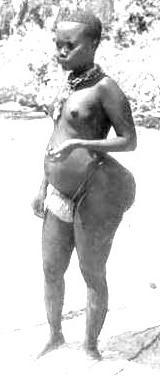
Steatopygia in a Hottentot woman
Enlarge picture
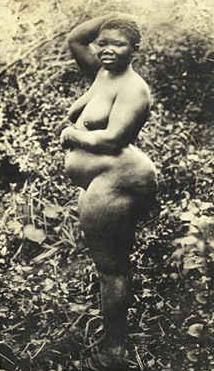
Steatopygia is a high degree of fat accumulation in and around the buttocks.

The deposit of fat is not confined to the buttock regions, but extends to the outside and front of the thighs, forming a thick layer reaching sometimes to the knee.

This is a widespread genetic trait of the Khoisan (more commonly known as Bushmen).

It is specially a female feature, but it occurs in a lesser degree at men too (in most genetic variations of Homo sapiens, females tend to exhibit a greater propensity to fat tissue accumulation in the buttock region as compared with males).

This trait is also found amongst the Pygmies of Central Africa or from Andaman Islands (Southeast Asia).

Khoisan see this as a beauty sign: it begins in infancy and is fully developed by the time of the first pregnancy.

Steatopygia is often accompanied by the formation of elongated labia (labia minora may extend as much as 4 inches (10 cm) (!) outside the vulva).

Look how a Boer in the XVIII the century describes this trait:

"The lining of the body appears to be loose, so that in certain places part of it dangles out. They have to themselves this peculiarity from other races that most of them possess finger-shaped appendages, always double, hanging down from the private parts; these are evidently nymphae (labia minora)."

James Cook, the famous British navigator, noted in 1771,
while passing by Cape colony:

"The great question among natural historians, whether the women of this country have or have not that fleshy flap or apron which has been called the Sinus pudoris. The most recent testimony of travellers commands us to put the cutaneous ventrale of female Hottentots in the same category as the human tail, and in like manner to relegate it to the fables."

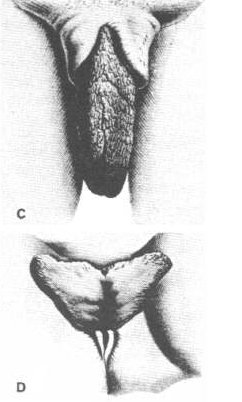
Enlarged labia minor in steatopygia
Enlarge picture
Steatopygia was studied for the first time by scientists in 1805, by French zoologists Péron and Lesueur, but at that time, many thought this was inaccurate or exaggerated, or that they had examined monstrosities and represented them as normal, or perhaps the subject may had been regarded as indelicate.

The labia forms can vary amongst Bushmen populations: in South West Africa, each labium is flattened and broadened to form a wing-like object, when laid out flat (the 'butterfly' type) while in Botswana and the Cape Province of South Africa the width is reduced and the anterior part thickened, resulting in an object like the wattle of a turkey-cock.

The 'wattle' type is commonly 3-4" long (7˝ - 10 cm), the 'butterfly' l˝ - 2" (3.8 - 6.3 cm).

Pygmies (both from Africa and Asia) and Bushmen are seen as the remnants of the most archaic current races and once, they inhabited most of Africa, from the Gulf of Aden to the Cape of Good Hope and all southern Asia till New Guinea.

Andaman pygmy woman with steatopygia
Enlarge picture
Bushman woman with steatopygia
Enlarge picture
Hottentots, of mixed Bushmen-Bantu roots, also often present this trait, as do Basters, mulattoes between Boers and Bushmen or Hottentots, while at the Khoisan, males can present steatopygia more often than Hottentot women.

It seems that steatopygia in both sexes was common in early types of Homo sapiens.

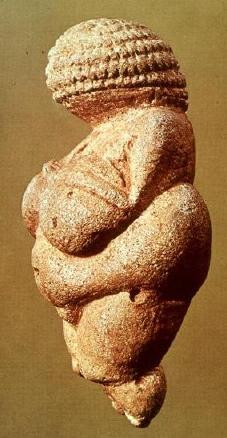
Paleolithic figurines and cave paintings from Europe depicting women, some as old as 30,000 years, clearly display stetopygia.

Those Cro-Magnon were more similar racially to the current Bushmen and Pygmies than any current European type.

However, the type of Neolithic Venus figurines (about 10,000 years old) do not strictly match steatopygia, since they have an angle of about 120 degrees between the back and the buttocks, while steatopygia is characterized at an angle of just about 90 degrees.

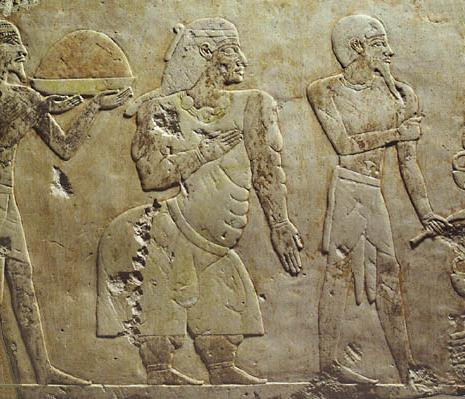
In 3500 years old Egyptian painting, the queen of Punt is presented displaying steatopygia, so this country still not precisely located could have been situated in Eastern Africa.

These very large buttocks occur sporadically also among current African and Europid women. (of course, some African women can possess Khoisan genes, so they display real steatopygia).


Enlarge picture
In steatopygia, the buttocks consist of masses of fat incorporated between criss-crossed sheets of connective tissue, joined to one another in a regular manner, while in other greatly enlarged buttocks, there is a mere accumulation of fat between two of the gluteus muscles (maximus and medius).

Steatopygia is believed to be an adaptive physiological feature for female humans living in hot environments, as it maximizes their bodies' surface-area/volume ratio but keeps enough fat to produce hormones needed for menstruation.

Paleolithic figurine from Europe displaying steatopygia
Enlarge picture
With fat deposited heavily in only certain areas in the middle on the trunk of the body, the limbs are left slim enough to expel heat more efficiently.

But more likely, being able to store large fat amounts is important in very seasonal environments like those in African savanna, where during the dry season, a food shortage installs, and live largely off of their stored fat.

Bushmen and pygmies are still hunters-gatherers, unlike other African populations that practice agriculture, so they do not experience severe food shortage during the dry season.

Women possessing these fat deposits can keep on reproducing through the unproductive seasons, thereby increasing their fitness.

Others say that the steatopygia developed as a response to sexual selection.

These Bushmen....
TELL US WHAT YOU THINK:

77,770 hits · 21 comments · Link to this article · Print article · Send to friend · Subscribe to news

MUST-READ RELATED ARTICLES:


Not Synchronized Ovulations Impede Lousy Males to Have Sex

Why Do Women Have Breasts?

How to Cool Off Using the Ass

...Get the Best Perfume from the Cat's A**...

Get The Best S*** Coffee!

READER COMMENTS:


Comment #1 by: Maija on 12 May 2010, 15:55 UTC reply to this comment

Hi

I am a university student considering writing a dissertation related to steatopygia in the Khoisan people, and evidence of it being a universal early hominin trait.

I was just wondering if you could let me know what references you used to write this article? Or if there are any important papers and research that may help me.

Thanks a lot, I found this article fascinating by the way!

Maija


Comment #2 by: mcmanus on 01 Sep 2010, 09:11 UTC reply to this comment

This reeks of racism.

"Those Cro-Magnon were more similar racially to the current Bushmen and Pygmies than any current European type."
It is so obvious what your agenda is, and in this day and age, saying that an ethnicity in African are less advanced than Europeans is NOT ok. I seriously hope this website its affiliates and author correct this, as it deeply saddens me to have discrimination masquerade as science.

Comment #2.1 by: meme on 24 Oct 2010, 00:51 GMT

Thank you, I am a African-American women, and I was feeling alittle uneasy about the story. Thank you for saying something!

Comment #2.2 by: Lel on 23 Oct 2011, 22:51 GMT

The !Kung San, or Kalahari Bushmen have been found to be the genetic group most likely to be the group from which all the human races have come. How or where you get the idea that they are therefore "less advanced" is a mystery to me. Less advanced towards what?

Since humans are affected by natural selection as much as any other organism, it follows that we are different because our ancestors adapted to survive in varying environments. You're advanced if you fit your environment well. I don't think anyone could argue that the group that's spent longest in its environment must be the group most perfectly attuned to it, therefore, the most advanced.

You're exposing your own bias when you say that archaic is less advanced, and imply that modern is more advanced. Your accusation that an agenda is revealed is frightening. I assume you write from ignorance or I would have to wonder what your own agenda was.

Comment #2.3 by: NotThatGuy on 20 Nov 2011, 17:25 GMT

Wait, you hold the belief that an African Bushman who has yet to invent the wheel is on the same evolution cycle as a Atomic Engineer? What are you smoking?


Comment #3 by: ginni on 08 Sep 2010, 20:49 UTC reply to this comment

I'd like to think there's some prehistoric-type reason why some women have very large rear-ends compared to the rest of their body AND why that's considered a good thing (by some). For example, broad hips made/make carrying and birthing a healthy child more likely, especially in ancient times, thus that trait was important for survival. I can understand the storage of fat for survival in lean times, but why just the buttocks?


Comment #4 by: parahacker on 17 Oct 2010, 08:35 UTC reply to this comment

mcmanus, you're an idiot on two counts.

First of all, the actual condition primarily afflicts people of african descent. It's racist if you *don't* acknowledge this, because it happens to be black people under discussion.

Secondly, the quotations of those people who first identified and labeled the condition were from 18th century europeans. And you want to revise history to sanitize their words? Screw you. People like you are why we breed complete morons in our schools.


Comment #5 by: truthalwaysprevails on 01 Jan 2011, 17:27 UTC reply to this comment

PARAHACKER, you are the one that is a moron .Just about all 18 century non black scientist and so call experts were 100 racist. This so call story is 100 racist and you're 100% wrong!

Comment #5.1 by: history MA on 05 Apr 2011, 19:03 GMT

I agree that the story is presented with hints of racism. Whether author is racist or not, it is very Eurocentric and written just as exploitatively as colonial "explorers" treated the varying ethnicities they encountered. Primitivism is a curious thing; why has white/euro-culture otherized so much of the world? I have no answer, but this article is very much primitivistic and exhibitionist/exploitative. I'm using it to prompt discussion on these topics in class next week.

There are some really good books on Saarjite Baartman (the "hottentot venus") and human zoos/exhibition. Also, a new (2010) French film has been released on S. Baartman-- I don't know if it's "good" in that it reveals the extreme racist and exploitation of the era, but the preview seemed to suggest it would do so.

As far as being "presentist" which Parahacker seems to be suggesting some comments are, we cannot "forgive" those in the past who were elitist and racist simply because they weren't as "progressive" as current society-- which is not much more progressive, and still harbors this fetish with the "other" (freaks, "primitives," anything outside of "our" every day life). Presentism is, I think, one of the most critical tools a scholar can bring to historical studies.

Comment #5.2 by: gigi on 04 Jun 2011, 20:31 GMT

You know, I don't get all these comments about something that is factual and historical. I don't profess to be a doctor or historian, however, I am competent enough to make visual observations. I think to make racist comments, one has to be a racist. Observations are clinical data, unbiased, and, well observations.
African women possess larger gluteal muscles or steatopygia, due to their environment. It's not a racist comment, it's an observation. And the article supports this information, just as it would support more melanin in the African's skin to prevent sun damage. As well as another article would support observations of another race, who are genetically prone to no melanin, because they live in cold climates. Or maybe, another observation study would report that another race is genetically inclined to have bad teeth, or almond-shaped eyes, or be shorter, or taller, have blue eyes, or pink eyes, or have better relations with their elders.

It's an observation, people. Please don't inject your own personal beliefs. These articles, or observations are facts. Can't change facts, but you can change your attitudes.

Comment #5.3 by: Gabriella on 20 Oct 2011, 00:14 GMT

gigi: You are drawing a false conclusion. You are determining this article as factual without considering the source, or the veracity of the "facts" presented.

And PRESENTED is the key word here: This article is a PRESENTATION based on visual representation of so-called facts. The only pictures PRESENTED for your observation are those of African women. So what? Does this prove that in all the world, this abnormality occurs only in African women based on the observations of various men in their travels through Africa (which accounts for what seems a prurient interest in labia) and hot climate conditions? These particular climate conditions exist no where else in the world?

In other words, you are accepting everything PRESENTED to you without question, without curiosity, and without critical assessment. The article lacks comparisons, it lacks depth. It PRESENTS information in a scientific fashion, but sans the Scientific Method, which makes it merely a form of manipulation.

"Steatopygia is believed to be an adaptive physiological feature for female humans
living in hot environments, as it maximizes their bodies' surface-area/volume ratio
but keeps enough fat to produce hormones needed for menstruation."

BELIEVED TO BE is not a proven fact, it is an opinion. It is, yes, an observation, as you say, and as is true of observation, it is subjective. We each see what we want to see, that which aligns with our beliefs and our preconceptions.

All I am saying is that it is important to separate opinion/propaganda from fact in order to form intelligent conclusions, to think clearly.


Comment #6 by: tinmam on 02 Jul 2011, 02:50 UTC reply to this comment

I found this research to be very interesting and helpful to me . Being a white male with a large trunk myself, I also find modern people offensive, still to this day.

Comment #6.1 by: GHANDI on 29 Sep 2011, 10:35 GMT

I am so glad that we have pictures of people who lived a century ago and who exhibit unusual body features...the opinion of those who took the pictures is only significant in that we have an idea of what they were thinking. I consider Cro-Magnon man to be far superior to "modern" man simply because early man was far less destructive to the planet than we modernists. As far as whether the people who took the pictures consider themselves to be superior or not, their opinion indicts them of their ignorance. A superior human being is merely a term to excuse ignorance. Yesterday's victim often becomes tomorrow's killer. Superiority is merely the excuse to steal. Like the other primates on this earth, thievery is a bad choice and can become a way of life. You can steal possessions, you can steal respect. You can give away your possession and you can give respect. Your choice.


Comment #7 by: GHANDI on 29 Sep 2011, 10:38 UTC reply to this comment

Cro-Magnon man was far superior to "modern" man. Early man would have never wanted to destroy his earthly home.

Comment #7.1 by: moz on 27 Dec 2011, 16:01 GMT

pft, only because he couldn't. Sour grapes, if you ask me.


Comment #8 by: STGC on 14 Oct 2011, 16:37 UTC reply to this comment

Well - the only two women I know who exhibit a high degree of fat accumulation around the buttocks are white and blonde. I cannot say anything about elongated labia because, of course, this is not visible. Do the two conditions always go hand in hand. This article seems to suggest that this condition exists exclusively among certain tribes. I think there is more to this that has not been researched and explored.

Comment #8.1 by: PAINTCAN on 15 Oct 2011, 02:41 GMT

I think you people getting hot over the racial issue are missing a point. Human beings were living in relatively isolated circumstance for over 100,000 years. Only within the last 5000 years or so, have they been combining into states and civilizations and breaking down the walls of genetic isolation. They have tended to see that human beings are more alike then different.

Don't confuse chauvinism with racism. The gen pool of modern man has been mixed with migrations. There is little point in trying to claim one pool is superior to another. It would account for why the big * is not restricted to women of African origin.

But in the modern world this is an archaic trait. These women have a difficult time getting around. The world isn't designed for people their size and a survival trait has become a handicap. Who knows what other traits might become handicaps in the future?

There may be a way in the future of switching off the gene, perhaps during gestation?


Comment #9 by: Lel on 23 Oct 2011, 23:40 UTC reply to this comment

@ Gabriella on 20 Oct 2011

I don't think you can argue that OTHERS are not applying critical judgement if YOU are prepared to describe steatopygia as an "abnormality" without providing any explanation for that assesment.

Steatopygia as a physical characteristic is known to exist. This article provides a definition of steatopygia, with a few illustrations. It provides a physiological description, and a couple of plausible theories for the development and possible evolutionary advantage of the characteristic. There's a little history, and a little paleo-anthropology. It's a little all over the place, and an unnecessary amount of space is given to discussion of pudenda, but other than that, it's not objectionable.

Nowhere in the article is steatopygia described as an abnormality, and nowhere is it described as a negative characteristic. Those commenters who are outraged have exposed the bias they've brought to their reading of the article.

I suggest that if you find description of difference offensive, then your belief and preconception may be that you represent the norm. You can have no basis for that belief.

There's no basis for the belief, also suggested in the comments, that modern is "more advanced" than archaic. Advanced towards what?

Comment #9.1 by: moz on 27 Dec 2011, 16:02 GMT

Whatever you say, Adolph.


Comment #10 by: Hitler on 28 Dec 2011, 22:41 UTC reply to this comment

Racist crap. Get a life.


Comment #11 by: error in article on 08 Jan 2012, 08:43 UTC reply to this comment

bit about Cro Magnons being more genetically similar to Bushmen than Europeans are is scientifically inaccurate. Cro Magnon mitochondrial dna has been sequenced and reveals heavy interbreeding between cro-magnon and the ancestors of modern european populations.

Copyright © 2001-2012 Softpedia. Contact/Tip us at

WindowsGamesDriversMacLinuxScriptsMobileHandheldNews

SUBMIT PROGRAM   |   ADVERTISE   |   GET HELP   |   SEND US FEEDBACK   |   RSS FEEDS   |   UPDATE YOUR SOFTWARE   |   ROMANIAN FORUM