 14 DAY TRIAL //
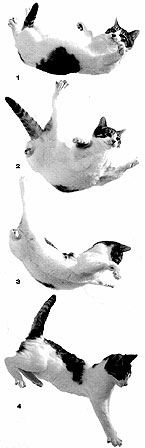
 Why does the cat always land on all four legs? Why do we keep on breathing, even if we sleep? This is the result of reflexes - automatic reactions that are not consciously controlled.
Reflexes can be varied, from simple like retreating hand in contact with a hot object, to more complicated ones, that help us maintain the balance. We are born with many basic reflexes, which we forget as we learn new activities. The reflex is triggered unconsciously by a certain stimulus.
A reflex has a three-segment path: analyzer (a sense organ or the skin), a nervous center, and an executer, muscle or gland. Conscious actions are not reflexes, as there is an analysis stage in between, the response being influenced by experience, mood, wishes, and so on. This means that at different moments, a stimulus will induce various reactions, but the same reflex.
A conscious reaction is more powerful than a reflex: we can keep our hand over a hot stove, but only with a conscious effort. Thus, the reflexes are quick methods that protect us against harmful stimuli. Some important reflexes, like breathing, can be consciously impeded just for short periods of time.
Reflexes can be varied: they control the muscles' movements, the body's basic functions and orientation. Some reflexes are well determined reactions to dangerous or frightening situations. Muscular reflexes, tested by hitting the knee with a little hammer, are caused by the perception of the vibrations by specialized receptors from the muscle. Signals reach the spine, and the motor neurons will make the muscle jump. These reflexes are controlled by the vegetative nervous system, controlling the muscular tonus so that the body is always ready for action. The spinal reflexes can be more rapid, controlled by the sympathetic nervous system, or slower, controlled by the parasympathetic nervous system. The same mechanism is connected to the pain stimuli, the body reacting rapidly to the application of these stimuli.
We talked about how cats fall. Similarly, if we slip on ice, the body twists rapidly trying to regain its balance, while the hands are pushed laterally to avoid falling. These complex reactions employ brain compartments, like receptors for balance in the inner ear. These receptors transmit information about our position to the cerebellum and this one transmits orders to the limbs' muscles.
The speed of the movement is much higher in the case of reflexes, compared to when we have to consciously establish our position. Newborn babies have many reflexes, which they lose afterwards, but others are learned later. The newborn will empty its bladder of urine each time it feels pressure. As it grows, the child learns to control this reflex. But even adults cannot control this endlessly. Reflexes like urination or breathing can be controlled for a while, others are completely involuntary, like the heart beat.
The behavioral reflexes are the most complex ones. The most famous is "fight or flight" in situations of crisis. If a robber attacks us, we flee or decide to fight him. The body's requirements are the same in both situations, especially heart beat and breathing rates, pumping more oxygen and glucose through blood to the muscles. Abundant sweating allows the body to cool down during the flight or fight, and the skin becomes paler, because a lot of blood is pumped in the muscles. These reflexes can appear even when we just think about something frightening or threatening, being part of the conditioned answer and are determined by the sympathetic system, while the functions return to normal due to the parasympathetic system.
The conditioned reflex is produced by a stimulus different from what produced it initially (naturally), which is now associated with the new stimulus. You may have learned about Pavlov's famous experiments, with the dog salivating each time it heard a bell ring, which in time it associated with dinner. These associations between food and sound appeared in time. Animal training is based on conditioning the animal.
Reflexes save time and mental energy in situations which require speed and quickness, especially when our life is threatened. In medicine, checking the muscle reflexes allows the doctors to determine eventual nervous system issues.
Some reflexes are less important. People can live without the muscular reflexes. But the reflex of maintaining the posture is very important. Imagine you'd have to continuously focus on maintaining your balance. If the blinking reflex is lost, the eye will be harmed by particles gathering on its surface and which cannot be removed. Losing the breathing reflex is probably the most dangerous, especially when we sleep (then the voluntary breathing does not work).