 14 DAY TRIAL //
 Brown dwarf stars are the coldest class of failed stars in the universe, some of which weighing as little as 3 percent of the mass of the Sun, insufficient to start nuclear fusion reactions in their core, thus being unable to generate their own internal energy. Just like with gas giants, observations regarding the mass of such objects are critical for theoretical predictions, therefore with the help of the Hubble Space Telescope and the Keck Telescope astronomers have measured for the first time the mass of the coldest brown dwarf star.
"Mass is the fundamental parameter that governs the life-history of a free-floating object, and thus after many years of patient measurements, we are delighted to report the first masses of the very faintest, coldest brown dwarfs. After weighing these tiny, dim, cold objects, we have confirmed that the theoretical predictions are mostly correct, but not entirely so", said Dr. Michael Liu from the Institute for Astronomy at the University of Hawaii.
Brown dwarf stars are believed to be the transitional objects linking gas giant planets and stars. Since they are so cold (about 400 degrees Celsius), brown dwarfs can only emit energies about 300,000 times lower than that of the Sun, enough nonetheless to make themselves noticed from outside the solar system. "Astronomers have measured the energy output and temperatures for a myriad of brown dwarfs. However, the most important property of all is the hardest one to measure - the mass.", said Dr. Michael J. Ireland from the University of Sydney, who also participated in the study.
The mass of brown dwarfs can be extracted from observations regarding binary brown dwarf systems, since the orbital movement of celestial objects is in direct relation to their mass. "These are very challenging measurements, because brown dwarf binaries have tiny separations on the sky and orbit each other very slowly. We needed to obtain the sharpest measurements that are possible with current telescopes to precisely monitor their motion", said Mr. Trent J. Dupuy from the Institute for Astronomy at the University of Hawaii.
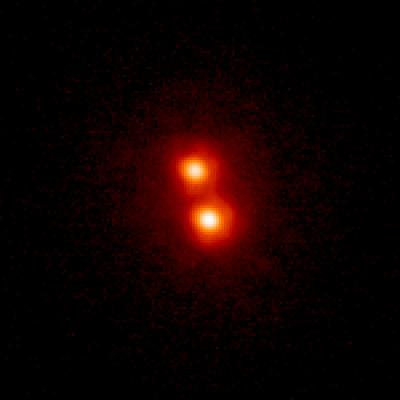
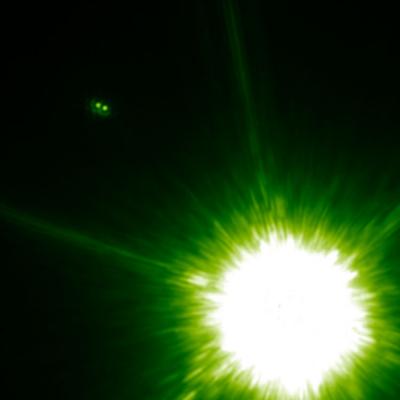
Using the 10 meter Keck II Telescope of Mauna Kea, thus benefiting from a powerful adaptive system used to counter the turbulence of the planet's atmosphere, and the Hubble Space Telescope, the researching team was able to measure the characteristics of the orbital movement of two brown dwarfs in a binary system, dubbed 2MASS 1534-2952AB, consisting of two methane brown dwarfs with masses of about 6 respectively 3 percent of that of the Sun. Another system, dubbed HD 120948BC, was shown to contain two objects with masses of about 11 and 5.5 percent of the mass of the Sun.
Currently existing models used to predict the masses of brown dwarfs mostly rely on the energy output and temperature parameters of the star, although the new measurement showed that the theoretical models do not correspond with the observations, since the temperature of one of the binaries was much lower in relation to the energy output, while the other binary was warmer.
"While there is general agreement between our data and the predictions, something is not quite right with the theoretical studies of brown dwarfs, either in determining their temperatures or in predicting their energy output. Or perhaps both. These findings will be a challenge for the theorists, and we are inspired to measure the masses of more brown dwarfs in the coming years to better understand the problem", said Dr. Liu.