 14 DAY TRIAL //
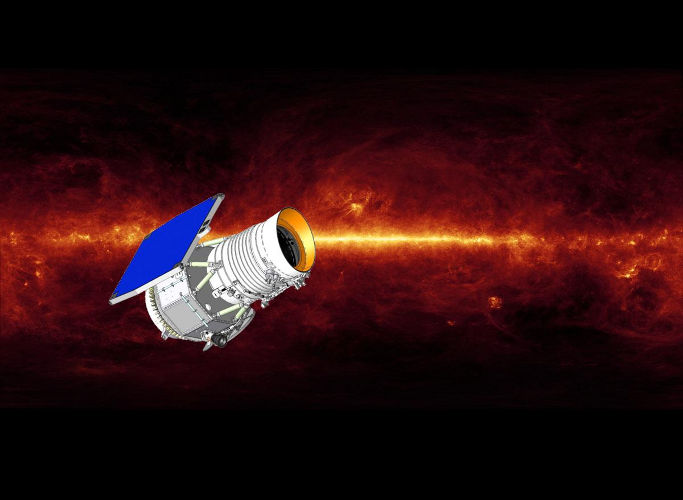
 NASA announces the its WISE mission is currently getting warmer. The Wide-Field Infrared Explorer is being cooled to chilling temperatures via liquid hydrogen, but supplies are now running out, and there is no way to resupply the spacecraft.
In order for infrared observatories to be sensitive to even the most remote heat signatures, they need to be cooled to lower temperatures than the object they are trying to “see.” The closer the telescope is to absolute zero, the more obscure objects it is able to make out in the distant Universe.
As such, when IR observatories exhaust their supply of liquid hydrogen, or whatever chemical they are using for the job, they lose sensitivity in their detectors. WISE recently experienced an elevation in temperature of only 34 degrees Fahrenheit, but one of its detectors is already useless.
The nominal operating temperature of WISE is 12 Kelvin, or minus 438 degrees Fahrenheit. Now, as the outer coolant tank is depleted, temperature levels have climbed to 31 Kelvin (minus 404 degrees Fahrenheit), which disabled the longest-wavelength band most sensitive to heat.
The loss comes just after the telescope completed its primary objective, which was to produce a map of the Universe at IR wavelengths, to a depth of 7 overlapping image frames. This important milestone was achieved on July 17, 2010. The mission has generated more than 1.5 million images so far.
Experts at the NASA Jet Propulsion Laboratory (JPL), in Pasadena, California, announce that the primary, inner coolant tank still has a healthy supply of hydrogen. They add that the functionality of the other IR instruments on the telescope will not be impaired any time soon.
The JPL experts, who manage the mission, say that the observatory has discovered numerous celestial bodies and structures, including 29,000 new asteroids, 100+ near-Earth objects (NEO), and 15 comets. At this point, WISE is involved in conducting its second scan of the Universe.
Scientists hope that this will allow them to discover more cosmic structures, and that it will also help confirm some of the findings from the first survey. It's currently unclear whether the Explorer will have enough coolant to complete the second survey, but experts want to get as much of it as possible done before hydrogen coolant runs out.