 14 DAY TRIAL //
 Over the past few years, the range of potential applications for laser devices has increased exponentially, and some scientists now even envision outfitting certain types of aircraft with them, so that they could directly communicate with friendly submarines and also hunt for enemy ships. When a laser beam hits the water, it detonates and creates several small supersonic “booms,” which could constitute the basis of the future communication system. Additionally, these tiny explosions could also be used as a sonar, for hunting enemy subs that may be trespassing on national territory.
“The lasers we're using in experiments now are pretty compact. They're smaller than desk-sized and could fly on an aircraft,” LiveScience quotes US Naval Research Laboratory Physicist Ted Jones as saying. The expert also believes that traditional communication devices, such as radios, are beginning to become ineffective, and are also exposing submarines to an increased risk.
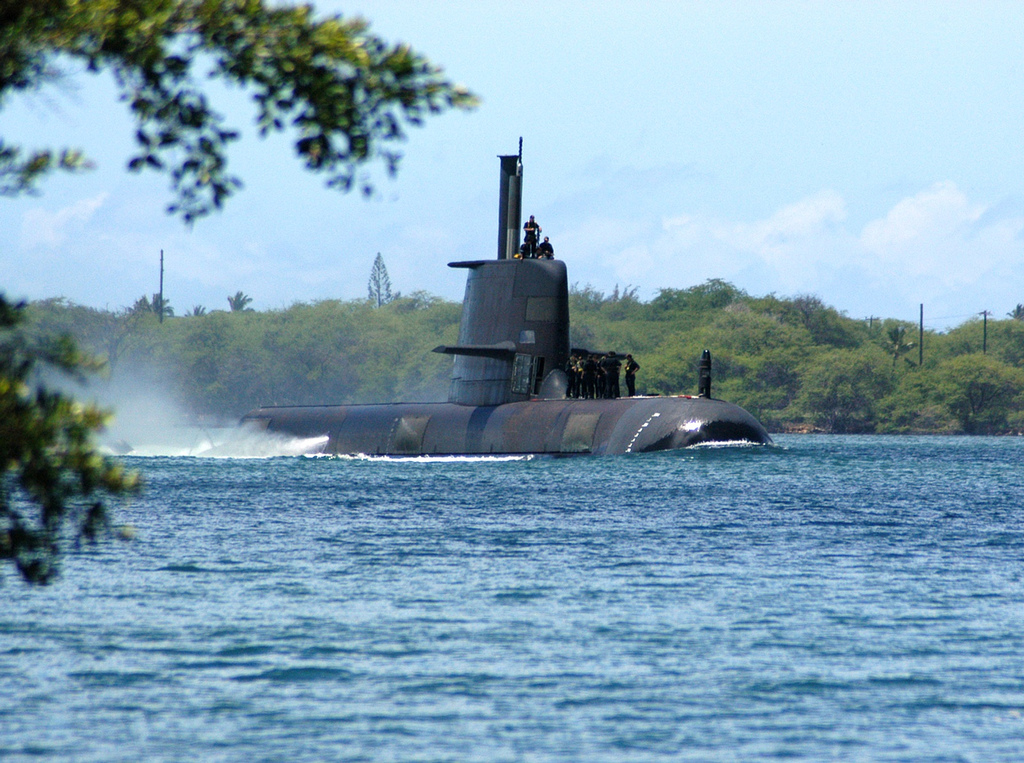
Whenever an underwater boat wants to radio to mission command, or to its fight group, it has to surface, which exposes it to enemy attacks. What the new method will do is basically ensure that this necessity is surpassed.
While electromagnetic communication devices do not work underwater, because the liquid is a poor conductor of their operating frequencies, lasers can penetrate a very high depth, while at the same time gaining strength. That is to say, certain polarizations and wavelengths of laser light are used, which get more focused in the water.
With the liquid forcing the beam on itself, the area around it becomes shortly overheated, expands into a super-hot bubble, and then explodes. “It's a very hot little bubble of Steam that expands supersonically, makes a little shock wave, dissipates a bit and then turns into an ordinary acoustic pulse,” the expert adds for the publication.
As far as detecting other boats go, the system would work fairly simple: a network of sonar buoys would be dropped over a certain area, and then the same plane could use the laser to scout the depths. When an anomalous sound is heard, it may be the indication that something is lurking under the waves.
But the project has come under attack from environmentalists, who are worried that the intensely loud “booms” could endanger and even kill marine animals in the area. The fact that dolphins and whales use echolocation to communicate and position themselves in the water is well known, and it's precisely disturbances in the natural noise of the ocean that are triggering massive stranding events in New Zealand and Tasmania each year. A noise louder than 210 dB, as the scientists want to use, could virtually destroy their ears altogether, or make them deaf in any case.