 14 DAY TRIAL //
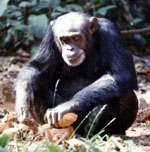
 In a finding that challenges a long-held belief regarding the cultural spread of tool use among chimpanzees, researchers report that chimpanzees in the Ebo forest, Cameroon, use stone hammers to crack open hard-shelled nuts to access the nutrient-rich seeds. The findings are significant because this nut-cracking behavior was previously known only in a distant chimpanzee population in extreme western Africa and was thought to be restricted by geographical boundaries that prevented cultural spread of the technique from animal to animal.
The findings, which involve the most endangered and least-understood subspecies of chimpanzee, are reported by Dr. Bethan Morgan and Ekwoge Abwe of the Zoological Society of San Diego's Conservation and Research for Endangered Species (CRES) and appear in the August 22nd issue of the journal Current Biology, published by Cell Press.
Prior to this discovery, it was thought that chimpanzee nut-cracking behavior was confined to the region west of the N'Zo-Sassandra River in Cote d'Ivoire. Because there are no relevant ecological or genetic differences between populations on either side of this "information barrier," explain the researchers of the new study, the implication had been that nut-cracking is a behavioral tradition constrained in its spread by a physical barrier: It was absent to the east of the river because it had not been invented there.
The new finding that chimpanzees crack open nuts more than 1700 km east of the supposed barrier challenges this long-accepted model. According to the authors of the study, the discontinuous distribution of the nut-cracking behavior may indicate that the original "culture zone" was larger, and nut-cracking behavior has become extinct between the N'Zo-Sassandra and Ebo. Alternatively, it may indicate that nut-cracking has been invented on more than one occasion in widely separated populations.
This is one of the first reports of tool use for Pan Troglodytes vellerosus, the most endangered and understudied chimpanzee subspecies. It highlights the necessity to preserve the rich array of cultures found across chimpanzee populations and communities, which represent our best model for understanding the evolution of hominid cultural diversity. As such, the new finding promises to both benefit research and inform the conservation of our closest living relative.