 14 DAY TRIAL //
 Rather than carrying their own protection devices, astronauts visiting the Moon could benefit from the protective effect of the so-called deflector shield protecting certain areas of the lunar surface. Localized magnetic fields are responsible for this protective effect, but not much is known about them.
They were discovered during the Apollo missions, when scientists found swirling patches of soil that were lighter in color than their surroundings. Some of these features were tens of kilometers across.
Subsequent studies demonstrated that they were most likely caused by localized magnetic fields. In a new study, experts at Center for Fundamental Physics and RAL Space at the Rutherford Appleton Laboratory (RAL), in the UK, looked at how these magnetic fields work.
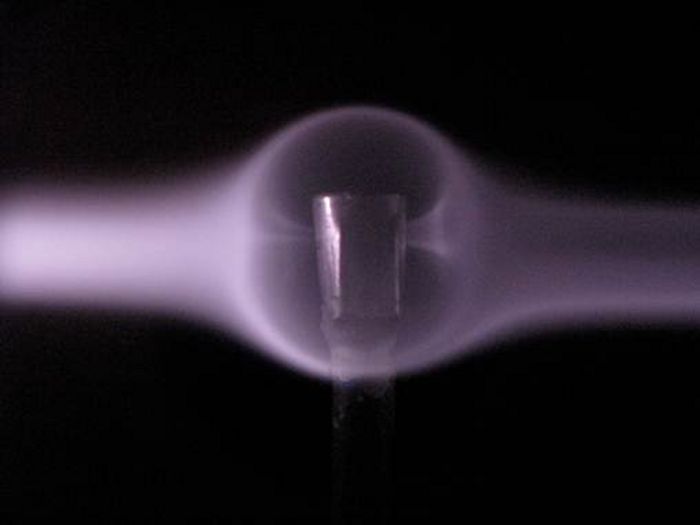
Using a combination of real-life data and computer models, they were able to figure out that these areas of the lunar surface are, in fact, capable to deflecting some of the solar radiation that normally bathes the surface, on account of the fact that the Moon only has a tenuous atmosphere.
However, the study produced some unexpected conclusions. “When we first tried the experiment in the Solar Wind Tunnel and it worked, it was very exciting. The active force which deflect the solar wind particles is electric not magnetic,” RAL Space lead scientist Dr. Ruth Bamford explains.
“The electric field is created naturally by the edges of the moon's magnetic 'bubbles.' What matters is the 'gradient' in the magnetic field, rather than the overall size of the magnetic bubble. So they can be as small as you like – as long as the gradient is steep enough,” he goes on to say.
Learning more about these mini-magnetospheres could enable scientists to develop a way of manipulating and amplifying them, with potential applications for space exploration. As humanity is pondering the establishment of a lunar base, such studies are becoming increasingly important.
If successful, these investigations could see astronauts taking cover from solar winds on the lunar surface, without being confined to caves, as previously planned. Interestingly, the same principles could be applied to spacecraft heading to other worlds, such as the Red Planet.
“We still need to determine quite how effective this mechanism would be at deflecting the real hazardous higher energy particles. The jury is still out on that one, but such an active shield could make the difference between survivable and certain death for astronauts on their way to Mars,” Bamford adds.
Details of the new study will appear in an upcoming issue of the esteemed scientific journal Physical Review Letters. The research was supported by RAL Space, Space Weather initiatives and the Center for Fundamental Physics.