
|
|
|
|
|
Ubuntu 9.04 Boots in 21.4 SecondsWith EXT4 as the default filesystem. |
|
| |
There are only two days left until the third Alpha version of the upcoming Ubuntu 9.04 (Jaunty Jackalope) will be available
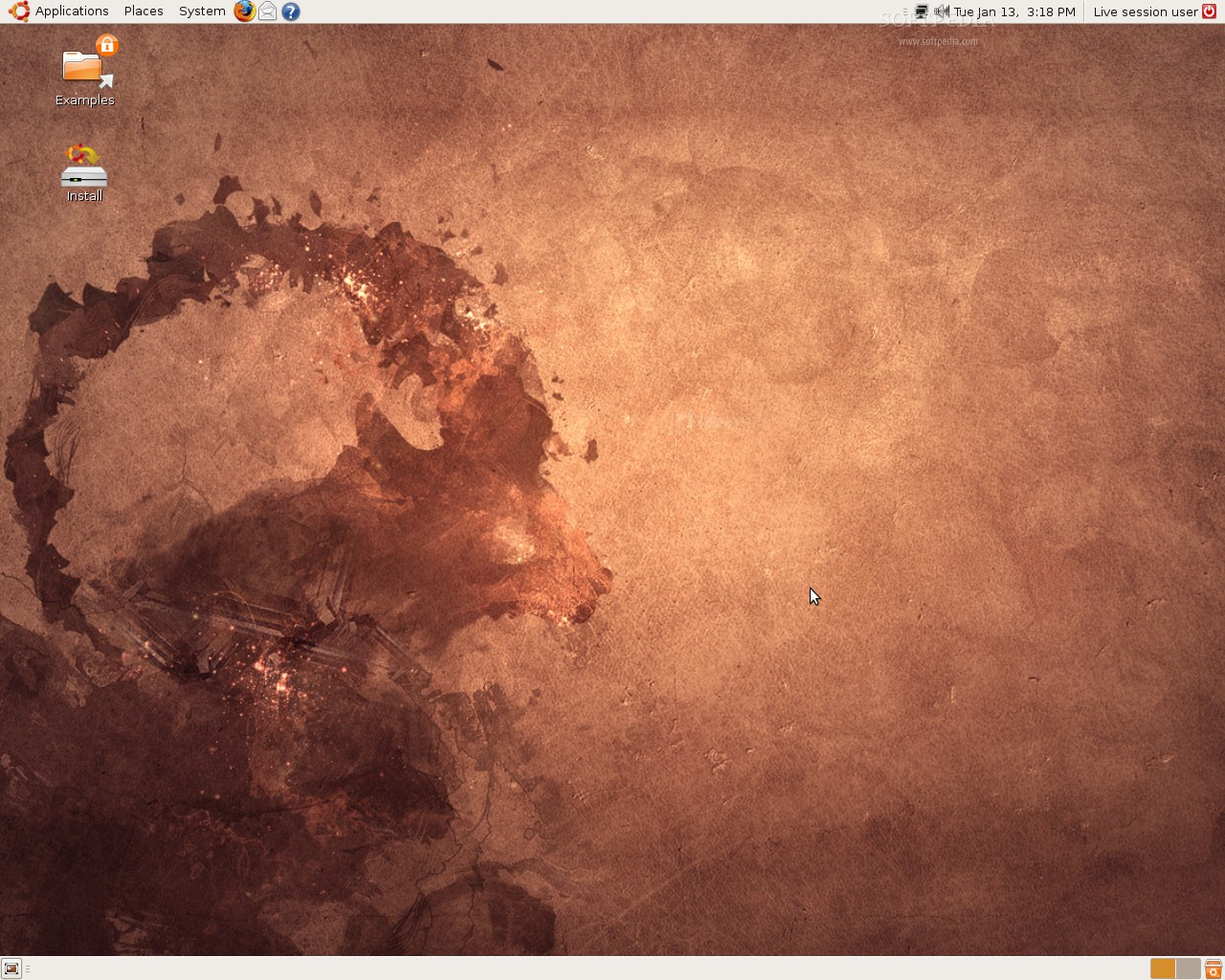
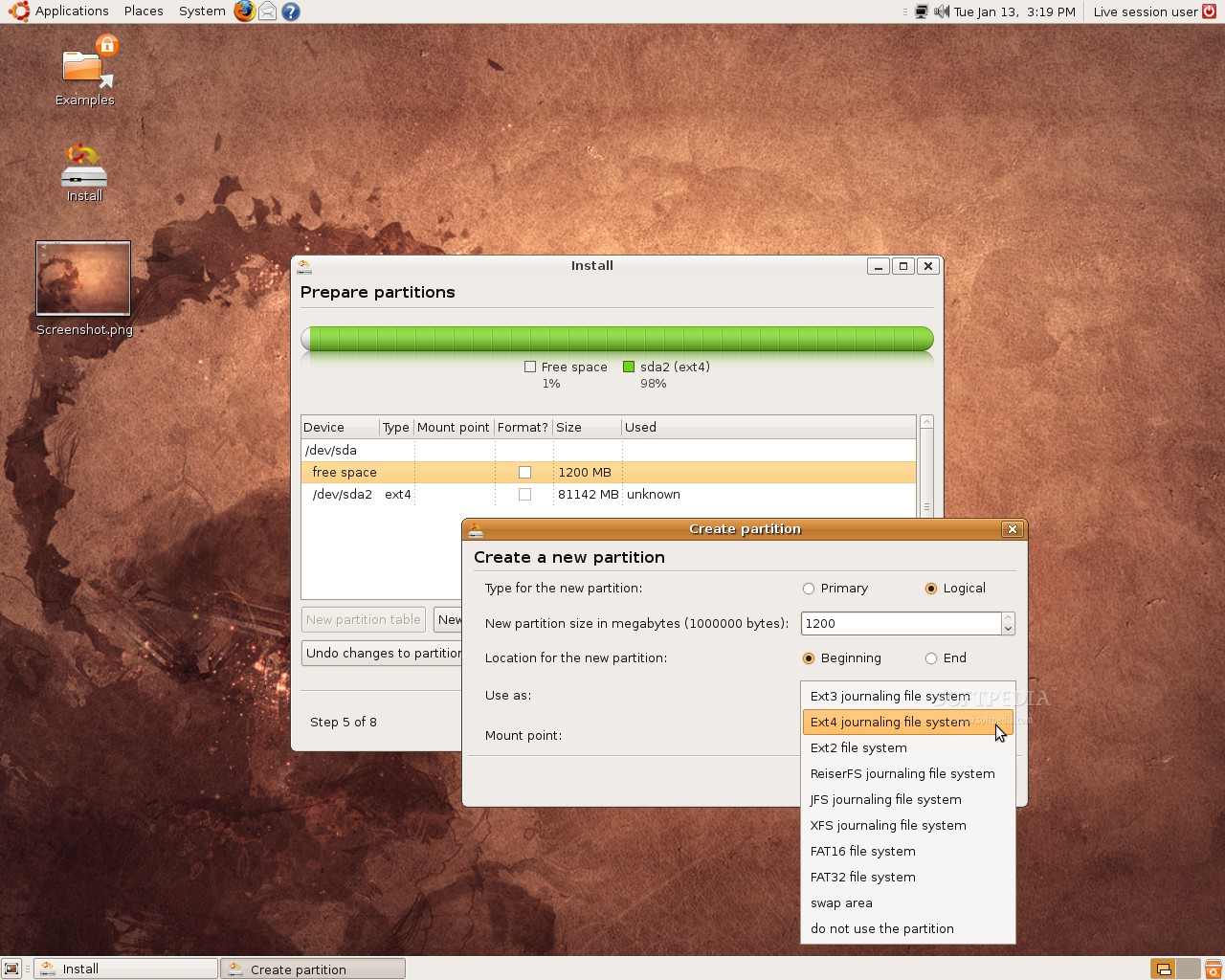
(for testing), and... we couldn't resist the temptation to take the current daily build for a test drive, before our usual screenshot tour, and taste the "sweetness" of that evolutionary EXT4 Linux filesystem. Announced on Christmas Eve, the EXT4 filesystem is now declared stable and it is distributed with version 2.6.28 of the Linux kernel and later. However, the good news is that the EXT4 filesystem was implemented in the upcoming Ubuntu 9.04 Alpha 3 a couple of days ago and it will be available in the Ubuntu Installer, if you choose manual partitioning (see the screenshot below for details). The bad news is that EXT4 will not be the default filesystem for the Ubuntu OS until version 9.10, due for release in late October this year. OK, OK... so how will the end user benefit from this EXT4 filesystem? Well, first of all, the whole system will be much faster and more reliable compared to one with EXT3 (I guess that some of you still remember the Firefox/Ext3 issue), it will boot faster (the current article proves that) and it's able to handle files with sizes of up to 16 TB (terabytes). But these are just a few of the features brought by the fourth extended filesystem, for more details you can check the Wikipedia entry for EXT4. We've tested the boot process of a default Ubuntu 8.10 and 9.04 Alpha (Build 20090112.1) installation on two machines, an AMD Sempron 1.8 Ghz, 80 GB IDE hard drive with 512 RAM DDR and an Intel Core 2 Duo E4300 running at 2.2 Ghz, 250 GB SATA hard drive with 4 GB RAM DDR2. Here are the results of our tests: · Ubuntu 8.10 with EXT3 filesystem boots in 31.8 seconds ( on the AMD Sempron system); · Ubuntu 9.04 Alpha (Build 20090112.1) with EXT3 filesystem boots in 28.3 seconds ( on the AMD Sempron system); · Ubuntu 9.04 Alpha (Build 20090112.1) with EXT4 filesystem boots in 23.1 seconds ( on the AMD Sempron system). · Ubuntu 8.10 with EXT3 filesystem boots in 26.8 seconds (on the Intel Core 2 Duo system); · Ubuntu 9.04 Alpha (Build 20090112.1) with EXT3 filesystem boots in 24.5 seconds (on the Intel Core 2 Duo system); · Ubuntu 9.04 Alpha (Build 20090112.1) with EXT4 filesystem boots in 21.4 seconds ( on the Intel Core 2 Duo system)! The boot times were calculated from the moment the GRUB boot loader appeared on the screen and until the login manager was displayed. As you can see, there is an approximately 8.7 second difference between an Ubuntu 8.10 (Intrepid Ibex) installation and an Ubuntu 9.04 Alpha (Jaunty Jackalope) one on the first system and 5.4 second difference on the second system. But this does not stop us from hoping that the boot times will decrease even more until the final version of Ubuntu 9.04 hits the streets. Currently, EXT4 can only be applied from the text mode installation of Ubuntu 9.04 (the Alternate CD). Don't forget to check our website on Thursday for the screenshot tour of Ubuntu 9.04 (Jaunty Jackalope) Alpha 3 when we will reveal even more goodies from the Ubuntu land. Later Edit: We apologise for not having listed all the results of our tests. Therefore, we've added the missing two tests: Ubuntu 8.10 and Ubuntu 9.04 Alpha (Build 20090112.1) with EXT3 on the Intel Core 2 Duo system.
|
|
| Article rating: |
|
Very Good (4.3/5) |
54 vote(s) |
|

|
|
|
User opinions: |
| Comment #1 by: Mo on 13 Jan 2009, 20:36 GMT | reply to this comment | This is awesome, can't wait for 9.04 to be released. |
| Comment #1.1 by: Jeremy Gates on 14 Jan 2009, 13:24 GMT | That's nothing; my windows 7 system with an amd64 3800 (single core) boots in 13 seconds from the post screen to the desktop... |
| Comment #1.2 by: LNader on 14 Jan 2009, 15:30 GMT | *Grin* "Mr. Gates" here is defending Windows 7...
Guess someone has to. :P |
| Comment #1.3 by: WindowsFoo on 15 Jan 2009, 04:09 GMT | Yeah, so windows 7 loads much faster, so that all of those boot sector viruses and Tojans can get to work much faster than in XP or Vista! :) |
| Comment #1.4 by: Andy Fong on 15 Jan 2009, 19:58 GMT | I notice windows starting from XP boots pretty fast but it basically just put up a picture on you desktop to make you think it's booted up. Anything you try to do on the first few minutes will only give you the hour glass. |
| Comment #1.5 by: BooYaa on 16 Jan 2009, 04:51 GMT | See when Ubuntu finishes booting it's actually done. When Windows finishes booting you've got to wait another couple of minutes while all the other crap starts.
A brand new XP PC boots nice and fast, 3 week later it's pretty sluggish, 1 year later it's slow as a dog, 2 years later you're reinstalling.
Not a fan boy just a user of both OSes |
| Comment #1.6 by: Robasauras on 16 Jan 2009, 04:58 GMT | Thats because Windows 7 is beta with 90% of the crap missing until release. |
| Comment #1.7 by: Arup on 03 May 2009, 03:43 GMT | Windows fast boot is a misnomer, the acutal test should be about functional desktop, if you remove the start delay from grub, Jaunty will take you to a functional desktop way quicker than Windos 7, in case of Windows, once the AV and other start up stuff loads, it crawls to a halt and in case of Linux, thats not the case as by the time you have come to your desktop, everything is functional, thats the real world test. |
| Comment #2 by: dragonbite on 13 Jan 2009, 20:53 GMT | reply to this comment | Ever since I read that boot-up times were going to be a focus of Jaunty, I have held off from upgrading until Jaunty on my laptop! |
| Comment #3 by: Brett Dreher on 13 Jan 2009, 21:14 GMT | reply to this comment | Nice article, I remember when I was reading I believe Shuttleworth's blog where he mentioned that Jaunty will be extra quick on bootups. Question though, what was the boot time of the intel Core2 system for both Ubuntu 8.10 and Ubuntu 9.04 with EXT3 enabled? It seems as if you only posted half the needed data with nothing to compare it to and would of been interested in how the new filesystem effects the faster hardware. Thanks. |
| Comment #4 by: Kynan on 13 Jan 2009, 23:49 GMT | reply to this comment | Yea this is great news! i love a fast bootup.
"Currently, EXT4 can only be applied from the text mode installation of Ubuntu 9.04 (the Alternate CD). "
hope that it will be a nice graphical gui to install EXT4 by the time the full release is out and fingers crossed for a really nice theme to replace the well outdated Human theme. If Ubuntu can manage to do this properly and professionally it should make for a very impressive release! |
| Comment #5 by: santi on 14 Jan 2009, 02:39 GMT | reply to this comment | You should also include the 8.10 boot times on the Intel Core 2 Duo system. You can't put the Intel machine times in the same bag as the timer of the AMD... |
| Comment #6 by: tmsbrdrs on 14 Jan 2009, 04:18 GMT | reply to this comment | Did anyone else drool? I swear that article should've come with a bib. |
| Comment #7 by: Ian on 14 Jan 2009, 05:11 GMT | reply to this comment | Impressive, but my install of Windows 7 boots in 18... |
| Comment #8 by: bob on 14 Jan 2009, 07:33 GMT | reply to this comment | its not really a 10s difference when you are comparing two separate builds on two separate systems, if you compared the beta w/ 8.10 on the core 2 duo with ext3 vs ext4 then it would be safe to assume such, but that's not the case
AMD sempron v Intel C2D is not a fair fight |
| Comment #9 by: marc on 14 Jan 2009, 08:50 GMT | reply to this comment | That's crap, I am using arch linux. I boot in 13sec. |
| Comment #9.1 by: Shane Kerns on 15 Jan 2009, 20:54 GMT | Anyone who can build a custom tight kernel on linux will be able to boot really fast. I use Slamd64 (64bit Slackware) and my boot time blows any ones mentioned boot time out of the water. 7seconds on Slamd64 and even without a custom kernel it was 9seconds. |
| Comment #9.2 by: Rasalon on 07 Apr 2009, 20:26 GMT | My Pentium1 166MHz running Slackware boots in under fifteen seconds.
No initrd, all kenrnel modules compiled in, virtually no init scripts.
If you really need fast booting on Linux, you get it. |
| Comment #10 by: pacmania1982 on 14 Jan 2009, 09:31 GMT | reply to this comment | 1TB is NOT 1000GB - why oh WHY do people believe this rubbish. Its 1024GB
It pisses me off that hard drive manufacturers can get away with this, so you buy a 1TB drive and actually you only have 937GB, its not fair, and its not right. No one else would get away with it |
| Comment #11 by: António Oliveira on 14 Jan 2009, 09:49 GMT | reply to this comment | This is great! I can't wait!!! |
| Comment #12 by: ceadda on 14 Jan 2009, 09:51 GMT | reply to this comment | Actually, TB, terrabyte, IS 1000GB.
And GB, giggabyte IS 1000MB
The proper but rather unused terms for the 1024 versions of these capacities is actually TiB and GiB.
Standing for Tebibyte and Gibibyte.
So stop correcting the correct article. |
| Comment #13 by: Tris on 14 Jan 2009, 10:08 GMT | reply to this comment | Good point pacmania2. Definitions of size are very subjective
No-one argues that 1KB is 1024 bytes. However, is 1MB, 1,000,000 bytes (as the name implies), 1,000KB or 1,024KB?
Step that up to GB and you could have: 1,000,000,000 bytes, 1024 MB, 1,000 MB, 1,000,000 KB, 1,024,000 KB etc. All of which are different. Too awkward
I kinda agree with the HD manufacturers that 1 Megabyte is a million bytes (1,000,000). I think it's bizarre that operating systems deal in base 1024.
That aside, always look forward to a new Ubuntu. It does grate having to do a rebuild twice a year but that's no bad thing. Always get a nice, fresh install.
Interesting to see that other distros and Windows 7 are booting that fast. How much ground can they make up by April? |
| Comment #13.1 by: clay on 30 Jan 2009, 04:00 GMT | The reason for that is because computers use transistors, which have two states: off-0 and on-1 this is a base 2 system, or binary. That is how information is stored, one 1 or 0 is a bit and there are 8 bits in a byte, 1024 bytes in a MB and so on. 2*2=4 4*2=8 *2=16 *2=32....64, 128, 256, 512, 1024.
Not the best explaination but at least the information is correct.
And 1 MB is 1024 KB |
| Comment #14 by: Me Again on 14 Jan 2009, 10:27 GMT | reply to this comment | @ceadda: the article is not correct. Ext4 actually supports files up to 16TiB in size.
1TB is 1024GB, but, because hard drive manufactures sometimes think otherwise (depending on how it suits them better), the TiB (and related) was invented, just to make it absolutely clear. |
| Comment #15 by: Woody on 14 Jan 2009, 11:16 GMT | reply to this comment | My mac boot in 14.34 seconds only using 11GB though so. |
| Comment #15.1 by: Bill on 15 Jan 2009, 16:34 GMT | Nobody cares about your Mac. At least until Apple opens their OSX codebase so we can fiddle with it (and I don't mean Darwin). Or at least allow us to ubiquitously install it on everything from a watch to a supercomputer (especially one that doesn't have a bitten apple on it). The topic here is improvements to our favorite open source OS. I am excited to see the improvements to Ubuntu. |
| Comment #16 by: Miles on 14 Jan 2009, 11:59 GMT | reply to this comment | Great. Now, if only the boot time BEFORE Grub could be worked on by manufacturers… The BIOS takes ages to boot on my Asus P5K motherboard. |
| Comment #17 by: Don on 14 Jan 2009, 12:02 GMT | reply to this comment | Tris,
You would under stand why 1GB = 1024MB if you learned some history about computers and base 2 numbering systems a.k.a. binary. each place in the binary numbering system is double of the previous place. e.g. 0 1 2 4 8 16 32 64 128 256 512 1024. and there you have why 1GB =1024MB. have a nice day. |
| Comment #18 by: Hamburger1984 on 14 Jan 2009, 12:11 GMT | reply to this comment | some clarification on the TB/TiB issue: http://xkcd.com/394/ |
| Comment #19 by: Marius Nestor on 14 Jan 2009, 13:01 GMT | reply to this comment | Regarding the TB, TiB issue...
From Wikipedia (http://en.wikipedia.org/wiki/Terabyte)...
# According to the SI standard usage, a terabyte (TB) contains 1,000,000,000,000 bytes = 10004 or 1012 bytes.
# According to binary arithmetic, a terabyte contains 1,099,511,627,776 bytes = 10244 or 240 bytes. Ambiguity can be avoided by using the term "tebibyte" when the binary meaning is intended.
We've modified the article accordingly.
P.S.: I don't think any of us will use such gigantic files in the near future :) |
| Comment #20 by: senyo on 14 Jan 2009, 14:09 GMT | reply to this comment | hey this is gonna be tight, even the 8.10 boots fast so the announcement of another one that would faster is really a hit.Linux really rocks. |
| Comment #21 by: arnox on 14 Jan 2009, 15:54 GMT | reply to this comment | This is fantastic news, BUT I'd like to point out that our web server which runs Ubuntu 7.10 64 (4 cores, 8GB ram, 2TB raid5), hasn't been rebooted in over a year :-)
I think it's worth mentioning that Windows would benefit from this feature more then linux. We don't need to reboot all the time :-) |
| Comment #22 by: carolinason on 14 Jan 2009, 18:01 GMT | reply to this comment | My 7 year old pc running Debian boots in 15 seconds, I guess ext4 should take that down to about 11 or 12. |
| Comment #23 by: Simon on 14 Jan 2009, 18:02 GMT | reply to this comment | Who cares about windows 7 beta. When MS eventually ship it, and you have paid out another small fortune to have the system vista was sold to be, then you can start to quote some time comparisons.
Booting to desktop means been able to actually use the device, not staring at a desktop screen while the system is still loading. Does your time take the virus scanner load into account too. |
| Comment #25 by: Brian Culler on 14 Jan 2009, 18:09 GMT | reply to this comment | Guess I'm the only one who doesn't care about boot times. Isn't the whole point of linux that you don't have to reboot it? :p
So what if it takes 20 seconds or 30 seconds to boot... I only should boot it once every couple of years :) |
| Comment #26 by: SgtNasty on 14 Jan 2009, 18:10 GMT | reply to this comment | umm freedos boots up in 5.5 seconds |
| Comment #27 by: name on 14 Jan 2009, 19:25 GMT | reply to this comment | i hope someday day stop doing whatever they are doing and start fixing the 40000 something bugs they have open, maybe then they can call it a real OS |
| Comment #28 by: Blaque on 14 Jan 2009, 19:31 GMT | reply to this comment | Why are we worried about boot times? Who's rebooting their Linux box enough to really worry about it? This is something the Windows folks have to worry about. |
| Comment #29 by: noone on 14 Jan 2009, 19:36 GMT | reply to this comment | 1k = 1000 so 1TB actually are 1000GB
what you mean is 1KiB = 1024GiB |
| Comment #30 by: Nick on 14 Jan 2009, 20:20 GMT | reply to this comment | Even though ext4 won't be the default FS in 9.04 - to my understanding all that is needed is to change the ext3 in the /etc/fstab file to ext4 and reboot, that then will go faster :-), and then your FS will be "converted" to ext4. |
| Comment #31 by: Andrew on 14 Jan 2009, 20:58 GMT | reply to this comment | Its called a file-system and it uses space. |
| Comment #32 by: Lubi on 14 Jan 2009, 21:29 GMT | reply to this comment | The problem is that booting the Bios is too slow... |
| Comment #33 by: mustafa on 14 Jan 2009, 22:19 GMT | reply to this comment | k = kilo = 1000^1
m = mega = 1000^2
g = giga = 1000^3
t = tera = 1000^4
so 1 terabyte = 1.000.000.000.000 byte
ki = kibi = 1024^1
mi = mebi = 1024^2
gi = gibi = 1024^3
ti = tebi = 1024^4
so 1 tebibyte = 1024^4 byte = 1024 gibibyte
harddisk manufacturers tell the truth. windows doesn't.
that is a common mistake, but it is. |
| Comment #34 by: NetSRL on 14 Jan 2009, 22:22 GMT | reply to this comment | Well i marked Ubuntu 9.04 to be next i will upgrade to cause i now have Ubuntu 8.04 and i cant wait for it. |
| Comment #35 by: Alex Launi on 14 Jan 2009, 22:34 GMT | reply to this comment | Who cares about boottime? It's the most worthless statistic in computer benchmarking, 10 seconds, 2 minutes, it doesn't matter. Why are people shutting down in the first place, this is why suspend was created. I know right now you're thinking, "but suspend doesn't work on my computer". Ok, SO FIX SUSPEND! |
| Comment #35.1 by: paul on 21 Jan 2009, 09:51 GMT | Boot times do count when you are working on a Notebook. Not that any Windows boot times interest me in the least, since I will not run such a virus laden OS on any of my personal machines (I do have to run VMs for testing of development work and that includes Windows).
Sp the answer to all of the "Linux users do not have to reboot", is do not forget about notebook users!! When the notebook has to go with you, you reboot! |
| Comment #36 by: Jimmy on 14 Jan 2009, 22:43 GMT | reply to this comment | Thats cool but I hope it's not handicapped like they did with XP. Boots to a logon screen fast but does not have networking so you just have to wait for all that to start up while attempting to logon.
Booting to a logon screen is not really usefull if all the time you gain just gets added to the logon process. |
| Comment #37 by: BUGabundo on 14 Jan 2009, 23:09 GMT | reply to this comment | I'm very far from those speeds!
http://fileland.bugabundo.net/fotos/Linux/bootchart
Can you please install Bootchar and share with us the result?
you can find the charts in: /var/log/bootchart/
thanks |
| Comment #38 by: JF on 14 Jan 2009, 23:26 GMT | reply to this comment | The problem with this comparison, is that most computers (besides linux) are not ready to go once they reach the login screen. You must log in, then wait for everything you have ever installed to start up before you can access your desktop.
Yes, I'm looking at you, Windows. |
| Comment #39 by: Scott on 14 Jan 2009, 23:36 GMT | reply to this comment | This really is great news. And people who leave their machines on, never needing to reboot (servers aside) don't you consider your electricity bill and the environment? Ah well, never mind. At least if you do ever need to reboot it should be fast in Jaunty. Bring it on! :-D |
| Comment #40 by: DrArkaneX on 15 Jan 2009, 00:15 GMT | reply to this comment | Uhm, we're talking about a desktop, not console. |
| Comment #41 by: john on 15 Jan 2009, 00:32 GMT | reply to this comment | my system already boot in 9 seconds..... on a simple centrino 1.4 mhz with 768mb of ram |
| Comment #42 by: Ken D'Ambrosio on 15 Jan 2009, 01:15 GMT | reply to this comment | No, it doesn't boot that fast. Windows 7 cheats -- in a way that's not altogether evil, but is, nevertheless, cheating. When one thinks about "booting" in the classical sense, one thinks "initialize all components and be ready for operation." Windows 7, instead, makes "booting" to mean "fire up the GUI... period." The device initialization is occurrig behind the scenes and may not be ready for some time after you're in the GUI. Want to do this with Linux? Simply change /etc/rc*/S30(g|k|x)dm to a lower number (e.g., "S01").
Bottom line: Windows' 7 "boot time" is marketing, not real. |
| Comment #43 by: vistabuntu on 15 Jan 2009, 03:33 GMT | reply to this comment | my vista x64 system is up for months at a time, honestly, boot times? who cares? If the system runs stable for a year solid, id gladly let it take a whole day to boot...
even on my linux eee i boot times are inconsequential, thats to be its like making cup holders a priority on your sports car |
| Comment #44 by: Niko B on 15 Jan 2009, 03:44 GMT | reply to this comment | Yeah, but Microsoft does weird things - like load services while you're in the desktop. Linux typically does this sequentially during boot up.
Maybe I'm wrong. Don't really care that much. It's difficult to make a proper comparison. |
| Comment #45 by: ranger on 15 Jan 2009, 04:57 GMT | reply to this comment | No. but the 8TB filesystem size limit of ext3 (on x86_64 at least) is already starting to hurt ... |
| Comment #46 by: Kanji on 15 Jan 2009, 05:15 GMT | reply to this comment | @noone
Read the comments before you post.
@name
I would love to see all of the windows bugs documented. That would be quite a list to check out. To bad most would be user errors and not real bugs.
@Nick
You have to be up late trolling. |
| Comment #47 by: Marius Nestor on 15 Jan 2009, 06:34 GMT | reply to this comment | For Nick: Nope! You need to format the partitition(s) or the whole hard drive with EXT4. |
| Comment #48 by: Deramin on 15 Jan 2009, 07:00 GMT | reply to this comment | I use Ubuntu on my laptop. Whenever I move I shut down the laptop to save battery and jarring my hard drive. XP on the same system boots so slowly when it hits the desktop (after trying to cut the crud down) that class is half way over before I can use the stupid thing. Even 8.10 boots fast enough for my laptop to actually be practical. I like that I *could* leave Ubuntu running forever if I need to, but of this device that's not going to happen. I'm really glad they're improving boot times even more. |
| Comment #49 by: MacroRodent on 15 Jan 2009, 07:27 GMT | reply to this comment | Note that comparing almost any of the other modern Linux fil systems with ext3 shows speedups! I have myself used ext3 and XFS on two different but very comparably-specced machines, and some operations in XFS are order of magnitude faster. It is especially noticeable when you delete on large directories (whether they have lots of files, or contain large files like ISOs).
It is just too bad ext3 has been the distro default. IMHO it is like running Linux with the handbrake on. Hopefully ext4 eventually becoming the default will fix this (but why couldn't the distros already have just used one of the better alternatives available for years?). |
| Comment #50 by: treloret on 15 Jan 2009, 08:27 GMT | reply to this comment | I used to have a PC, with 1MB of memory, no mibi/mobi/mibyte or whatever, 1 megabyte, (not exactly ofcourse, only 640KB base memory and such, and shadowed rom parts/BIOS data in the upper part), but to my computer's and my knowledge, that was 1048576 bytes, aka 1024KB. Which makes perfect sense for the base 2 system that PCs work with. That marketing will give you inflated numbers for HDDs or use mbit instead of megabyte doesn't make it true. |
| Comment #51 by: Marius Nestor on 15 Jan 2009, 08:35 GMT | reply to this comment | For Jimmy: Of course there is networking... and all the drivers :) After login, only the some of the GNOME services and applications start. |
| Comment #52 by: mippe on 15 Jan 2009, 08:51 GMT | reply to this comment | But will your windows 7 boot in 13 seconds after you've used it for a month? :] |
| Comment #53 by: RiotingPacifist on 15 Jan 2009, 10:51 GMT | reply to this comment | what about reiser or xfs , i know drinking the kool aid is nice but id bet that they still outperform ext |
| Comment #54 by: tux on 15 Jan 2009, 12:43 GMT | reply to this comment | your comparation is wrong. is not 10 sec. the diference between the ext4 and ext3, just is 3.1 (on the C2D system). you cannot compare a same thing in a difference systems, then you could say: in my 386 the ext4 boot in 60 sec and in my C2D 21.4: the difference is 40 sec.?? No |
| Comment #54.1 by: Marius Nestor on 15 Jan 2009, 22:11 GMT | Fixed |
| Comment #55 by: Exsecrabilus on 15 Jan 2009, 14:40 GMT | reply to this comment | I'm confused, did you say that the Ext4 filesystem can only be applied from the Alternate CD? Then what's that screenshot you've posted that shows you can apply it also from the Live CD?
Someone please respond and make this clear. |
| Comment #55.1 by: Marius Nestor on 15 Jan 2009, 15:09 GMT | The screenshot shows that the EXT4 filesystem is available as an option for the hard disk formatting procedure if you choose Manual partitioning. The problem is that Ubuntu 9.04 is in early Alpha stage and it doesn't allow you to format the hard disk as EXT4. You can choose to format a partition with EXT4, as you can see from the screenshot, but it will format it as EXT3. It is a bug, but it will be fixed until April, when the final version will be released.
At the moment, only the Alternate CD works... because it offers text-mode installation. We will reveal more tonight in the Alpha 3 Screenshot Tour! |
| Comment #56 by: Seb on 16 Jan 2009, 00:14 GMT | reply to this comment | YES a Tera is 1000 Giga as defined in the decimal system. As such
1TB = 1000GB
1024 is based on the binary system it's called a Tebibyte for Tera Binary byte and shoud be abbreviated TiB.
1TiB = 1024Gib
Then you are contradicting yourself. Assuming you were right and a Terabyte was 1024Gb. Hard drive manufacturers would be giving you more than a thousand. Not less.
Also formated capacity is a different things all together. A 1TB drive should be able to handle 1,000,000,000,000 bytes if you need 40 billion bytes for the files system then it's not the manufacturers fault. The file system itself also has to be stored. |
| Comment #57 by: Soumitra Sarkar on 16 Jan 2009, 05:42 GMT | reply to this comment | I'm confused, did you say that the Ext4 filesystem can only be applied from the Alternate CD? Then what's that screenshot you've posted that shows you can apply it also from the Live CD?
Someone please respond and make this clear. |
| Comment #57.1 by: Marius Nestor on 16 Jan 2009, 09:48 GMT | I just did.... look at the comment above! |
| Comment #58 by: Federico on 16 Jan 2009, 10:36 GMT | reply to this comment | @Jeremy Gates
Your Windows 7 machine boots in 13 seconds now. After one month of use it will boot in 40 seconds.
Windows gets worse day after day. Linux does not. |
| Comment #59 by: mariuz on 16 Jan 2009, 17:06 GMT | reply to this comment | i'm just migrating from intreprid to jaunty (to have an good grub and ext4 enabled kernel)
then i will upgrade the partition from ext3 to ext4
seems to be an better fs for large files too (see the phoronix articles and benchmarks) |
| Comment #60 by: james on 16 Jan 2009, 20:46 GMT | reply to this comment | WOW ! Let's see, if that improves to 10 seconds faster, and I boot up six times in a year, (which I don't), that is going to save me .....hmmm... MY GOD ! A WHOLE MINUTE ! |
| Comment #60.1 by: chai on 17 Jun 2009, 03:42 GMT | Reading this blog, I appreciate anything I may learn and thank people for valid info, but isn't there too much quibbling? It would be nice if that aggression and competitiveness could be tamed at some mutual cooperation instead of upsmanship-downsmanship. I like Ubuntu 8.1. I have Freespire 1 on an old desktop and like it's non-crashability but it's outdated and now I can't install over it because Grub pops up before I can get an install disk of SUSE, Ubuntu or anything else to get to the partitioning program or anything - ie, don't get to welcome screen.
QUESTION: IF SUCH A PROBLEM EXISTS, WILL A PURCHASED SOFTWARE PROGRAM THAT CLEANS OFF THE WHOLE DISC WORK, OR IS THERE A LESS EXPENSIVE WAY? i ERASED MY XP ON MY LAPTOP BY MISTAKE AND CAN'T GET LINUX TO INSTALL. IT'S A DELL LATITUDE C800 AND I HAVE SEEN OTHER PEOPLE SAYING THEY ALSO GET A DOUBLE SCREEN. WHEN I TRY TO INSTALL SUSE, (NEW INSTALL DISC) IT ALMOST RUNS LIVE BUT WON'T INSTALL.
ANY IDEAS 9AS OPPOSED TO QUIBBLETARIANISM? |
| Comment #61 by: sergei on 17 Jan 2009, 02:42 GMT | reply to this comment | Ubuntu does alot of hidden stuff. Other Linux dists are more open. |
| Comment #62 by: Felix on 18 Jan 2009, 01:37 GMT | reply to this comment | I have tested Jaunt Alpha 3 on my Dell Latitude Core 2 Duo 2.5GHz 2GB laptop.
Here are my results:
Start Auto-Login Shutdown
8.10 Ext3 38 60 19
Jaunty Ext3 26 54 17
Jaunty Ext4 24.5 49.5/51.5 17
Unfortunately the 8.04 partition is not a fresh install, so make whatever adjustment you want on that account.
However, Jaunty definitely looks faster than 8.10 (10%) and Ext4 looks faster than Ext3 (6.5%).
:-) |
| Comment #63 by: BUGabundo on 18 Jan 2009, 15:42 GMT | reply to this comment | please see comment #37, and redo the tests to show bootchart images
Thanks |
| Comment #64 by: Fekix on 19 Jan 2009, 09:34 GMT | reply to this comment | My boot chart is here:
https://wiki.ubuntu.com/BootCharting
It is the first entry in the Jaunty table a long way down the page (user: Felix).
The boot chart time shows 17 seconds which is obviously very different from the 24.5 seconds it takes to get to the login window, or the 50 seconds to get to 'Clock' i.e. gnome fully loaded and all tool bar items showing.
My boot chart time for 8.10 was 28 seconds.
(I didn't do boot chart for Jaunty on Ext3) |
| Comment #65 by: DUH on 20 Jan 2009, 18:42 GMT | reply to this comment | Well here is what I want to know. If there CPU is fairly quick and some decent ram like around a gig, what is there motherboards running at?? Im not seeing the speed of the motherboard or speed of the ram or speed of the hard drive. Big difference between 800 MHz and 1400 MHz on board speed. And who really cares if it boots in 9 sec or whatever, its hype to make people believe the OS is gonna operate at faster speeds. What they still don't tell you is if you don't know how to keep your system clean in any OS, boot up time is squat, which it is any ways. The more you install on it and make all this stuff run on start up, do you really think your boot up time is gonna stay at 9 sec? Personally I'm just tired of WINDOWS. It basically has the same look as WIN 95, just a few changes in graphics and the filing system. GEES. Why am I suppose to spend that kind of money on something that really hasn't changed a whole lot. Look at LINUX and all the different distros, now that would be something I would be willing to pay for cause its all different. But that is just me!! |
| Comment #66 by: atanok on 21 Jan 2009, 06:00 GMT | reply to this comment | #61: that's just them trying to make Microsoft users feel home. They couldn't quite get the malware support running yet, though.
btw, it's funny to see a Windows user experiencing with Ubuntu for the first times, afraid to do stuff that would usually end up with the system being bloated and infected.
Sounds like a mistreated slave released from captivity that still expects to be whipped on the slightest mistake. |
| Comment #67 by: khushil on 21 Jan 2009, 12:59 GMT | reply to this comment | I used to wait two hours for my C64 to load Rambo so I could play it on a Sunday afternoon. Sometimes I'd sit for hours typing out code listings to see a ball bounce around a screen and make a noise if it hit the edge. It doesn't' really matter how fast your boot time is, what really matters is how much fun you're going to have afterwards! I use Ubuntu, Debian, Windows and OSX and I use them all for different things. Speed is not everything, quality is. |
| Comment #68 by: Glowball on 21 Jan 2009, 18:31 GMT | reply to this comment | Well, actually, that's not right. 1 TB = 1000 GB. 1 TiB = 1024 GB.
Hard drive manufacturers work with TB, your pc with TiB. So 1 TB will be 931 GiB.
Oh, ontopic: Seems nice ^^ |
| Comment #69 by: at on 24 Jan 2009, 21:19 GMT | reply to this comment | Well. If you would check the history a bit you will get an understanding why the GiB etc was invented..
In the beginning hd-manufacturers also used 1024 for calculating the size. Then a number of years ago it seems like some sales-person got the bright idea to make the drives sound larger and they started to use 1000 and it's been like that since then.
I HATE the new GiB standard for something that should not be needed just because the hd-manufacturers started to calculate the size in a different way. Computers always deals in binary and the largest number you can get with 10 bits is 1024. learn to deal with it! :) |
| Comment #70 by: Will on 26 Jan 2009, 16:23 GMT | reply to this comment | Windows 7 does not boot in 13 seconds. Not even in a vm would it boot that fast. |
| Comment #71 by: robbie enderle on 29 Jan 2009, 02:55 GMT | reply to this comment | Maybe I will give it a chance but this years Ubuntu hasnt impressed me.
I finally got rid of the Ubuntu that came wth my Dell Mini 9,
Gnome is sad, depressing and limited but if you must then Mint does an even better job.
I tried Kubuntu 8.10 to see how its KDE4.1 works and its still a weak KDE. (I went to PCLinuxOS because I didnt think Kubuntu was good enough to become my friends and family distro).
Distros are a question of taste but the great thing is they are all the same.
Same software, same desktop, different wallpaper and different marketing.
And eventually all distros will ahve 21 second bootup.
Looking at Ubuntu fanbois, you cant get too upset. Many of them idealize the Mac phenomenon and marketing strategies, so they try to ape their users mannerism.
Its ok,we were all young like that. Better then get all amped over great free software than the two proprietary competition.
BTW, didnt some IBM engineers demo a 5 second bootup at some conference?
Since Ive read this, forgive me for not getting all moist over 21 seconds.
Heck, give me a Splashtoplike embedded Linux where I can access the browser within 5 seconds while the OS loads in the bacground and I will be thrilled. |
| Comment #72 by: Felix on 31 Jan 2009, 23:28 GMT | reply to this comment | An update on my results from post #62 above:
Start Auto-Login Shutdown
8.10 Ext3 38 60 19
Jaunty Ext3 26 54 17
Jaunty Ext4 24.5 49.5/51.5 17
Now that I have my Jaunty EXT4 partition booting to the same /home it has got considerably slower:
27.7 56.7 17 |
| Comment #73 by: Luca Brivio on 19 Feb 2009, 06:21 GMT | reply to this comment | Please see http://en.wikipedia.org/wiki/Terabyte :-) |
| Comment #74 by: Luca Brivio on 19 Feb 2009, 06:29 GMT | reply to this comment | Can you make sure those aren't just the results of partitions not being checked the same way as ext3 ones are, and so on? |
| Comment #75 by: jordanwb on 25 Feb 2009, 00:41 GMT | reply to this comment | That's interesting. My Asus P5QL-Pro takes about 1/3 of the total boot time. |
| Comment #76 by: tom1 on 01 Apr 2009, 19:55 GMT | reply to this comment | About HDD capacities: Manufacturers mess with their clients, because they say 'our brand new product has 1TB storage and 16MB cache memory' - this shows that when they need, the 1MB=1000000B, and in other cases they assume 1MB as 1024KB (cache size). The 'so called' starndard was created for people having enough money to force/pay for any standarization that is convinient for their business.
About 9.04: I'm curious what compatibility level EXT4 will bring for SSD's. This is the future, at least for home users. Ext3 needs special tweaks to run flawlessly on my OCZ SSD... |
| Comment #77 by: Samuel on 09 Apr 2009, 12:12 GMT | reply to this comment | Yes i have to agree Windows 7 can boot in 13 seconds ..provided given the right setup.
The reason why any Windows version can boot faster than this current release of ubuntu or any other releases of Linux is because Windows DOES NOT LOAD the DESKTOP or your BACKGROUNd applications ( those non system applications) in to memory at the login menu.Only when you login WIndows , the desktop environment starts to boot. Whereas , Linux loads most of the background services while booting up |
| Comment #78 by: sven on 14 Apr 2009, 01:02 GMT | reply to this comment | ok so we shouldn't need to reboot with linux, sure, but have you ever realised the amount of electricity (and cash) that we waste by leaving it running while not using it? I may sound like another greeny but until people start to think about the little things we do we are never going to reduce the energy we use.
but apart from that looking forward to the new ubuntu and who gives a shit if it's 10s faster, i never heard of anyone having a shit in 10 sec ;) |
| Comment #79 by: webnothing on 16 Apr 2009, 23:13 GMT | reply to this comment | My ubuntu 9 beta install has been on my pc for a month now. Loaded with programs and etc. It FULLY loads in 16 seconds flat with all my startup programs already loaded. This is a core 2 duo 2.4 system with sata2. Windows 7 loads in 20 seconds on the same system. Recently I had to reinstall windows 7 because of a memory problem on startup and reinstalling didn't help, it happened after I got a newer version of w7. I hope the official release will be good. I do prefer my own custom desktop in Linux than what windows 7 has to offer. |
| Comment #80 by: Bob on 18 Apr 2009, 10:21 GMT | reply to this comment | Great, now I can boot into Linux faster so I can remember that there are 5 zillion things it cannot do faster than ever...
I'll care how long Ubuntu takes to boot up when it can do more than just surf the net and write emails :P |
| Comment #81 by: Fabien Mannessier on 25 Apr 2009, 19:18 GMT | reply to this comment | Frankly, boot time isn't very important. I usually only reboot my lap when the system asks to, and it's fairly often in windows. Otherwise, hibernating or suspending is clearly more important to me. Anyway, this article tells me that improvements are on the way..... |
| Comment #82 by: jonny rocket on 26 Apr 2009, 15:47 GMT | reply to this comment | why is there all these windows lovers on here? they are paid by bill gates to bash linux. i mean think about it, why else would they be here. why are they so worried about it? they must scour the web in search of linux stories. you guys just keep using your windows (viruses, trojans, BSODs, $$$) and we will use our free, awesome, protected and stable linux. we know who you are. |
| Comment #83 by: greg on 29 Apr 2009, 09:18 GMT | reply to this comment | You can install using ext4 from the GUI, you just have to do manual partitioning instead of automatic. |
| Comment #84 by: Joe on 12 Oct 2009, 21:52 GMT | reply to this comment | Boot time doesn't matter to me... I'm just looking forward to any brand new features canonical decide to put into 9.10...
I've been stuck on xp for the last year ¬¬ |
|
|
|