 14 DAY TRIAL //
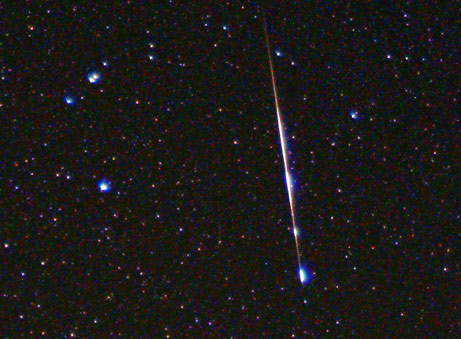
 Be prepared this weekend: you will witness the most amazing cosmic shower as the summer's annual meteor dazzling show reaches its peak. As this year the moon won't interfere with the Perseid meteor shower, the eager beavers hope to watch streaking fireballs late Sunday into dawn Monday, no matter the longitude.
At the peak of the shower, as many as 60 meteors/hour could be seen, as it has already been estimated. And now this annual show comes with an extra bonus: Mars can be seen as a bright red dot in the northeastern sky.
"We have front-row seats this year," said Kelly Beatty, executive editor of Sky & Telescope magazine.
In 2006, Perseid shower was somewhat dim due to the moon's interference, whose shine shadowed many of the faint meteors. As this weekend there is a new moon, the sky is going to be dark, the perfect time to watch meteors.
As Perseid meteors can be seen from any direction in the sky, the skygazers should choose a dark patch of sky out of light pollution and just wait for the meteors to show themselves.
Dim meteors are perceived like momentary flashes of light while the brighter ones leave dire straits. Their number should rise steadily through the night, reaching the peak just before sunrise. But the Perseids are still visible for several nights following the peak. While other space shows need a telescope or binoculars to be watched, the meteor shower can be seen with the naked eye.
As Perseids are so predictable, this is a meteoric show that comes most at hand. This phenomenon gets its name from the constellation Perseus, where these meteors root from and take place when the Earth's orbit crosses the path of debris discarded by Comet Swift-Tuttle.
When this cosmic junk, the size of a sand grain, penetrate the Earth's atmosphere, it burns up in a flash, giving birth to the sky flames. In the past, spectacular Perseid displays led to the report of mysterious lights in the sky. Maybe hence the UFO phenomenon.