 14 DAY TRIAL //
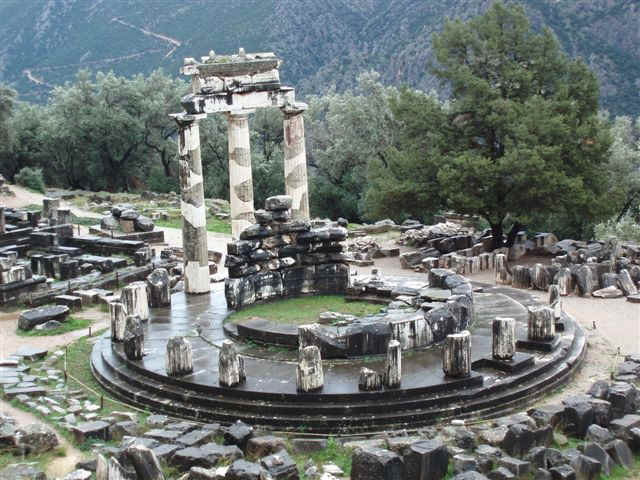
 Placed in the center of Greece, north of the Gulf of Corinth, the sanctuary of Apollo in Delphi represented, for centuries, the most sought and famous oracle of the ancient world. The spiritual influence and the magic connotations the oracle caused in the mind of the people made the city located at the base of the Parnassos Mountain to be considered an "omphalos" (center of the world) of the antiquity.
The Greek mythology says that Zeus released two eagles to fly into the heights from the both ends of the Universe. The meeting place of the eagles, over the rocks called Phadriade (the Shinning Ones), Rose and Hot, on the Parnassus Mountain, was considered the central point of the world.
Even if the oracle is often associated to Apollo's name, the sanctuary of Delphi was recorded to be raised over the ruins of a temple of the goddess Geea, Mother of the Earth, place that had been defended by a snake called Python. Apollo, Zeus' son, killed the snake with his arrows, ensuring his dominance over the region. The transfer of power from Geea to Apollo symbolizes the triumph of the patriarchal conception, brought by the Dorian tribes (pre-Greeks), who replaced the matriarchal organization, specific to the early Mediterranean pre-Indo-European society.
Apollo's sanctuary imposed gradually in the religious life of the antiquity, and therefore, during the 8th century BC, it turned into the most influent and prestigious spiritual center of the ancient Greece.
Between 595-586 BC, during the so-called "Sacred War", the region of Delphi was part of a federation of 12 tribes from northeastern Greece, administered by the Amphictyonic League. In 595 BC, the league intervened, helped by Athens and Sicyon, to defend Delphi against the ambitious plans of the rival city of Chrisso that wanted to have the absolute control of the area.
To commemorate the victory, the league instituted the first Pythic Games, similar to the Olympic Games, organized every four years, and comprising athletic and musical probes. The name of the games came from the name of the priestess of the oracle, Pythia. Over a millennium, until the 4th century AD, people from whole Greece and other areas came to Delphi to ask the oracle about businesses, marriages, land cultivating or journeys. Amongst the most famous visits to the oracle are those of Jason, the leader of the Argonaut trip into the Black Sea, in the search for the Golden Wool, or that of Cressus, the king of Lydia, before the war with the Persians.
Pythia, the priestess, must have been a village woman, aged over 50, who had an immaculate life. The priestess and the petitioners had to purify into the waters of the Castalla Spring at the base of the Parnassus Mountain, and then, to see if the god was in the mood for talking through the mouth of Pythia, a white goat was splashed with cold water. If the animal trembled with all its body, it was a good sign and the question was addressed to the oracle.
After that, the priestess continued with the petitioners into the inner sanctuary, passing in front of Dionysus' tomb, to drink from the holly water of Cassotis Spring. With the head backwards, mounted on a bronze tripod and chewing laurel leaves, Pythia would enter in trance and transmit Apollo's answer through unarticulated sounds, decoded by the priests.
At the beginning of the first century BC, the oracle entered into a decline. The last documentary mentioned answer was in 362 AD, when Roman emperor Julian the Apostate sent messengers to consult Pythia, who pronounced her last oracle: "Go and tell the king that the good times are gone, that Apollo does not have a shelter, nor laurel to pronounce his oracles and the water of the talky spring has gone dry." The oracle was closed in 381 AD, when emperor Theodosius forbade the pagan cults. In time, the sanctuary turned into a field of ruins.
In 1892, the Greek government allowed a French team to excavate the site of the oracle. The village of Castri, built during medieval times over the temple of Delphi, was moved stone by stone, against the will of its inhabitants. 19 centuries of debris were removed. Today, the ruins of the temple are also accompanied by a well preserved amphitheater and a stadium in the upper part, where Pythic Games took place.