
NEWS CATEGORIES:


NEWS ARCHIVE >>
SOFTPEDIA REVIEWS >>
MEET THE EDITORS >>
Home / News / Science / History

History


The Oldest Footprint in North America

It might be 10,000 years old

By Stefan Anitei, Science Editor

27th of October 2006, 08:02 GMT

Adjust text size:


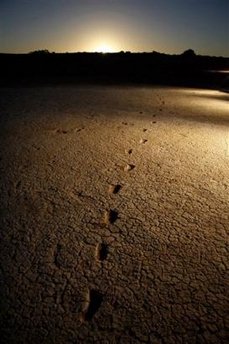
In May, Mexican archaeologists have found a trail of 13 fossilized footprints in travertine (a white rock) in a valley in Coahuila desert in northern Mexico, which could be among the oldest in the Americas. "The footprints were made by hunter gatherers who are believed to have lived thousands of years ago in the Coahuila valley of Cuatro Cienegas, 190 miles (306 kms) south of Eagle Pass, Texas," said archaeologist Yuri de la Rosa Gutierrez of Mexico's
National Institute of Anthropology and History.

"We believe (the footprints) are between 10,000 and 15,000 years old,'' De la Rosa said.

"We have evidence of the presence of hunter gatherers in the Coahuila desert more than 10,000 years ago.''

The age of the footprints is to be precisely determined at a laboratory in Bristol in Great Britain. The oldest footprints found in the Western hemisphere are in Chile, and were determined to be 13,000 years old. 6,000-year old footprints were found in California, Brazil and Nicaragua. So, these seem to be oldest footprints in North America.

The oldest known human footprints are those found in Laetoli, in Tanzania, made 3.5 million years ago. But the Laetoli footprints did not belong to modern human, in fact not even to Homo genus, but to its ancestor, Australopithecus. Each Mexican footprint is 10 inches (27 cm) long and under an inch (2 cm) deep, spread over a distance of 30 feet (10 meters). "It is likely they were imprinted in mud and preserved by some rapid change in the environment," said Arturo Gonzalez, director of the Desert Museum from Saltillo, in state capital of Coahuila.

"There must have been a natural phenomenon to rapidly cover them so they were not rubbed out and were perfectly preserved,'' Gonzalez said.
Read by 2,494 user(s) | Add comment | Link to this article TWEET THIS


Article rating:
Fair (2.5/5) 6 vote(s)    

Subscribe to news | Print article | Send to friend

© Copyright 2001-2009 Softpedia
Contact:


SEARCH THE NEWS ARCHIVE :


Today's News
| Yesterday's News | News Archive


MORE RELATED ARTICLES:


The Oldest Writings in Western Hemisphere

The Most Important Aztec Discovery in 28 Years

What Do the Mayan Carvings Depict?

User opinions:


Comment #1 by: gab1 on 29 Oct 2006, 08:07 GMT reply to this comment

http://today.reuters.co.uk/news/articlenews.aspx?type=scienceNews&storyID=2006-10-23T220302Z_01_N23412058_RTRIDST_0_SCIENCE-SCIENCE-DINOSAURS-DC.XML
This widely picked-up Reuters story discusses evidence of parasitic worms in dinosaur fossils. That may be fascinating to some, but what we find most interesting are some “clues” about how this dinosaur was buried:

… [a]n unusually well-preserved fossil …

… [t]ypically a carcass attracts multiple scavengers, and this one was largely undisturbed …

… the carcass was apparently buried before it had a chance to fall apart …

Pardon the flippancy, but what possibly could have caused this fossil to be buried so rapidly? http://www.answersingenesis.org/home/area/faq/fossils.asp#catastrophe

In other news, thirteen fossilized footprints have been discovered in northern Mexico. What do scientists say?

It is likely they were imprinted in mud and preserved by some rapid change in the environment, said Arturo Gonzalez … “[t]here must have been a natural phenomenon to rapidly cover them so they were not rubbed out and were perfectly preserved.”

Share your opinion:

Your Name:
Your Email Address:
(will not be used for commercial purposes)
Solve this to prove you're not a bot: =
Your review/opinion:


Windows tabGames tabDrivers tabMac tabLinux tabScripts tabMobile tabHandheld tabGadgets tabNews tab

SUBMIT PROGRAM   |   ADVERTISE   |   GET HELP   |   SEND US FEEDBACK   |   RSS FEEDS   |   ENTER NEWS SITE   |   ENGLISH BOARD   |   ROMANIAN FORUM