 14 DAY TRIAL //
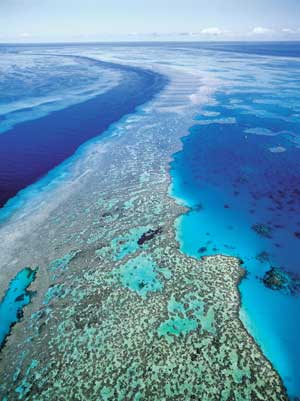
 The coral reefs form the largest biological structures on Earth. And the largest coral structure in the world is the Great Coral Barrier off the shore of northeastern Australia (parallel to the Queensland's shore), located in the Coral Sea: it is 2,010 km (1,200 mi) long and 2 to 150 km (1.2-92 mi) wide, which would cover the surface of Norway.
This is a tropical paradise with sunny islands, turquoise seas and gorgeous coral gardens.
It is also the most biologically diverse reef and marine ecosystem in the world. Only in an islet, researchers found 100 species of corals, 700 of fish (imagine this is five times more than the number of fish species encountered in the European rivers!), 25 species of sea cucumbers, 34 species of cone-shelled snails. This without mentioning the sea turtles and sea birds. Overall, the Great Barrier Reef has 1,464 fish species (this means 10 % of the fish species found in the oceans), 405 species of reef forming corals (50 % of all known species), 1,000 species of sponges (20 % of the known species), 4,000 species of mollusks, 500 species of birds and 150 species of echinoderms.
The Great Barrier is a succession of about 2,500 individual reefs of various type: platform, external and coastal, all forming a protective shield for the shore against the oceanic waves. Not all the islands of the barrier are coral-made. Some have a continental origin, being hill tops isolated from the mainland because of the rise of the sea level or the descend of the coast by about 100 m (330 ft). The Murray Islands represents the tops of three inactive volcanoes. The system of reefs and islands stretches from the Gulf of Papua (New Guinea) to the Lady Elliot island, south of the Capricorn Tropic. The continental platform in the barrier's area is 30-250 km (19-150 mi) wide and only 30-60 m (100-200 ft) deep, favoring the development of the reefs.
The Great Coral Barrier is very young: it emerged about 15,000 years ago, at the end of the last glaciation, when the sea level rose, the water flooded what was then dry land. Australian Aborigines inhabited Australia before the existence of the Great Coral Barrier. Asian traders could have visited the area before the Europeans, in search of trepang (a highly sought sea cucumber).
Today, the Great Coral Barrier is exploited for tourism, sea shells, corals and exotic fish. Resorts are found on the Gold Coast and Sunshine Coast. Over 500,000 tourists visit the area annually, mainly from May to December (during the dry season), avoiding the wet summers when the monsoons trigger cyclones.
In 1983, the whole area of 350,000 square km (140,000 square mi) was declared National Park. Still, the Great Coral Barrier is menaced by global warming and contamination, being exposed to coral bleaching in the next 50 years.