 14 DAY TRIAL //
 Bacteria are the smallest cell organisms. Only viruses are smaller than a bacterium. Bacteria are about 10 times smaller than eukaryotic cells (cells having a nucleus, like plants and animals) and are typically 0.5-5.0 micrometers long. (a micrometer is one thousandth of a millimeter).
Thats' why we need a microscope to see them.
You can imagine how small they are if many thousands are found in a droplet of saliva, represented by tens of species. With each inhalation, other thousands of bacteria reach our respiratory tract.
There are typically 40 million bacterial cells in a gram of soil and a million bacterial cells in a millilitre of fresh water; in all, there are approximately five nonillion (5?1030) bacteria in the world. Indeed, they are the most common life form on Earth, living in the most extreme conditions, from the bottom of the oceans and submarine hot vents to thermal springs.
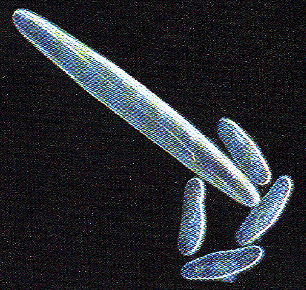
Nevertheless, there are some bacteria that can be quite large (in the scale of bacteria), like Epulopiscium fishelsoni, which reaches length of 0.7 mm (thus 150 times bigger than larger bacteria). This is the size of many small insects and crustaceans. You can see this bacteria with the unaided eye.
This species is the largest bacterial species ever found, living in the gut of most surgeonfish species, and was discovered in 1985. First, scientists could not determine what was the odd organism.
In 2002, Ester Angert, biologists at the Cornell University (US) proved that the organism was a bacterium, but with very special particularities.
The big problem for such a large bacterium, as in the case of any sole cell living by itself, is how to get and distribute the energy and nutrients throughout its large body-cell, on a "huge" length of half millimeter.
Angert found that Epulopiscium had 85,000 copies of its DNA spread throughout its interior, fact that allows the synthesis of proteins in the place where they are required, without the need of a complicated transport system: this way this bacterium has a 25 higher DNA amount than in a human cell.
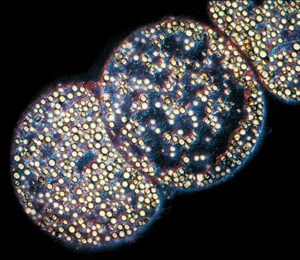
In 1999, an even larger bacterium has been found: Thiomargarita namibiensis, with a width up to 0.75 mm). The bacteria uses nitrates to synthesize organic chemicals. The species was first discovered off the coast of Namibia, but in 2005, a closely related species was found in a Gulf of Mexico cold seep.