 14 DAY TRIAL //
 Until 1951, nobody knew the source of the Orinoco River. Accumulating continuously torrents and rivers, Orinoco grows gradually while heading northward through the territory of Venezuela on over 2,000 km (1,250 mi) of thick jungle. In some places, the waters of Orinoco are as big as those of the Amazon and discharge into the Atlantic forming one of the largest deltas of the world. The compact and yellow mass of freshwater penetrates deep into the ocean, to 200 km (125 mi) from the mouths of the river.
Orinoco originates in northern Brazil, west of the Guyana Plateau. Its sources were found in 1951 by the French Joseph Groiet and the expedition could be possible only by using airplanes.
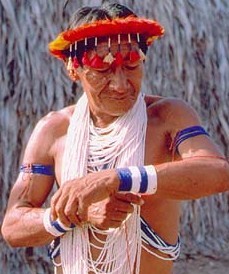
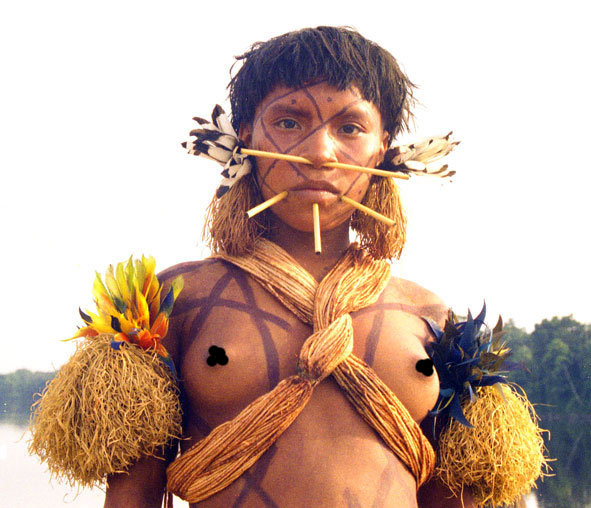
The area is the homeland of the Yanomami Indians. These tribes do not know the iron, nor the stone tools. They cut or grind using wooden blades. They hunt using long bows and arrows. The arrows have bamboo blades as tips, which are notched transversally so that they can break into the flesh.
The Maquiritari Carib Indians of the same area, enemies of the Yanomami, are skilled in making pirogues and they move on long distances on the upper Orinoco, that's why they are in more intense contact with the world of the White people.
The banks of the Middle Orinoco are inhabited by the Piaroa Indians. Their villages are placed along smaller affluents, well hidden into the jungle vegetation. Piaroa are masters of making the curare poisons, used both for hunting and as currency. The poison is concentrated into the liber tissue of the bark of curare (Strychnos toxifera). The bark is grated and slowly cooked till a dark deadly tar forms, used for daubing the arrow tips. This poison quickly paralyzes the heart. In some regions of the Amazon, the curare poison is made of Curarea tecunarum.
The quality of the curare depends on the drying process and it can be preserved for years. Curare is especially used for ointing the tips of the arrows of the blowpipes. The Piaroa do not practice pottery; they buy ceramic pots from the Guajibo Indians on the eastern bank of Orinoco. The curare made by Piaroa can reach further into the jungle, into Brazil and British Guyana.
Sometimes, the curare is combined with snake venom, other plant chemicals or crashed wasps. It is not about enhancing its power (as they do not) but simply fake currency (the operation has just an economical purpose).
Piaroa Indians live with a very strict blood prohibition. The blood must not fall onto the soil. That's why the wounded persons are isolated into the forest, in a hammock. During the menstruation, women too are isolated into the forest. When giving birth, women always do it into the water of the shallow rivers next to the Piaroa villages. An European visitor to a Piaroa village, who was bleeding on the face after shaving, was thrown into the river by the Indians! When he wanted to lance the abscess of a girl, they wanted to kill him...
The hunted animals are never skinned, but cooked as a whole. Before that, the animal is eviscerated on a stone, in the water of the river.
But the Indians of the lower Orinoco have experienced dramatic changes in their lifestyle, like the Guarao Indians of the Orinoco Delta. Guarao means "humans of the pirogues" in their own language. These people live on stilt houses, and each house has at least one anchored pirogue. The wasters do not represent a problem, as the tides clean the waters twice a day.
The problem for the Indians was represented by the fact that the delta is rich in oil, and small oil settlements appeared on the islets. On the upper stream of the river, there are rich iron mines, and that translated into an intense river traffic. The Guarao deliver wood for the industries, taking advantage of the tidal currents and making raft of logs with which they navigate on long distances through the channels between the lagoons. Today, Guarao are increasingly involved in the monetary economy and the life of the oil settlements. The decrease in the vital space also impedes hunting and fishing.
The lifestyle of the inner tribes (Maquiritari, Yanomami, Piaroa) is so far menaced by the emergence of the Catholic and Protestant Missions in the area.