 14 DAY TRIAL //
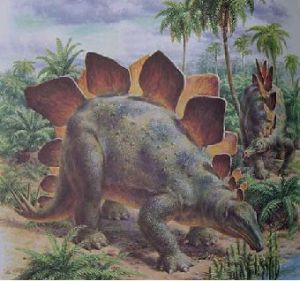
 Whether you are a dinosaur amateur or not does not matter because it's almost impossible not to be familiar with Stegosaurus' image: a bizarre looking 9 m (30 feet) long and 4 m (12 feet) tall, 4.5 tonnes weighed herbivorous dinosaur with a strewn with a double row of vertical plates and a tail adorned with spikes.
This anatomy puzzled the scientists for a long time: were the plates used for protection or to catch/radiate heat in/from the dinosaur's body?
Now the most accepted theory is that the plates were probably just an extreme case of elaborate and colorful display that individuals employed to recognize each other.
This is not a highly evolved dinosaur; it did not survive to Cretaceous, the last era of Dinosaur era. Till now, Stegosaurus fossils have been found only from Late Jurassic (the middle of the Dinosaur era) in West North America, but a recent find in Portugal points to the fact that these beasts also roamed the European Jurassic.
This is the second discovery of a dinosaur common to Europe and North America, the other one being a species of Allosaurus, a carnivorous dinosaur the same size with Tyrannosaurus rex, but with more developed arms.
These discoveries just enhance the idea that the two continents were once joined through land bridges that permitted dinosaurs to roam freely between them. "Both coasts were very close and the basins between them could emerge occasionally," said study leader Fernando Escaso of the University of Autonoma in Madrid, Spain.
During the first half of the dinosaur existence, 185-million-year long, all the northern continents were joined together into a giant landmass called Laurasia (while the southern ones in Gondwana). To the end of the Jurassic Period, about 150 million years ago, the Laurasia slowly began to cleave: North America on one side, Europe on the other, and the widening rift between them turned into the Northern Atlantic Ocean.
During this million-year process, sea levels fluctuated and occasionally land bridges emerged, facilitating fauna and flora exchange between the two continents.
The European Stegosaurus fossils, a tooth and parts of the animal's spinal column and leg bones, were discovered near the city of Batalha (central Portugal). The fossils are indistinguishable from those of a North American species, Stegosaurus ungulatus.
The discovery confirms the land-bridge, but nothing more. "At present, it isn't possible to know the structure, frequency and duration of these land bridges," said Escaso.
"The new Stegosaurus discovery supports something largely suspected in the past and helps flesh out some of the geological history of the region. It documents the second genus of dinosaurs that's well-known from the Jurassic of North America to be present in Europe, and thereby gives evidence that there was a fairly strong connection between these areas during that time," said Peter Makovicky, a paleontologist at the Field Museum in Chicago.