 14 DAY TRIAL //
 The earliest recorded supernova, SN 185, was viewed by Chinese astronomers in 185 AD. Modern day scientists think they have pretty much figured its formation mechanisms. But it seems the Universe still holds some surprises.
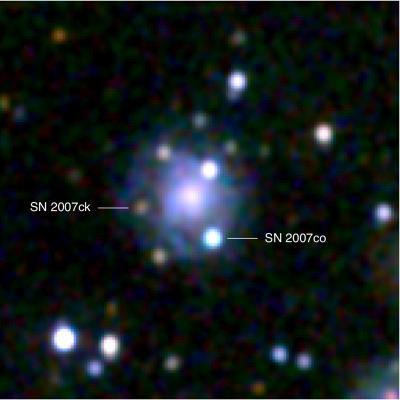
For the first time, NASA's Swift satellite observed two supernovae faring up in a distant and obscure galaxy in the constellation Hercules. They called it a double supernova because two such events were never before seen in the same galaxy so close together in time.
A massive star, burning brighter than our Star, eventually depletes its helium in the core and without any source of heat to balance the gravity, the core collapses until it reaches nuclear densities. This produces a supernova explosion.
The fact that two of these stars died in the same time in the MCG +05-43-16 galaxy, located at a distance of 380 million light-years from Earth, is a beautiful coincidence. This is also the first time astronomers observed a supernova in this galaxy.
As if this isn't unusual enough, the two stars that became supernovae are not of the same type. Supernova 2007ck is a Type II event that occurs when the core of a star much more massive than our Sun runs out of fuel for the nuclear reactions and collapses under its own gravity. This produced a shock wave that was observed from Earth on May 19.
The second star formed a Type Ia event, dubbed Supernova 2007co, that only happens when a white dwarf explodes. A white dwarf is what stars like our Sun become after they have exhausted their nuclear fuel. Near the end of its nuclear burning stage, such a star expels most of its outer material, creating a planetary nebula. Only the hot core of the star remains. This core becomes a very hot (T > 100,000K) young white dwarf, which cools down over the course of the next billion years or so.
When they burn out, the ensuing explosion produces a type of supernova that astrophysicists believe manufactures most of the iron in the universe, and more important, they seem to generate the elusive dark energy, an unknown force that dominates the universe.
"Most galaxies have a supernova every 25 to 100 years, so it?s remarkable to have a galaxy with two supernovae discovered just 16 days apart," says Stefan Immler of NASA?s Goddard Space Flight Center.