 14 DAY TRIAL //
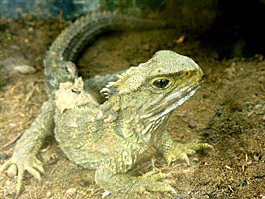
 The tuatara is by far the oldest reptile inhabiting the planet, a living fossil that survived isolated in the New Zealand, protected from competition and predation of other animal groups. Surprisingly, a DNA analysis published in the journal "Trends in Genetics," carried out by a team led by evolutionary biologist and ancient DNA expert Professor David Lambert at the Allan Wilson Centre for Molecular Ecology and Evolution, has come with a big surprise: despite the fact that tuatara has remained physically more or less unchanged since the dinosaur era, its DNA is evolving faster than any other animal investigated to date.
The evolution speed for Antarctic Ad?lie penguins, investigated by the same team, is the second one, being slightly slower than that of the tuatara (Sphenodon punctatus). The team measured this rate using DNA extracted from 8,000-year-old bones of tuatara.
"What we found is that the tuatara has the highest molecular evolutionary rate that anyone has measured," said Lambert. The DNA change rhythm was much faster than in species like the cave bear, lion, ox and horse.
"Of course we would have expected that the tuatara, which does everything slowly - they grow slowly, reproduce slowly and have a very slow metabolism - would have evolved slowly. In fact, at the DNA level, they evolve extremely quickly, which supports a hypothesis proposed by the evolutionary biologist Allan Wilson, who suggested that the rate of molecular evolution was uncoupled from the rate of morphological evolution," said Lambert.
The new study could help the conservation of the tuatara.
"We want to go on and measure the rate of molecular evolution for humans, as well as doing more work with moa and Antarctic fish to see if rates of DNA change are uncoupled in these species. There are human mummies in the Andes and some very good samples in Siberia where we have some collaborators, so we are hopeful we will be able to measure the rate of human evolution in these animals too," said Lambert.
The tuatara is the only living species of the reptilian order Sphehodontia, related to lizards. The order separated from other reptiles 200 million years ago (Upper Triassic), when the first dinosaurs had just started to walk the Earth, experienced an evolutionary bloom during the Mezozoic, but most species have vanished before the dinosaur extinction.