
NEWS CATEGORIES:


NEWS ARCHIVE >>
SOFTPEDIA REVIEWS >>
MEET THE EDITORS >>
Home / News / Apple / Tips&Tricks

Tips&Tricks


The Seven Most Important Leopard Interface Tweaks

Make your Mac look and behave like you want it to

By Sergiu Gatlan, Apple News Editor

30th of June 2008, 09:47 GMT

Adjust text size:


Steve Jobs presenting the OS X Leopard.
Enlarge picture
Do you remember the day when you first got to play with Apple's new cat? The day when you all went "aaaawww!" after clicking on a stack or using the 3D dock? I certainly do and I have to say that, albeit
enjoying most of the changes Apple has introduced in Leopard, like many other people that are using a Mac, I needed to change some of them to the way they were in Tiger or to a better, more unobtrusive look.

For instance, I'm sure that the 3D dock has made lots of fans since day one but there were people out there that did anything they could to change it back to the 2D look they were used to. Another part of the UI that generated lots of controversy is the translucent menu bar, translucency that made the menus difficult to read for some and that simply bothered others just by the looks of it.

What is one to do in such a case? Tweak, of course! And when it comes to tweaking, what else can be more obvious than an interface tweak. In this article, I will present you the most important nine secret Leopard tweaks I have used to make my Mac experience one that I could enjoy even more than if I had used a system with its default settings unchanged.

I call them "secret" because Apple hasn't made them public or included them in an easy to use application that could allow users to customize the OS's interface even more to their liking. I also call them "secret" because they cannot be accessed from any system menu or preference pane and this completely hides them from you or any other less nosey Mac user.

Without anymore talk, let's start the countdown and see how you can easily and quickly force the Finder to display the entire path to a file or directory in the title bar, add movable and removable spacers to the dock, change the login screen background with a single and simple command-line that you can run in your Terminal, customize the look of the menu bar, enable a secret Screen Sharing toolbar, make the good old switch between a 2D and a 3D dock, and disable the Safari option that will auto open the downloads.

The Finder window featuring the full directory path in the title bar.
Enlarge picture
1. Force the Finder to display the entire path to a file or directory in the window's title bar
Have you ever found yourself wandering around in the Finder to be able to realize out what the active directory path is? Make the Finder window display it by issuing the following commands from the Terminal:

CODE
defaults write com.apple.finder _FXShowPosixPathInTitle -bool YES
killall Finder

To turn off this tweak, all you have to do is to type the above commands again and change the YES at the end of the first command with a NO.

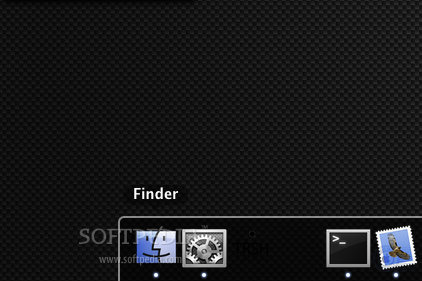
2. Add movable and removable spacers to your Mac's dock
The first time I heard about this one, I wondered how spacers could help me with. I'm pretty sure some of you might think exactly as I did but, after trying it, you will find out they are quite handy and that your dock will actually look way better than before. This is especially useful when you have a lot of apps and you want to group them by certain criteria. To enable this tweak, you have to use the following commands:

CODE
defaults write com.apple.dock persistent-apps -array-add '{"tile-type"="spacer-tile";}'
killall Dock

Your newly created dock spacers can be moved around on your desktop and also be removed by dragging them off the dock or by using the context menu.

3. Change the login screen background
To be able to do such a thing, there is more than one way to go. Some people suggest replacing the DefaultDesktop.jpg file that one can find in the /System/Library/CoreServices/ directory. Although this might work we, as well experienced Mac users, know better than to mess with files that reside in the /System folder and know that a much more proper way to do this job is to change the appropriate preference from the command-line using the following:

CODE
sudo defaults write /Library/Preferences/com.apple.loginwindow DesktopPicture "/Library/Desktop Pictures/Aqua Blue.jpg"

where "/Library/Desktop Pictures/Aqua Blue.jpg" is the path to the picture you want to set as your login screen background.

4. Easily customize the look of the menu bar
The one thing that totally annoyed me since day one is the new look of the Leopard menu bar (the translucency effect it had). And after a while, I did manage to find a way to get rid of it and have a completely white and nice looking menu bar as in Tiger. To be able to switch between the different looks the menu bar can have, you must use the following commands (as usual, from a Terminal window):

- Gray menu bar:
CODE
sudo defaults write /System/Library/LaunchDaemons/com.apple.WindowServer 'EnvironmentVariables' -dict 'CI_NO_BACKGROUND_IMAGE' 0

- White menu bar:
CODE
sudo defaults write /System/Library/LaunchDaemons/com.apple.WindowServer 'EnvironmentVariables' -dict 'CI_NO_BACKGROUND_IMAGE' 1

-Translucent menu bar:
CODE
sudo defaults delete /System/Library/LaunchDaemons/com.apple.WindowServer 'EnvironmentVariables'

Although this hack has actually been included by Apple in the Desktop & Screensaver Pane under the Desktop tab and you will easily be able to change the menu bar's look with just a click, I still want to mention it here because it is only available as a system preference starting with OS X 10.5.2 and the people that run a OS X 10.5.0 or 10.5.1 will still need it.

The secret Screen Sharing toolbar.
Enlarge picture
5. Enable a secret Screen Sharing toolbar
For the people that use Screen Sharing each and every day, this tweak can deliver quite a boost to the way they manage things while controlling a remote computer. To enable the toolbar with the extra secret buttons, run this command from a Terminal window:

CODE
defaults write com.apple.ScreenSharing 'NSToolbar Configuration ControlToolbar' -dict-add 'TB Item Identifiers' '(Scale,Control,Share,Curtain,Capture,FullScreen,GetClipboard,SendClipboard,Quality)'

I will let you discover what each new button does and I'm quite sure you are going to be pleasantly surprised.

The 2D dock.
Enlarge picture
6. Switch between a 2D and a 3D dock
This is probably the tweak that got the most celebration from the Leopard users who are still divided between the 2D and 3D. The ones that like the dock simple and clean as it was in Tiger, and the ones that will go for the 3D dock look and for the innovative modality to display icons using reflections and all the bling bling that we're used too. To enable the 2D look, you have to run these two commands from the command line:

CODE
defaults write com.apple.dock no-glass -boolean YES
killall Dock

In case you change your mind, think 2D is not for you after all and you have just made an unfortunate choice, you can easily get the 3D dock back by replacing YES in the first command with NO.

7. Disable the Safari option that will auto open the downloads
Although this is not a Leopard specific tweak, it is included in this article because I find it extremely annoying when Safari starts acting like it has a mind of its own. To enable it, use:

CODE
defaults write com.apple.Safari AutoOpenSafeDownloads -bool NO

and, in case you get to the conclusion that you like more the old untamed Safari, you just have to run the same command, this time replacing NO with YES.

There are a lot more Leopard related tweaks available out there but I have decided to write only about these because I find them to be the most important and that will have the biggest impact on your Mac experience in the end. If you think I've left out any important ones or that you find extremely useful and not too many people know about it, feel free to let us all know by inserting a comment below.


TAGS:

tweak | customize | interface | secret
Read by 10,218 user(s) | Add comment | Link to this article TWEET THIS


Article rating:
Good (3.2/5) 4 vote(s)    

Subscribe to news | Print article | Send to friend

© Copyright 2001-2009 Softpedia
Contact:


SEARCH THE NEWS ARCHIVE :


Today's News
| Yesterday's News | News Archive


MORE RELATED ARTICLES:


Turn Your Terminal Into a Quake-like Console

Useful Command-Line Tools for Your Mac

How to Install Open Source Apps and Packages with Fink

First Snow Leopard and Safari 4 Screens

Softpedia Recommended Mac Apps of the Week - 28.06.2008

User opinions:


Comment #1 by: Richard on 01 Jul 2008, 14:30 GMT reply to this comment

The show path of finder (#1) command

defaults write com.apple.finder _FXShowPosixPathInTitle -bool YES
killall Finder

Is there a space between "YES" and "killall Finder", no space or a hard return?

Feel free to simply edit the article rather than posting this.


Comment #2 by: Sergiu Gatlan on 01 Jul 2008, 16:46 GMT reply to this comment

Those are two separate commands. You will have to type them separately at the command-line in a Terminal window and hit after each one.

The first will force Finder to display the full path into the title bar and the second kills the Finder process so you can see the changes.


Comment #3 by: PJ on 03 Jun 2009, 20:07 GMT reply to this comment

I inserted the code for the dock spacers. It seemed to have done no more than put extra space between the icons that are separated by the already existing spacer. Can you be a bit more specific about how to add spacers? And, just in case, can you give the antidote to this code, in case I choose to remove it? Thanks very much.


Comment #4 by: Sergiu Gatlan on 04 Jun 2009, 06:47 GMT reply to this comment

The dock spacer will appear in your dock just in front of the icons of apps that run on your Mac but do not have a permanent icon in the dock.

To remove any of the spacers this command adds to your dock you just have to drag them off as you would do with any other icon you have in the dock.

Comment #4.1 by: PJ on 13 Jun 2009, 19:39 GMT

Thank you for your reply. I hope I don't try your patience with this follow-up.

What I have noticed since adding this code via Terminal is a greater physical distance between the permanently placed icons (trash, downloads, docs, etc.) and the others (if I knew your email address I could send you a screen shot of this - I'd be happy to take this discussion off-line here, too). I see one "dotted line" separator between those two sections, but I cannot figure out how to create and place other separators between other icons.

I apologize for not catching on to this immediately. I appreciate your help.

If I cannot get this to happen for me, can you provide me with code to undo what actually has changed since I entered the code in number 2 above (the greater physical distance between permanent and temporary icons I now have)?

Thank you, Sergiu.


Comment #5 by: Sergiu Gatlan on 15 Jun 2009, 07:51 GMT reply to this comment

As I said above your follow-up comment all you will have to do to remove the newly added separators is to grab them with your mouse and drag them off. This way they will be automatically removed from your Mac's dock.

If you want to further discuss this matter you can directly contact me using the following email: maceditor[AT]softpedia.com.

Share your opinion:

Your Name:
Your Email Address:
(will not be used for commercial purposes)
Solve this to prove you're not a bot: =
Your review/opinion:


Windows tabGames tabDrivers tabMac tabLinux tabScripts tabMobile tabHandheld tabGadgets tabNews tab

SUBMIT PROGRAM   |   ADVERTISE   |   GET HELP   |   SEND US FEEDBACK   |   RSS FEEDS   |   ENTER NEWS SITE   |   ENGLISH BOARD   |   ROMANIAN FORUM