 14 DAY TRIAL //
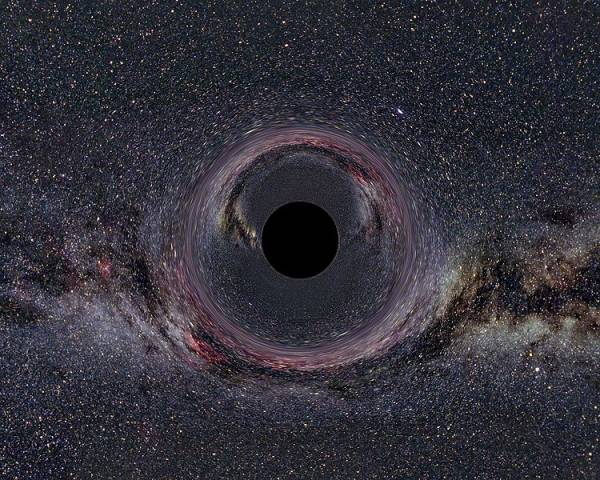
 The distant active galaxy that astronomers refer to as 1H0707-495 is currently the home of a supermassive black hole, which was the object of a new scientific 'close-up' study. The paper, which was published in the May 28th issue of the scientific journal Nature, details astrophysicists' efforts of better understanding the behemoth formation, which is reportedly engulfing the matter it draws near at a rate of two Earths per hour. That is to say, everything that is on our planet, plus one more time that, gets sucked into the black hole within a single hour.
Supermassive black holes, as a class of cosmic objects, are among the heaviest and deadliest things in the Universe. They tend to reach impressive dimensions, and sometimes get to have up to a billion times the mass of our Sun, and sometimes even more. They create a formation known as an accretion disk around them, from which they draw their “sustenance.” The speed at which they can cannibalize everything around them is dictated by the strength of their gravitational pull, as well as by their neighbors. It has been recently proven that the only thing that can stop a black hole's feeding frenzy is a relapsing supernova, exploding at regular intervals.
Experts from the University of Cambridge, who were also involved in the new study, used the European Space Agency's (ESA) XMM-Newton observatory for the observations. By peering inside 1H0707-495, they discovered a supermassive black hole at its core, but the formation only weighs an estimated three to five million solar masses, which is fairly low by all standards. They inferred the weight from the fact that there was a 30-second lag between the X-rays they detected as coming from the black hole itself and those found coming from its reflection in the accretion disk, LiveScience reports.
As particles travel around a black hole, they are accelerated within fractions of the speed of light, and experience all sorts of collisions between them. Eventually, they pass the event horizon and into the black hole. The problem is that, while doing this, they generate important amounts of X-rays, as well as other types of radiation, which are then spread around the black hole at nearly the speed of light. It's by measuring these byproducts of “feeding” that astronomers are now able to determine important traits pertaining to black holes, such as spin, size, radius and weight.