 14 DAY TRIAL //
 Scientists are nowadays focused on determining how the Universe looked like a very short time after the beginning of the Big Bang. This research leads to new knowledge on the CMB.
The event that “ignited” universal expansion is called the Big Bang, and it represents a time of accelerated inflation during which time the early Universe expanded its volume considerably.
It was not an explosion per se, but the raid expansion of matter was most likely similar in appearance to one. This primordial event left behind impressive traces, and one of them is the Cosmic Microwave Background, or the CMB.
This background can best be described as a form of residual light that continues to endure to this day. Researchers say that it can give us more details about what happened between 1×10-36 and 1×10-32 of the first second of the Universe.
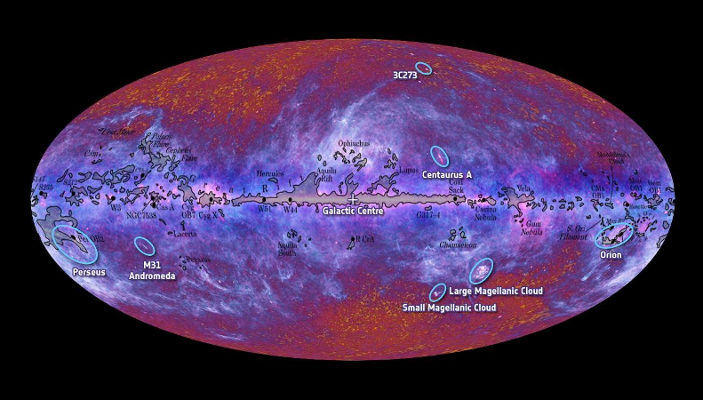
This radiation is the target of missions such as Wilkinson Microwave Anisotropy Probe (WMAP) and, more recently, the Planck Telescope operated by the European Space Agency (ESA).
According to experts, the Universe first became capable of allowing light to move unimpeded through it about 380,000 years after it began forming. Before that, all light was scattered by hot plasma.
But, all those eons ago, the temperature of the Cosmos dropped sufficiently to allow for the formation of the first atoms, and also to become transparent to radiation.
As this happened, the first photons were released in a singular moment. Some of them have long since been absorbed, but astrophysicists say plenty remain as part of the CMB, carrying the original data.
While the isotropy of the CMB made may believe in the cosmic inflation theory, the WMAP discovered that some degree of anisotropy (lumpiness) exists in the radiation.
The new discovery allows scientists to build mathematical models that predict the contents of the early Cosmos, Universe Today reports.
Further evidence are expected to be collected using Planck, which is the most advanced CMB-oriented telescope ever developed.
It was launched last years, aboard the same Ariane 5 rocket that also delivered the Herschel Space Observatory to orbit.