 14 DAY TRIAL //
 A dead zebra in the African savanna means a fiesta for the vultures around. But if we're talking about dead whales, this fiesta can last for decades. And there are specialized marine communities which are adapted for this purpose.
This is called whale fall and the first recognized one was in 1989 in southern California. Whale carcasses falling to the deep-ocean floor form an oasis of life in a deserted area, attracting a specialized group of clams, crabs and worms that feed for many years on the oil-rich bones and tissues.
Some believe that these random, deep-ocean oases are like bridges for organisms migrating from one ocean floor environment to another, searching for a hot vent or a cold seep, offering sustenance from bacteria making chemosynthesis (synthesis of organic chemicals based on energy-rich mineral chemicals, in the absence of light), as at depths of over 1,000 m (3,000 ft) there's no light for photosynthesis.
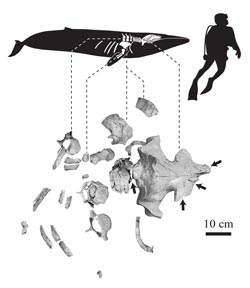
Now, a fossilized whale skeleton encountered 20 years ago on California's A?o Nuevo Island has appeared to be the youngest example on the Pacific coast of a fossil whale fall and the first in California, as found by a team of paleontologists at University of California, Berkeley.
"The fossil whale fall shows that these deep-sea communities didn't need especially large whales as a source of nutrients - in fact, the fossil whale from A?o Nuevo Island was no longer than a VW bug," said co-author Nick Pyenson, a graduate student in UC Berkeley's Department of Integrative Biology.
In fact, due to the unremarkable size (11 ft or 3.6 m), less than 50 % of the smallest current baleen whale, the fossil whale, whose remains included skull, spine and ribs, was neglected. It was displayed at Long Marine Laboratory in Santa Cruz until donated to the Museum of Paleontology in 2005.
Pyenson found 21 clams, each under a centimeter (0.4 inch) in length and one snail, most on the skull but also on the vertebrae.
The clams belonged to the same type that in our days gather around whale falls and extract energy from bones using specialized symbiotic bacteria, pointing that the whale fossil came from a whale fall.
"The whale came from 15 million-year-old sediments, the Monterey Formation, making the A?o Nuevo find much younger than most fossil whale falls discovered around the globe, the oldest of which date from 40 million years ago. The ocean floor is pretty much a desert until you get a whole whale carcass sinking to the bottom. We don't know how these creatures know to colonize it. Are they ever-present on the sea floor waiting for an animal to fall. But when the whale carcass hits, it forms this island refuge of high nutrient levels that can sustain an undersea community, some scientists calculate, for decades." said Pyenson.
"Over the past 18 years, more whale falls have been found around the world, and paleontologists have found examples in the fossil record as well. Most fossil examples, however, consist of isolated bones adjacent to deep-sea mollusks," he added. The A?o Nuevo skeleton was unusually complete, containing multiple mollusks, but the whale host species is very little known. Still, its tiny size pointed out that these specialized deep-sea communities didn't require large whale carcasses to evolve. Instead, the main factor appears to be the oil content of the whale's bones.
"What we have are relatives of modern chemosynthetic clams associated directly with the skeleton of a tiny, tiny whale, smaller than any other known from modern whale falls. That tells us that you don't need very large whales to sustain a whale fall, but what you probably need is a really oily skeleton." said Pyenson.
"Because they are more buoyant, oil-rich bones are likely one adaptation to allow deep diving. The A?o Nuevo whale fall find puts a lower limit of 11 million years on the origin of oily bones in whales," he added.