 14 DAY TRIAL //
 Sloths really deserve their name: 11 % of the sloths move only 38 m (126 ft) daily, and 38 % of them cannot move at all for 24 hours. Captive two-toed sloths are active about 7 hours each day. Moreover, coming to increase the impression of laziness is the fact that, since sloths are nocturnal, they just sleep or doze off constantly during the day. But this image of the lazy, always sleeping creature has been challenged by a new research published in the Royal Society journal Biology Letters.
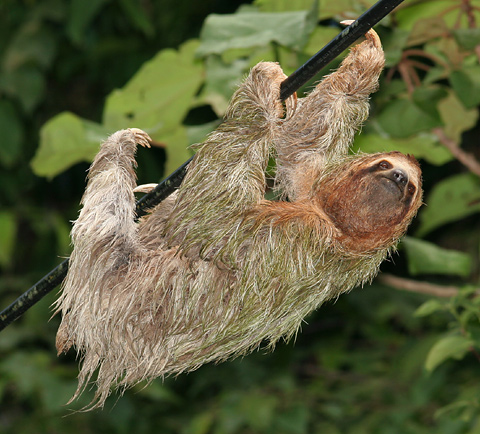
Instead of dozing for over 16 hours daily, like sloths living in captivity do, wild sloths seems to sleep just 9.6 hours a day, as found by this study made in the rainforest near the Smithsonian Tropical Research Institute on Barro Colorado Island, Panama.
"The study demonstrated for the first time that it was possible to record sleep in a wild animal. The real exciting finding was that they only slept 9.6 hours a day, which is much less than what people popularly believed and less than had been observed in a previous study of sloths in captivity. So they still may be sloth-like in terms of their speed of movement but in terms of their sleep they don't seem to sleep an inordinate amount of time," lead researcher Niels Rattenborg, of the Max Planck Institute for Ornithology in Starnberg, Germany, told BBC News.
"This might provide clues to the function of sleep. I think this finding is really going to open the door to a whole new age of sleep research on animals sleeping in their natural habitat," he added.
Sleep amount amongst various species varies a lot. Birds can sleep even while flying! During migration, birds take hundreds of naps during the day, each lasting only 9 seconds on average, to compensate the loss of night sleep. Giraffes are suddenly refreshed with only 2 hours of sleep daily, while pythons sleep 18 hours a day.
For this new study, the team made of researchers from Germany, Switzerland and the US, developed a small device that can monitor brain wave patterns connected with sleep. The devices were attached to 3 wild female brown-throated three-toed sloths that were then released into the wild. The animals were re-captured several days later. The devices had recorded an average sleep amount of 9.6 hours a day.
"Animals tend to sleep much more in captivity, where they have all their needs met. It's intuitive that animals would sleep less in the wild than in captivity - this technology gives us the opportunity to prove that's true," Dr Neil Stanley, an expert in sleep disorders at the Norfolk and Norwich University Hospital, UK, told BBC News.