 14 DAY TRIAL //
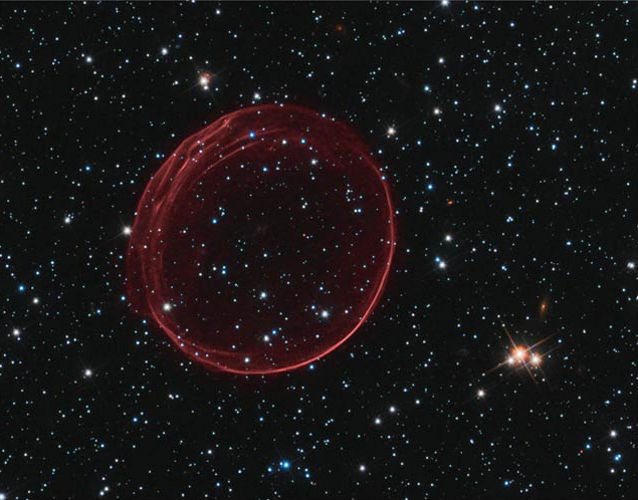
 Astronomers recently discovered a cosmic structures that immediately led them to think about Christmas ornaments. The serene gas bubble looks just like a tree globe decoration, albeit several billions of times larger than the former.
The impressive structure lies relatively closely-by, in the dwarf galaxy called the Large Magellanic Cloud, which is located very close to the Milky Way. The pristine shell was observed using the American space agency's famous Hubble Space Telescope.
According to investigators, the flimsy-looking “decoration” is located approximately 160,000 light-years away from our planet, and is in essence nothing more than the visible remnant of a powerful supernova explosion that occurred a long time ago.
As the massive star began shedding the outer layers of its atmosphere, it triggered the formation of this beautiful nebula, astronomers say. The core of the former cosmic fireball then most likely went on to implode and collapse.
The resulting cloud-like structure was dubbed SNR 0509-67.5 (SNR 0509). By analyzing its appearance and characteristics, researchers determined that it must have been produced by a type Ia supernova, Space reports.
This type of event is a bit different than the class if supernovae that go on to produce incredibly crushed stars such as black holes and neutron stars. Type Ia event are only triggered by the explosion of white dwarfs.
Scientists believe this only happens in binary stars systems featuring a single white dwarfs and so other, larger star, in which the former goes on to accrete matter from the latter.
Eventually, after gobbling up significant amounts of gas and dust, the white dwarf grows so much in size that it become unstable, and eventually shed the excess mass in violent thermonuclear explosions.
Pieces of the resulting ejecta then go on to disturb surrounding clouds of gas, which are then coerced into taking on various shapes, forming the nebula. Additionally, this shape can also be influenced by density variations in the interstellar medium.
SNR 0509 is relatively small, measuring just some 23 light-years across. However, astronomers have calculated that the formation is expanding at a rate of nearly 11 million miles per hour, or about 18 million kilometers per hour.
The new study of its structure was carried out using the Advanced Camera for Surveys (ACS) instrument on the Hubble. The telescope was upgrade to new capabilities in May 2009, when the space shuttle Atlantis and her crew spent 11 days installing new hardware.