 14 DAY TRIAL //
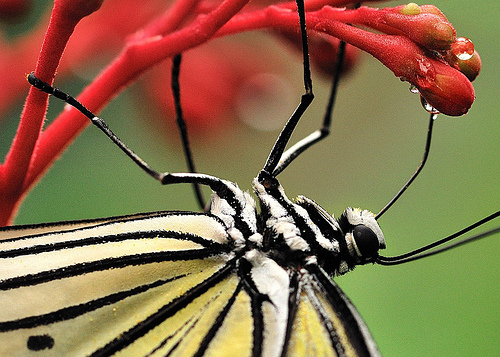
 It seems that every once in a while, nature's marvels provide more than just a beautiful thing to look at. The scientific field of biomimetics is actually based on this idea, and borrows from nature's creations those principles that might be adapted to devices or materials that could make humans’ lives easier or help technology progress. The same has been discovered to be true about butterflies, whose wings have a complex structure that repels water, much like the lotus leaves or rose petals.
Importing this feature on human-built materials would have a large range of obvious applications. With this thought in mind, a team of experts, led by Christophe Peroz from the French National Center for Scientific Research in Aubervilliers, imagined a surface that would provide a cheap way to keep water (and dirt) away from windows or windshields. Butterfly windows.
The property of the butterflies' wings to repel water is due to the structure of their surface, which shows microstructures in the shape of a waffle that prevents droplets from spreading out and forces them to roll off, carrying the incidental dirt along with them. But the team of researchers quickly concluded that recreating this kind of surface would be challenging in terms of speed and cost, as well as of the produced surface size. Mainly, this is due to the fact that the employed process is based on a template created by means of a lithographic technique regularly used in chip manufacturing.
So, Peroz's group worked around this difficulty by coming up with a cheaper alternative, which requires pouring silicon-based polymer liquids over real butterfly wings or lotus leaves and drying it. The resulting mold is filled with methyltriethoxysilane (MTEOS) – a liquid agent used in the glass-making process that turns into a gel upon spinning. The agent forms a thin layer of some 900 nanometers. By joining more such MTEOS films, a large water-repellent, self-cleaning surface can be obtained.