 14 DAY TRIAL //
 Norwegian researchers have just found the oldest known chunk of Earth crust, located in Greenland, and aged at least 3.8 billion years.
It is an ophiolite, an originally oceanic crust that was lifted and exposed within continental crust, that's why it's the best evidence yet that plates have been moving across the Earth's surface for at least one billion years longer than thought.
Plate tectonics would have started soon after the first solid crust grew dense enough to descend into the then-molten mantle below it, triggering the cycle of crust generation and destruction.
Pieces of ocean crust pushed up onto a piece of continental crust formed ophiolites. As ocean crust is heavier than continental crust, the emergence of ophiolites is quite rare and occurs when two tectonic plates are moving towards each other, one being pushed under the other. Pieces of the descending (subducted) oceanic plate can be broken and left over the other plate, resulting in ophiolites. The oldest known ophiolite is a 2.5 billion years Chinese one, but its dating had not been taken for certain.
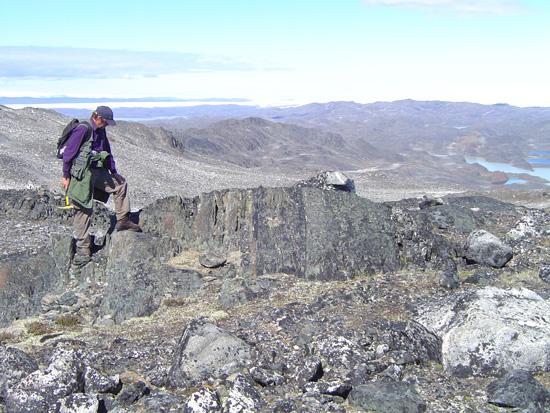
Now the team from the University of Bergen led by Harald Furnes has investigated an ophiolite fragment located in the Isua supracrustal belt in south-west Greenland. The fragment belongs to a distinctive layered deposit named "sheeted dikes", a main component of ophiolites, 30 - 50 m (100-170 ft) tall. "The rock association, together with the chemistry of the volcanic rocks, indicates it was an island arc environment, like the Mariana region in the western Pacific," said Furnes.
Island arcs are made of a row of volcanoes that emerge in the area where two plates are converging. "The Isuo rocks are only a small fragment of an ophiolite, but they are "very good evidence" of plate tectonics," said Timothy Kusky at Saint Louis University in Missouri, US, who found the 60 km (37 mi) Chinese ophiolite. However, "it's very rare to have the ophiolite complex preserved for so long because plate tectonics fragments them by crashing island arcs into continents and crunching continents together," said Kusky.
In 2001, researchers discovered the oldest known crystals ever found, tough zircons 4.4 billion years old.