 14 DAY TRIAL //
 Researchers from the National Institute of Standards and Technology (NIST) observed the behavior of the HIV protein, called Gag, and learned more about the infection process of the human immunodeficiency virus (HIV), which causes the acquired immunodeficiency syndrome (AIDS).
This newly developed research method allowed scientists to have a glimpse at the assembly of the HIV in a host cell.
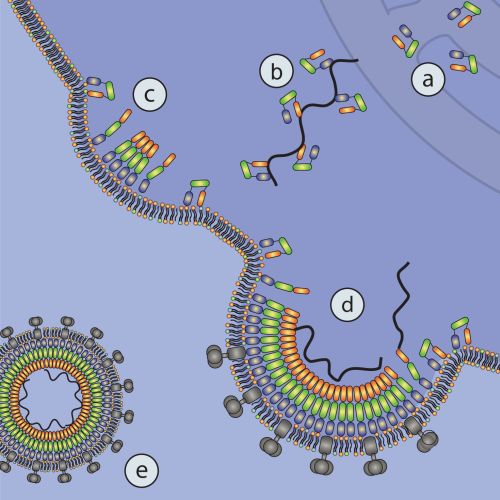
This Gag molecule acts like a minute gymnast, because it twists itself into different shapes inside a host cell, during the several stages of the HIV assembly.
It does so because each shape allows it to drag a piece of HIV genetic material closer to the cell membrane, where the viral particles grow.
The opposite end of the Gag molecule becomes anchored there, and little by little it forms a barrier that surrounds the infectious gene in the final version of the virus.
Until recently, scientists could only guess that the Gag protein plays many different roles in HIV assembly, but they had no idea about the actual details.
This insight became possible once the scientists managed to create an artificial cell membrane which allowed Gag to show off its different contortion skills, for the neuron research at the NIST Center for Neutron Research - NCNR.
The center also has the necessary equipment for the observation of large organic molecules, like proteins.
Hirsh Nanda, a postdoctoral researcher at the NCNR and a member of the multi-institutional research team explained that they “were able to mimic the different stages of the virus's development, and look at what Gag's conformation was at these various stages.
“We saw conformations that had never been seen before.”
He adds that better understanding Gag's behavior could allow scientists to develop new drugs that would target the assembly process of the virus.
Nanda hopes that this “method might reveal how to inhibit new viruses as they grow,” and describes the first paper of the team as an important step in presenting this new approach.
The research was a joint project between NIST, the National Cancer Institute and Carnegie-Mellon University, and the researchers already plan a new paper that will describe their latest observations on HIV.
“Our efforts have not yet shown us how many steps are involved in Gag's work assembling an HIV particle, but at least we can see what it looks like in each major interaction that likely occurs in the cell during assembly,” adds Nanda.
“It may allow us to characterize them for the first time.”
This new technique should also allow the analysis of large classes of membrane proteins, that are as difficult to examine as Gag.
The first paper on this research will be published on October 20, 2010, in the Biophysical Journal.