
Search Perform an advanced search query SOFTPEDIA
 
SOFTPEDIA
Updated one minute ago
HomeSubmit a program for being reviewedAdvertise on our websiteGet help on surfing our websitesSend us your feedbackGet information about our XML/RSS backend and how to use itBrowse the news archiveVisit our discussion forumVizitati forumul in limba romana


KLIP
  1. HOME
  2. SCIENCE
  3. TECHNOLOGY
  4. WEBMASTER
  5. SECURITY
  6. MICROSOFT
  7. LINUX
  8. APPLE
  9. GAMES
  10. TELECOMS
  11. REVIEWS
  12. LIFE & STYLE
  13. EDITORIALS
  14. INTERVIEWS
  15. RSS
Welcome!
Hello, Guest

Login if you have a Softpedia.com account.

Otherwise, register for one.

SCI PRY

Sausages Growing in the Trees

- The African Kigelia

By: Stefan Anitei, Science Editor

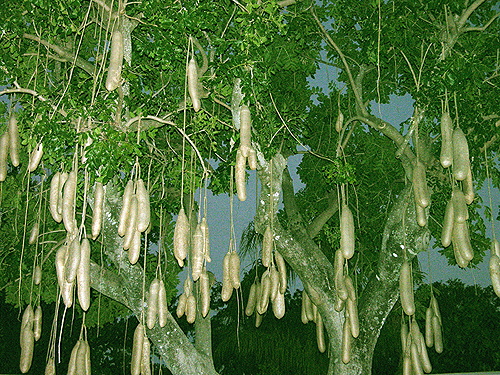
You may have heard about breadfruit trees. This is the sausage tree, to complete the hot dog.

When thinking about the trees of the African savanna, baobabs, acacias and eventually mopane trees come into your mind. But one of the most original trees of the African savanna
is the Sausage Tree (Kigelia africana), a tree found throughout tropical Africa from Senegal to Eritrea and Chad, and southwards to northern South Africa and Namibia.

The tree is not very tall, reaching a maximum height of 20m (66ft). By far, a Kigelia tree looks like an enormous green shop window, with the diameter of 20-30m (66-100ft), where sausages that are 30-100cm (1-3.3ft) long and 18cm (0.5ft) wide, weighing 3-10kg (7-22 pounds) hang on ropes. These "sausages" are just the fruit of the tree. They grow starting with dark waxy trumpet-shaped flowers that are pollinated by bats and some birds.

The fallen corollas of these flowers make a delicacy for the African buffaloes (Syncerus caffer). Instead, the shade of the dense canopy of the sausage tree, that protects of drought the nearby vegetation, attracts lions, antelopes and monkeys.

The most devoted consumers of Kigelia leaves and ripe "sausages" are the giraffes and Greater Kudu (a large antelope). The fallen fruit are sought by hippopotamuses, elephants, bush pigs, porcupines and some antelopes. Baboons too enjoy these fruit. All these mammals disperse the seeds of the Sausage Tree in their dung. The seeds are consumed by African Brown Parrots and Brown-headed Parrots, but also by cockatoos in Australia, where this tree is an exotic ornamental species.

In Africa, shamans use the tree sausage against rheumatism, snakebites, evil spirits, syphilis, and even tornadoes. A light alcoholic drink is made from the fruit, but like in the case of manioc, the fresh product is poisonous, and must be dried, roasted or fermented.

Kigelia is widely planted as ornamental tree in tropical areas outside Africa. One issue, though: the falling fruit can severely harm people or damage vehicles.

MORE RELATED ARTICLES: When What You See Is Not What You Believe It Is Disastrous Mini Ice Age around 536 AD, Caused by Volcanic Megablast Mystery Solved: Why Mammoths Were Humped Namib Desert: The Tallest Dunes Paleolithic: The Old Stone Age Animals and the Magnetic Field of the Earth The Shroud of Turin: Hoax Against Reality Butterflies: Amazing Records A World's Wonder: Rock Carved Cities A History of the Sex Chromosomes
 
Comments | Link here | Subscribe
Print | Send to friend
Today's News | Yesterday's News

Search:


25th March 2008, 14:25 GMT | Copyright (c) 2008 Softpedia | Contact:
Read by 591 user(s) | Rating: | 8 vote(s) so far | Cast your vote:
Sausages Growing in the Trees - USER OPINIONS


We are sorry, there are no opinions available for this article.


SHARE YOUR OPINION ABOUT Sausages Growing in the Trees

Since you are not logged on, your comments will have to be approved before being displayed.
Click here to login, or register.
Your Name:
Your Email:
Type in the result:
Your Opinion:


DO YOU WANT TO CONTACT US?  

If you have some comments or you want to send us some information you can send us an email directly to .
You can use the form below for the same purpose.
Your full name: (at least 3 characters)
Your email address: (at least 5 characters)
Message subject: (at least 5 characters)
Message text:
(at least 10 characters)
Type in the result:


© 2001 - 2008 Softpedia. All rights reserved.
Softpedia™ and Softpedia™ logo are registered trademarks of SoftNews NET SRL.
Copyright Information | Privacy Policy | Terms of Use | Contact Softpedia | Update your software | Archive