 14 DAY TRIAL //
 It is almost unbelievable that Mars, having barely any atmosphere, is able to create sand storms so powerful that they are visible from the surface of our planet. During these storms sand is being lifted high into the Red Planet's atmosphere and dropped only to stir up other dust particles present of the surface of the planet. Aside from having a thin atmosphere, Mars also has very weak winds, which further deepens the mystery to how sand dunes migrate.
Saltation
A recent study carried out inside wind tunnels showed that the behavior of sand grains both on Earth and on Mars is largely influenced by the atmosphere. "When the particles are heavy, they cannot be lifted off from the ground by the wind, so they remain very close to the ground", says study team member Eric Parteli from the Universidade Federal do Ceara. Alternatively, light weight particles are blown off high into the atmosphere and travel long distances.
The process in between the two is called 'saltation', when particles are knocked above the surface by the Martian wind. When they finally collide with other particles on the surface they rest on the ground, while the other particles are carried across the surface. The same process is responsible for the creation of the Sahara desert and could as well be occurring on the Red Planet. "We only know that saltation occurs on Mars because we see that there are dunes", said Parteli.
The problem is that it is unknown whether these dunes are relatively recent or they are remnants of the time when the Martian atmosphere was much denser than today. Although having a much thinner atmosphere than Earth, Mars is able to generate winds exceeding 10 times the velocity of those on our planet. "So we know actually that the winds of Mars are actually very weak. They remain very much below the minimum threshold for saltation all the time", explains Parteli.
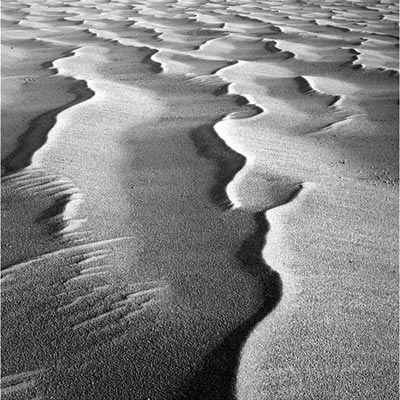
Nonetheless, there is clear evidence that saltation may still be occurring even today and ground images have proven that numerous times over the years. Because the Martian gravitational field is three times weaker than Earth's, "the particle is allowed to remain longer in the atmosphere. It is not pushed downward by the gravity so strongly as it is on Earth", he said.
Sand dunes
Saltation could occur on Mars in regions with stronger winds, such as in the case of the areas in the vicinity of the polar ice caps or in locations with a slightly higher air density, says Kevin Williams, Buffalo State College investigator. Sand dunes on the surface of the Red Planet not only show the type of wind acting in the respective area, but they also provide us with an indication to the direction the air flow is following.
Barchans for example, which are sand dunes characteristic to both Earth and Mars, are created by winds blowing in a single direction, while longitudinal sand dunes are formed by winds blowing from two directions. Wind speed and temperature are also critical in the shaping of a dune.