 14 DAY TRIAL //
 The flash storage has been one of the technologies that have undoubtedly changed the face of consumer electronics appliances. It can store a large amount of data on a tiny surface, at the cost of only a few milliwatts.
DRAM memory needs permanent refreshing to preserve its contents, but Flash storage can do without power for about ten years, and yet the data will still be there. However, Flash memory is handicapped by large access times. The ideal candidate for tomorrow's storage technology will act as fast as DRAM, while preserving the data for a long period of time, just like Flash memory.
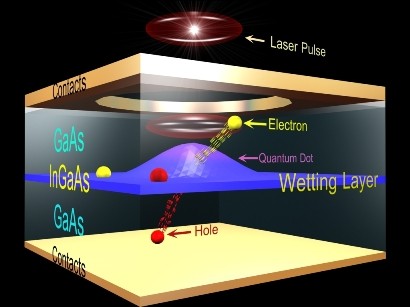
German scientists have announced that they are working on a new storage technology, made of quantum dots. These dots are nothing more than an assembly of atoms, confined in a space so that the motion of electrons would be impossible. This assembly would act like a single atom, while its electronic properties could be modified at will, either by changing the size of the assembly, or by changing the atoms themselves.
The rough materials used for building quantum dots are silicon and germanium, as well as "element cocktails", such as gallium, indium, arsenide, aluminum, and antimony. These materials are alleged to have access time of around 10ns, with a refresh rate of about 0.7 Hz. This is just the beginning, as researchers estimate that some other combinations of materials will result in a storage time of about one million years.
The quantum dots - based memory is more flexible than Flash, since the latter uses the huge potential barrier created by a silicon oxide layer, that prevents electrons from tunneling it, in order to preserve the data. But, to delete and write a flash cell, electrons require an increased amount of energy, which would destroy the silicon layer over time.
If using quantum dots, the barrier can be kept at a lower level, since the atoms have tunable electrical properties. The German researchers have estimated that the barrier may be four times lower than the classical silicon dioxide. The new material is estimated to store data for about one million years, at an access time of only 10ns. If the quantum dots memory can be mass-produced, it will surely replace flash memory, RAM as well as hard drives.