 14 DAY TRIAL //
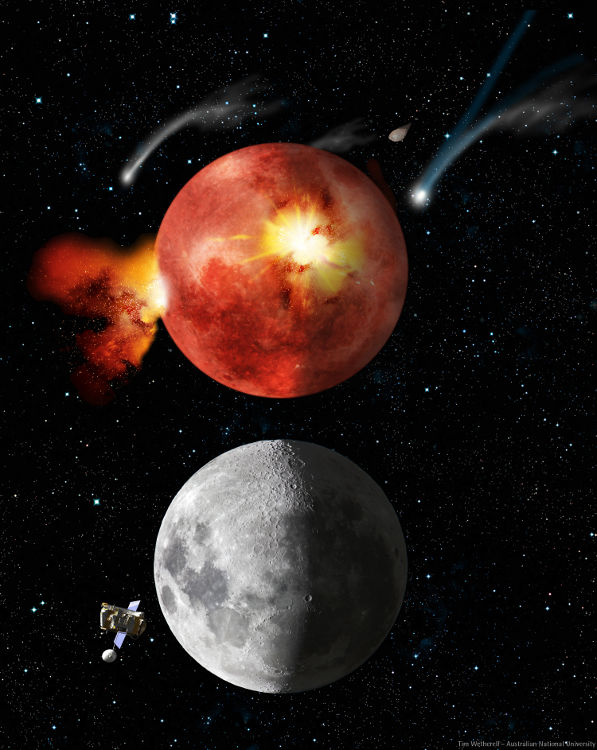
 Most of the precious metals that exist on Earth today may have been brought here by comets and asteroids billions of years ago. At that time, the entire inner solar system passed through a violent phase called the Late Heavy Bombardment.
During those times, vast numbers of comets, asteroids, meteorites and other space bodies battered the four rocky inner planets, causing massive amounts of damage. Most of the largest craters on Earth, Mercury, Mars, Venus and the Moon were produced during those times.
But the LHB also had some positive effects, researchers are beginning to uncover. Some say that vast amounts of water were brought here via cometary ices, and that it was through this event that our planet's atmosphere and oceans formed.
In a new study, experts propose that even the precious metals here were delivered billions of years ago, as Earth was just differentiating its layers based on weight. The phenomenon saw iron sink to the planetary core, while lighter elements made their way to the crust and solidified.
However, basic chemistry tells us that precious metals such as gold and tungsten have a high affinity for iron, which means that they should have sunk to the core billions of years ago. If that is the case, then how is it that we can still find important deposits in the crust?
The mystery is immediately solved if we accept that the LHB brought them here after Earth got its layer, some 3.9 billion years ago. “This is the process by which we have most of the precious elements accessible on Earth today,” Matthias Willbold explains.
The researcher holds an appointment as a geologist at the University of Bristol. Details of the study he and his team conducted appear in the September 8 issue of the top scientific journal Nature, Space reports.
Another interesting consequence of the Bombardment may have been that the hot rocks in the upper layers of the mantle began to flow. This is an essential aspect of plate tectonics, and a phenomenon that contributes significantly to the way our planet functions.
“We want to measure more ancient samples to see how the mantle might have changed over time,” Willbold explains, adding that his team will soon begin to conduct isotopic analysis on the different types of precious metals they come across.
These studies should give them a better understanding of the metals' origins. Understanding the LHB and its effects could reveal more data about how our planet formed, but also on how different the solar system was nearly 4 billion years ago.