 14 DAY TRIAL //
 Traveling 100 years ago in the Vanuatu islands would have meant you were going to lose your head. And you body inside the stomachs of the locals, as they were still practicing cannibalism in certain areas.
Now, over 50 headless skeletons have been discovered in one of the oldest cemeteries of the Pacific islands, belonging to a complex society of seafarers, the Lapita people. They are believed by some to be the ancestors of the Polynesians, and the new research sheds light on the issue of whether these people were isolated islanders or kept contact with remote Lapita tribes, either for finding marriage partners, or just to maintain social connections. The results have been published in the October issue of the journal American Antiquity.
"The real question is did they live in isolation or did they keep in communication with the islands that might have been further back in their ancestry, because they generally spread from west to east across the Pacific," said lead author Alex Bentley, an anthropologist at Durham University in the UK.
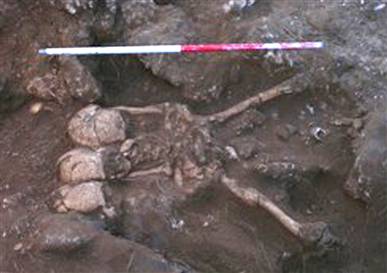
The 3,000-year-old individuals were dug in 2003 on Efate Island (Vanuatu). Of the headless skeletons, only one man had three skulls located on his chest. In the last half century, over 200 Lapita sites have been discovered, but none contained more than 20 individuals. "This site is that much more extraordinary due to the fact that it is the earliest and by far the largest cemetery ever found in the Pacific. The excellent preservation and large number of burials, now up to 60 individuals, is giving us a first real chance to study this early colonizing population," said co-author Stuart Bedford of the Australian National University.
Oxygen isotope analyses from the teeth of 17 of the headless skeletons revealed their diet. "The researchers found four Lapita individuals who were buried facing south, unlike the others, and whose isotope levels were significantly different from the others, possibly indicating a small group of immigrants who traveled from hundreds of miles away," said Bentley.
Their isotope ratio corresponded to a more terrestrial alimentation, unlike the sea-based diet of the other islanders' skeletons. "There's no way they could be from East Asia. Most likely they were from maybe as far away as New Guinea," Bentley told LiveScience. "The Lapita expansion had already reached New Guinea by the time Vanuatu was settled."
The man with three skulls on his chest, dubbed TEO 10E, was from amongst the "immigrants", but the skulls on his chest belonged to local individuals. The Lapita first buried the dead head-attached, and later, after only the bones remained from the corpse, they removed the skulls, preserved in shrines. "It is a sign of veneration of the senior individual. The skulls of all those buried were removed during the mortuary process and presumably curated somewhere. Upon the death and burial of TEO 10E, these three skulls were retrieved and placed on his chest." said Bedford.
Locals buried alongside the newcomers means that particular individual was greatly respected amongst the Lapita population. "The curious burials among the identified group of prehistoric Pacific mariners, who were among the best navigators on earth for the next 3,000 years, indicate they were admired by the locals for their amazing long-distance traveling abilities. Maybe these guys were maintaining specific contacts with specific other communities as opposed to just coming in willy-nilly from here and there.", Bentley added.