 14 DAY TRIAL //
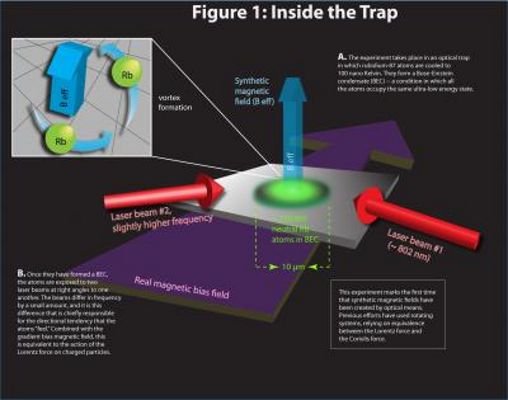
 Synthetic magnetism is a very rare and exotic condition, in which neutral atoms start exhibiting magnetic behavior all of a sudden. They basically act like they are charged particles interacting with a magnetic field – but the really tricky part is that they do so without actually having an electric charge, or being subjected to a magnetic field of any sort. In their new investigation, experts at the University of Maryland managed to use laser light to instill this type of behavior in neutral atoms at will, in an achievement that could soon see physicists gaining new insights into how magnetism, one of the four fundamental forces in the Universe, works.
The innovation also breaks new ground in quantum physics. Experts reveal that the work could lead to a better understanding of condensed-matter systems, and to developing research angles that were never even thought possible. Investigators may also learn more about the laws governing the behavior of quantum objects, as well as gain an overall increased level of knowledge in fundamental physics. But perhaps the most amazing thing is the fact that future quantum experiments could be controlled thoroughly, in the sense that none of their parameters would be left to chance anymore.
“The creation of synthetic magnetic fields for ultra-cold neutral atoms enables previously impossible experiments in these most quintessential of quantum mechanical systems,” Joint Quantum Institute fellow Ian Spielman says. The expert, who has been the leader of the study group, is also a physicist at the US National Institute of Standards and Technology (NIST). A report detailing the team's achievements appears in the December 3 issue of the respected scientific journal Nature.
“By adding an optical lattice potential to our synthetic magnetic field,” he says, “we have the opportunity to create both long anticipated systems such as the Hofstadter butterfly – an iconic pattern of energy levels for non-interacting particles – and potentially to realize totally new states of matter such as quantum Hall states of bosons.” A large number of organizations contributed to financing this work, including the Office of Naval Research, the Army Research Office, and the US National Science Foundation – through the NSF Physics Frontier Center at the Joint Quantum Institute.