 14 DAY TRIAL //
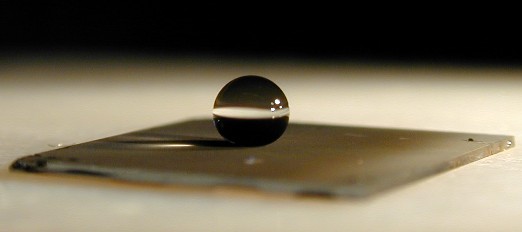
 Quite seldom, it's science's turn to beat nature, and nanotechnology appears to be of big help in this task. The latest discovery refers to a material that is able to repel any liquid that comes in contact with it, preventing adherence and constraining the drops into a spherical form after causing them to bounce back. This might not seem as an easy task once you think there are liquids that will not normally adopt such shape for their droplets.
A team of US researchers from the Massachusetts Institute of Technology (MIT), led by Robert Cohen, have managed to conceive a perfectly xenophobic surface, which literally rejects any liquid, and even got its name – omniphobic, meaning that it is afraid of everything. Now a short lesson in science is required so that you can better understand what actually happens.
Liquids naturally possess a characteristic related to the tension of their surface – for some, it is stronger, while for others, it is extremely weak. This tension pushes the molecules together and, since it comes from all directions, it forces the drop of a liquid to form a spherical shape. This can be better observed in zero gravity conditions. But, as said, some liquids, such as an oil called pentane, have such a low surface tension (15 milliNewtons per meter or mN/m) that they tend to spread into a flat pool instead of gathering into a spherical drop.
So, what the MIT scientists did was to use tiny silicon mushroom-like formations (which are even referred to as “toadstools”) arranged in tight patterns that would enhance the tension on liquids' surface, preventing the drops from collapsing. The silicon stems of the toadstools are 300-nanometer tall, and the broad caps are made of silicon dioxide. "If you stand on top of one of these [toadstools] and start walking towards the edge, you'll pass through all angles and eventually you'll be standing upside down," Cohen explained for New Scientist.
In order to enhance the effect, the researchers coated the toadstools with fluorodecyl POSS, a chemical generally used for making surfaces more hydrophobic (water-repellent). But the drawback to their material is that it's highly fragile; thus, it is not yet prone to be used in large-scale applications. But if it could be made sturdier, a glass improved with such a material would be almost impossible to be dirtied.