 14 DAY TRIAL //
 A study led by Terry Magnuson, researcher at the UNC Lineberger Comprehensive Cancer Center and Mauro Calabrese, a scientist at the University of North Carolina shows a new perspective over the X-inactivation process.
The phenomenon consists of X chromosome regulation by the cells and has an indisputable importance in the mammalian evolution.
“This is a classic example of a basic research discovery. X-inactivation is a flagship model for understanding how non-coding RNAs orchestrate large-scale control of gene expression,” said Prof. Calabrese, as cited by EurekAlert.
“In the simplest terms, we are trying to understand how cells regulate expression of their genes.”
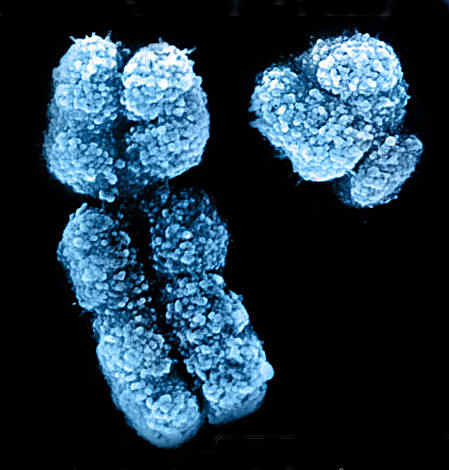
It is known that the female body comprises two X chromosomes, while the male one has one X and one Y. The X-inactivation is a process of reduction of one of the two Xs, whose occurrence is still undisclosed despite the experts' long-time efforts.
Calabrese's research team has used a technique based on high-transit sectioning in order to observe the chromosomes' action and placement in the human body.
“Basically, this is using the sequencing technology as a high resolution microscope,” explained Prof. Calabrese.
Researchers have discovered surprising data. Seen through a microscope, the X chromosome normally has a cloudy appearance, given the fact that is veiled in a non-coding RNA, called Xist.
What surprised scientists was to discover signs of operating genes inside the Xist cloud, while it was previously known that the genes located inside it are totally inactive.
Scientists revealed marks of DNase I responsiveness inside the Xist, which is normally a sign of transcription activity. This shows that the cell's nucleus receives information of usable DNA from the inactive X, although there is something which doesn't allow its activation.
“We were surprised to see that. If they were totally silent, you would expect this to be not there,” said Prof. Calabrese. “This suggests that transcription factors or other proteins that bind DNA are still accessing the inactive X.”
Scientists believe that a full comprehension of the X-inactivation process would lead to a larger perspective over the non-coding RNA inside the cell, with a significant importance for the understanding and treatment of certain diseases.