
Softpedia
 

NEWS CATEGORIES:


NEWS ARCHIVE >>
SOFTPEDIA REVIEWS >>
MEET THE EDITORS >>
Home > News > Editor Blogs > Science

February 10th, 2012, 16:39 GMT · By

BLOG

North Pole Is Next Waypoint for All Continents

SHARE:

Adjust text size:

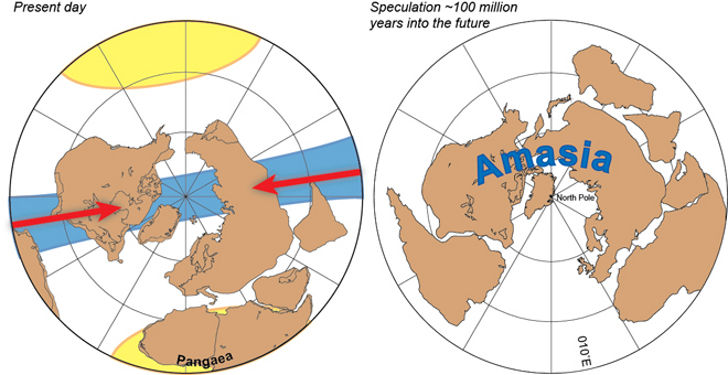
The image to the right shows the arrangement of continents around 100 million years from now, as proposed by the Yale team Enlarge picture - The image to the right shows the arrangement of continents around 100 million years from now, as proposed by the Yale team
In a paper published in the Februray 8 issue of the top scientific journal Nature, investigators at the Yale University showcase a scenario detailing how Earth's continents will rearrange themselves. We are currently right in the middle of a supercontinental cycle.

Such a cycle usually lasts for hundreds of millions of years, and this one is scheduled to conclude within 50 million years or so. At that time, both American continents, Eurasia and Africa will slam into each other over the North Pole, with Greenland right in the center of the new supercontinent.

The newly-born continent, made primarily out of sectors currently in North America and Asia, will be called Amasia. Interestingly, the Atlantic Ocean will disappear entirely. This is odd because it is the location where new crust is currently being formed, pushing the Americas and Eurasia further apart.

What is even more interesting is that Amasia will eventually center itself right where Africa is now, reclaiming the same position that the Pangaea supercontinent had at the end of the Permian Epoch, around 250 million years ago. The continent's dispersal coincided with the P-Tr. extinction event, Wired reports.

TELL US WHAT YOU THINK:

722 hits · 1 comment · Link to this article · Print article · Send to friend · Subscribe to news

MUST-READ RELATED ARTICLES:


Plate Tectonics May Trigger Pole Swaps

Earth's Crust Is Recycled in the Lower Mantle

Subduction Is More than 2 Billion Years Old

Precious Metals Were Brought Here by Comets and Asteroids

Analyzing the Most Stable Core of the American Continent

READER COMMENTS:


Comment #1 by: Barry on 11 Feb 2012, 22:06 UTC reply to this comment

One million years? Scientifically interesting but a sad prediction for climate change extremists. Somehow I think the Himalyan glaciers will still be with us in 30 years. Regardless it won't effect me much with the 10-15 years I have left.

Copyright © 2001-2012 Softpedia. Contact/Tip us at

WindowsGamesDriversMacLinuxScriptsMobileHandheldNews

SUBMIT PROGRAM   |   ADVERTISE   |   GET HELP   |   SEND US FEEDBACK   |   RSS FEEDS   |   UPDATE YOUR SOFTWARE   |   ROMANIAN FORUM