 14 DAY TRIAL //
 The traditional fiber optic is virtually reduced to transmitting light through a narrow cylindrical glass core. However, this particular design imposes certain restrictions to sending light signals over great distances, such as the fact that the glass fiber optic is highly sensitive to powerful light signals, which can damage it, cannot work in a broad band of the electromagnetic spectrum - therefore it cannot transmit signals such as those in the x-ray and ultra-violet wavelengths, and short light pulses get blurred through the fiber optic as it is made of glass.
Furthermore, fiber glass requires light rectifiers to amplify the signals at certain distance intervals, which makes the maintenance and exploitation of the link extremely hard. On the other hand, scientists have been experimenting new fiber optic designs and lately have succeeded in developing a new fiber optic that promises to fix all the problems related to the usage of glass fiber for light signal transmissions.
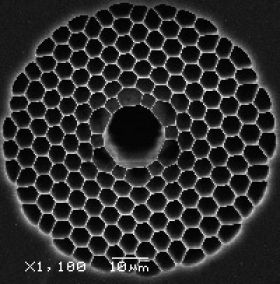
The process of fiber optic manufacturing could be greatly simplified and sped up by creating hollow optical fibers, respectively a week's time spent to fabricate glass fiber optic could be reduced to no longer than a day, which would also reduce the costs of the manufacturing process. The initial tests on the hollow core fiber reveal that it can support faster and more powerful optical telecommunication networks and can also transmit x-ray and ultraviolet light, which is usually required in biomedical surgical procedures.
The new design proposed by professor Jonathan Knight, from the Center for Photonics & Photonic Material in the Department of Physics at the University of Bath, is practically superior in every aspect to the glass fiber optic. It basically involves creating tiny holes in the traditional glass fiber optic core, through which light can travel. The hollow glass fiber optic core is filled with air, thus removing the limitations related to the range of the light wavelengths used and transmitting short light pulses.