 14 DAY TRIAL //
 Hydrogen fuel-cell technology sounds almost too good to be true. You combine cheap and plentiful hydrogen and oxygen gas, the fuel cell generates electricity and the by-product is simply water. But there's something more involved.
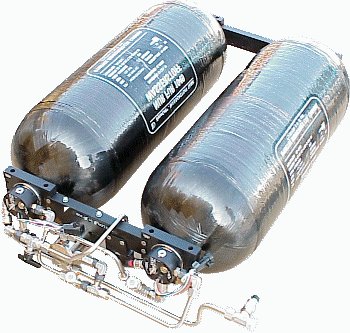
So far, the biggest downside of hydrogen-powered cars is the fact that it is very difficult to store it safely and it's not stable either, so these cars require bulky pressurized tanks that could explode much in the same way a methane gas tank does.
Now, a unique discovery made by researchers at the University of Tennessee Knoxville, called "electronic growth" could greatly influence the efficiency of hydrogen fuel cells by increasing the hydrogen storage capabilities.
This process consists in adding tiny amounts of bismuth (Bi), a heavy brittle white crystalline trivalent poor metal, to a very thin film made of lead atoms; a new "quantum alloy" is produced, with physical properties and stability easy to fine-tune.
The name "electronic growth" comes from the ability of the new method to control the properties and formation of the alloy, based on the number of free electrons it contains. Adding bismuth adds electrons, thus achieving superconductivity, a physical trait difficult to control without suppressing or destroying the material.
Hanno Weitering, a professor of physics and joint faculty member between UT and Oak Ridge National Laboratory, together with co-authors Zhenyu Zhang, a UT-ORNL research professor and Jim Thompson, UT professor of physics, discovered this new method and are convinced it could be used in storage applications, due to the fact that it allows hydrogen atoms to travel in and out of an incredibly thin sheet of this new material.
Their method is so promising that the U.S. Department of Energy offered a $1.2-million grant to the researchers, so that they will study exactly how this quantum alloy could influence the efficiency of hydrogen fuel cells.