 14 DAY TRIAL //
 They can grow a piece of bone or a piece of skin, but with the latest technologies, it seems they can also grow new hearts, or at least pieces, for heart attack survivors, children born with heart malformations, or those with clogged or weak blood vessels.
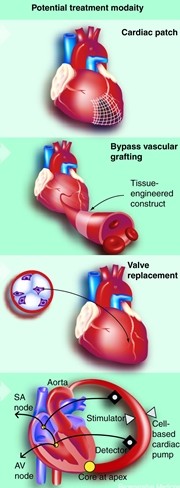
A team at the University of Michigan Medical School describes in the journal Regenerative Medicine that scientists are closer than ever to "bioengineering" heart pieces, heart valves and major blood vessels.
"But hurdles still remain before the products of this tissue engineering are ready to be implanted in patients as replacements for diseased or malformed structures," the team noted, like finding which types of cells possess the most potential, and detecting the best way to develop those cells to make viable cardiac tissue that is strong, long-lasting and structured like living tissue.
"Tissue engineering is a rapidly evolving field, and cardiovascular tissue is one of the most exciting areas but also one of the most challenging," said Dr. Ravi Birla, lead author and director of the U-M Artificial Heart Laboratory.
"Although there remain tremendous technological challenges, we are now at a point where we can engineer first-generation prototypes of all cardiovascular structures: heart muscle, tri-leaflet valves, blood vessels, cell-based cardiac pumps and tissue engineered ventricles," said Birla.
In December 2006, Birla and Dr. Yen-Chih Huang, described their success in growing pulsing, three-dimensional patches of bioengineered heart muscle (BEHM) employing a new technique based on fibrin hydrogel, which is faster than others.
The gel sustained rat cardiac cells for a while, before the fibrin disintegrated as the cells reproduced and developed after a few days into tissue.
BEHM could generate pulsating forces and react to stimulation in a manner more similar to real muscle.
More researches have shown how polymeric scaffolds can be employed to achieve heart muscle of any shape or size to fit the area of the damaged heart muscle, like in heart attack.
U-M is applying for patent protection on the Artificial Heart Laboratory's developments and is searching for a corporate partner to help deliver the technology to market.
The U-M team's bioreactor allows up to 11 specimens of tissue to be grown in the same conditions at the same time, and each specimen is "stretched" employing a special device that can both induce forces and measure the forces developed when the tissue begins contracting and beating on its own.
The team reports that it got a doubling of the contracting force in just a week, by stretching the BEHM at 1 Hertz.
The development of heart muscle, heart valve and blood vessel tissue in the lab needs careful control of factors like temperature, oxygen and carbon dioxide levels, nutrients and pH level, implied in triggering the syntheses of molecules signaling and connecting with other cells, and to build the extra cellular matrix of the tissue.
The Artificial Heart Laboratory is going to develop a new perfusion system that can transport controlled nutrient exchange to the tissue engineered heart muscle which does not rely on a traditional cell culture incubator, enabling the scientists to control the culture environment of the cells during heart muscle development.
The researchers are still not determined which cell type is the best for growing new hearts.
Heart muscle tissue is constituted of several types of cells, but the heart cells are hard to drive into other cells and by now, "adult" stem cells could not be turned into heart cells and embryonic stem cells still pose legal obstacles; other types of cells like from muscle cells taken from skeletal muscles came with mixed results.